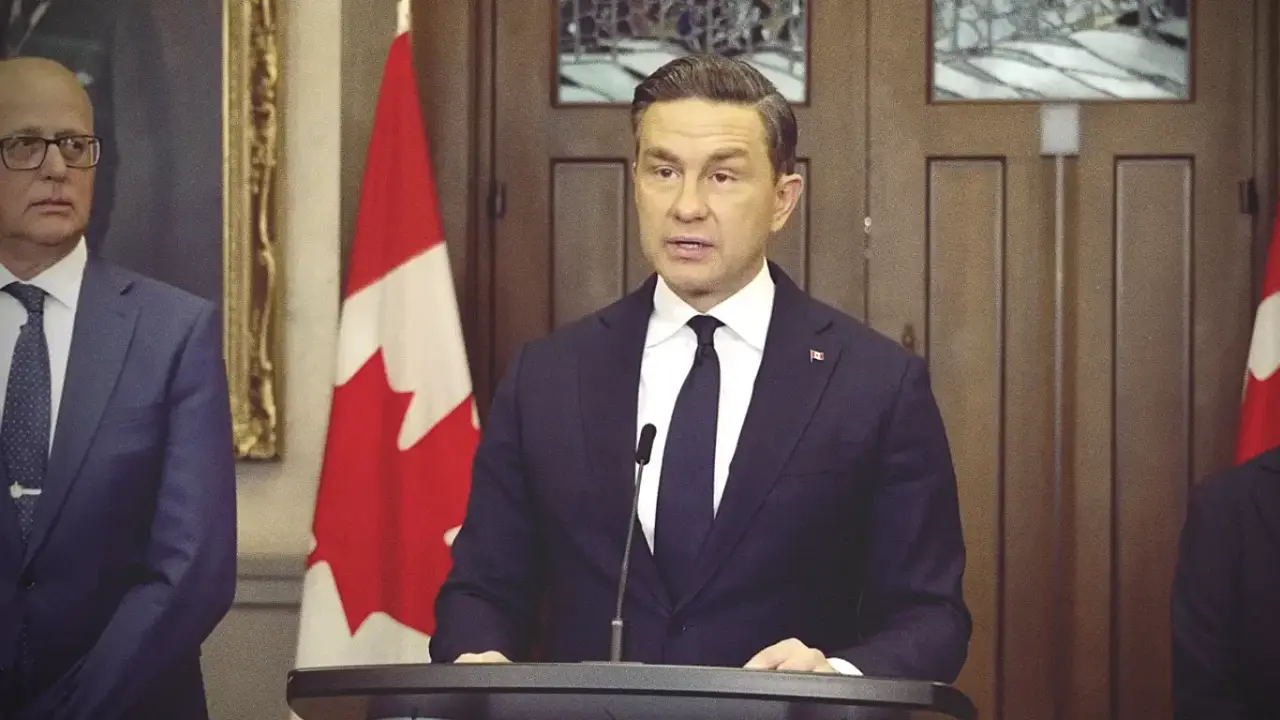
The view from the House of Commons Foyer on April 23, 2026, was a stark departure from the polished, globalist theater we have come to expect from the Prime Minister's Office. While Mark Carney spends his weeks assembling an "Advisory Committee" of the usual corporate suspects—billionaire CEOs and retired political fixtures who have never seen the inside of a mold-making shop—the Leader of the Opposition finally handed Canadians a weapon instead of a press release.
For the workers in Windsor, the stakes are not a "joint review" or a "diplomatic protocol." They are measured in a billion dollars of vanished opportunity—a toll Pierre Poilievre explicitly pinned on Windsor's mold-making sector during his April 23, 2026, press conference. The provincial government's recent announcement of a $7.3 million "Ontario Together Trade Fund" is a generous description for a drop in a billion-dollar bucket; it is a rounding error in the face of a regional catastrophe. The Americans, wielding Section 232 of the U.S. Trade Expansion Act of 1962, are not asking for a dialogue; they are enforcing a baseline. They have slammed a 50% "Core Metal" tariff on our steel and aluminum, and while the Prime Minister plays the role of the refined supplicant, the "Brookfield Prime Minister" seems more concerned with his offshore tax structures than the domestic manufacturing floor.
The Hammer has seen this play before. It is the illusion of activity masking the reality of surrender.
The statutory leverage in the ground
The core of Poilievre's proposal is a "Strategic Reserve" of critical minerals and oil. It is a concept that offends the sensibilities of the Ottawa dinner circuit because it involves the use of raw, sovereign leverage. Canada possesses 10 of the 12 minerals NATO classifies as essential for the defense of the West. This isn't just a list of rocks; it's a list of survival. We produce the tungsten required for armor-piercing shells and gallium for advanced radar systems.
Specifically, Canada produces germanium—a critical input in infrared optics and military thermal imaging systems. As Heather Exner-Pirot, director of energy, natural resources, and environment at the Macdonald-Laurier Institute, testified to the House of Commons Standing Committee on Natural Resources (RNNR) in October 2025, these are the niche materials where North American vulnerabilities are most acute. The United States currently lacks the domestic processing and refining capacity to replace these inputs at scale. Without them, the American defense machine—from night-vision goggles to drone guidance systems—grinds to a halt.
Poilievre's plan involves weaponizing Section 25.2 of the Investment Canada Act. By expanding the definition of "national security injury" to include trade aggression, the executive can legally restrict the export of these 10 minerals to any nation that does not maintain tariff-free trade with us. It's transactional reality. The Americans need our minerals to arm their military; their voters need our aluminum to build the Ford F-Series—America's best-selling vehicle nameplate for over four decades. A tariff on Canadian aluminum is not a tax on us; it is a tax on the American pick-up truck.
The January 2026 USTR failure
The Carney administration's failure is not just one of tone, but of technical neglect. The Office of the United States Trade Representative (USTR) submitted its mandatory report to Congress in early January 2026, 180 days before the mandated CUSMA review. That report was a laundry list of Canadian failures that Carney has chosen to ignore. The U.S. has explicitly identified Canada's digital regulations—specifically the platform obligations and data residency requirements—as "market access barriers" that justify retaliatory action.
While Carney was busy releasing YouTube videos attempting to wrap himself in the mantle of historical figures, the Americans were documenting our failure to meet dairy Tariff Rate Quota (TRQ) obligations and our inability to secure the supply chain from "Chinese transshipment." The USTR's 2026 National Trade Estimate, released on March 31, 2026, confirmed that Washington views our digital services tax and streaming laws as bargaining chips to be traded for our manufacturing jobs. Carney is walking into a July 1 review with a stack of press releases; the Americans are walking in with scalpels.
The Ethics Committee hammer and the Section 2 loophole
It is difficult to take the Prime Minister's "Team Canada" approach seriously when his own personal interests remain a fog of legalisms and blind trusts. During a March 17, 2025, news conference, Carney famously claimed to own "nothing but cash and real estate," painting a self-portrait of financial simplicity. However, that image was shattered on April 23, 2026, when the House of Commons Standing Committee on Access to Information, Privacy and Ethics tabled a devastating 79-page report.
The committee recommended that Prime Ministers be required to sell all controlled assets within 60 days of assuming office, stating plainly that blind trusts are "not good enough" to prevent conflicts of interest in the modern age. According to verified reports, Carney held approximately US$6.8 million in unexercised Brookfield stock options as of late 2024. While the PMO maintains his compliance, the current Conflict of Interest Act (COIA) contains a loophole large enough to drive a private equity fortune through.
The "general application" and "broad class" loopholes in Section 2(1) of the COIA are the specific mechanics Carney is using to skirt accountability. Under these provisions, an office holder is not considered to be in a conflict of interest if the decision they make affects an entire sector or a broad class of people. By this logic, Carney can craft sweeping national policies on green energy or critical minerals that directly benefit the massive portfolio of his former firm, and he is technically in compliance because he isn't helping only Brookfield.
Most explosively, the April 23, 2026, report recommended updating the Act to prohibit public office holders from investing in companies that utilize tax havens—a direct shot at the Bermuda and Cayman Islands structures synonymous with the "Brookfield model" of global asset management. The Liberal members of the committee, led by Leslie Church (the former Chief of Staff to Finance Minister Chrystia Freeland), issued a dissenting report claiming this crossed the line into "punitive transparency." By tethering herself to the Freeland legacy of fiscal opacity, Church has effectively prioritized the protection of the Prime Minister's offshore options over the "fiscal social contract."
The Isaac Brock illusion vs. industrial reality
On April 19, 2026, Mark Carney released a video address invoking Sir Isaac Brock, the 19th-century general who stopped the American takeover in 1812. It was a staggering bit of performance art for a man who has presided over the hollowing out of our manufacturing core. Carney stood in the Prime Minister's Office, holding a figurine of Brock, attempting to project the image of a defiant defender. Yet, in the same week, he described trade with the U.S. as a "weakness" that must be corrected. One wonders if the real Sir Isaac Brock ever struggled so mightily with a basic economic contradiction.
The "rupture" Carney warned about isn't some future threat; it is the current reality for the steelworkers in Hamilton and the mold-makers in Windsor. While the Prime Minister attempts to invoke historical resilience, the Americans are moving with the speed of an industrial engine. Their 50% "Core Metal" tariff is hitting our mold-making sector where it hurts most: capital equipment. Windsor companies are reporting an inability to pass these costs on to U.S. customers, leading to a total stall in regional investment.
Under Carney's watch, the U.S. Department of Commerce nearly tripled anti-dumping duties on Canadian lumber to 20.56% in August 2025—contributing to a suffocating 35% total combined burden on the sector. In response, the Carney administration has offered nothing but "quiet diplomacy" and "Team Canada" councils that produce no results. If we do not break the tariff blockade, we are looking at the permanent hollowing out of Ontario's manufacturing belt.
The July 1 deadline: A 16-year term at stake
The clock is not a suggestion. Article 34.7 of the CUSMA requires a decision by July 1, 2026. If we do not confirm our intent to extend the agreement for a 16-year term, we enter a cycle of annual reviews that will bleed this country dry through sheer uncertainty. This is the "rupture" of capital. No investor will put money into a Windsor plant or a Sudbury mine if they don't know if the border will be open in twelve months.
Poilievre's plan is not "radical." It is the restoration of the basic duty of the state: to protect the breadwinners of the nation. It is the realization that we are not a client state; we are a self-reliant nation with the minerals the world needs to survive. The Americans have made it clear: they want manufacturing back on their side of the border. If we don't make it in their interest to keep the border open, they will simply continue to eat our lunch while we wait for the next "Team Canada" meeting.
A leader's first duty is to the people who work for a living, not the people who live on the interests of others. If we don't use our leverage now, we will be entering the 2026 review with a white flag instead of a strategy. It is time to stop apologizing for our strengths and start using them.
The Hammer will be watching.