The western premiers are gathering in Kananaskis, Alberta, and the ghost at the banquet is no longer just western alienation. It is the spectre of a formal constitutional rupture.
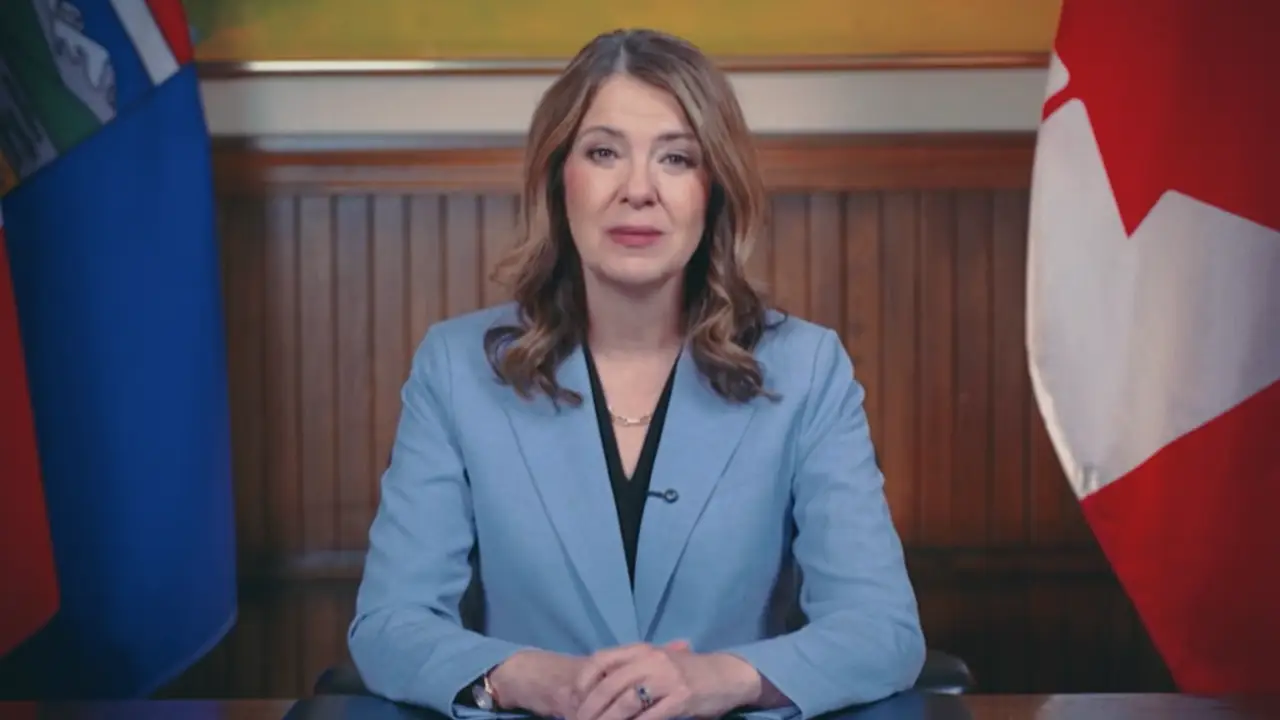
On Thursday, May 21, in a televised address, Alberta Premier Danielle Smith made the province's trajectory undeniable. She announced that on October 19, Albertans will go to the polls. The ballot will not ask for an immediate declaration of independence. Instead, it will ask if the government should commence the legal process required under the Constitution to hold a future, binding referendum on separation.
It is a referendum to trigger a referendum. And while the Prime Minister may find comfort in that procedural buffer, he fundamentally misunderstands the political reality it represents.
Prime Minister Mark Carney, speaking to reporters in Ottawa today, May 25, dismissed the maneuver entirely. Invoking his tenure as Governor of the Bank of England during the Brexit vote, Carney warned that framing a referendum as a "free option" to gain leverage in future negotiations is a "very dangerous bluff."
But the Prime Minister misdiagnoses the board. Alberta is not bluffing for leverage. The bluff is coming from Ottawa, and the cards are entirely visible to anyone paying attention to the statutory architecture of the last three years.
The Sovereignty Shield
To understand how we arrived at a referendum, one must understand the legislative armour Alberta has already forged. This is not a sudden flare-up of prairie populism. It is a systematic, statutory rejection of federal overreach, built piece by piece over years of jurisdictional warfare.
Look no further than the Alberta Sovereignty Within a United Canada Act. Passed in late 2022, the legislation was designed specifically as a bulwark against federal intrusion. While Sections 3 and 4 provide the active mechanisms for the province to push back, the true defensive brilliance lies in the interpretive limitation of Section 2(b).
The Centre for Constitutional Studies has documented the profound implications of this mechanism. In an analysis published by the Centre on September 14, 2023, constitutional scholar Emmett Macfarlane noted that Section 2(b) of the Act "explicitly carves out a loophole for 'provincial entities'"—such as municipalities or local police forces—to engage in "active non-compliance or even violation of federal law."
Furthermore, scholars Martin Olszynski and Nigel Bankes at the University of Calgary argued in a December 6, 2022, publication on ABlawg that the Act essentially usurps the judiciary's role, potentially violating Section 96 of the Constitution Act, 1867 by establishing an unconstitutional framework for passing judgment on federal initiatives.
These are not theoretical white papers. This is the operative law of Alberta. The province built a statutory shield to protect its economy from a federal government that has repeatedly attempted to override the constitutional division of powers. The legislation shifts the burden: instead of Alberta spending years in court pleading for its rights, Ottawa is forced to legally challenge Alberta's refusal to enforce federal mandates.
Ottawa’s Procedural Weapon
And what is Ottawa’s response to this assertion of provincial right? The Prime Minister reaches for the Clarity Act (S.C. 2000, c. 26).
Passed in the wake of the near-fatal 1995 Quebec referendum, the Clarity Act demands that any question regarding secession must be a clear expression of the democratic will. Crucially, it grants the federal House of Commons the unilateral power to determine whether a referendum question is "clear" before any constitutional negotiations can legally begin.
The Carney government is already telegraphing that it will use the Clarity Act as a procedural weapon to invalidate the October 19 vote before the ballots are even counted. The federal strategy is to trap Alberta in a bureaucratic maze, demanding that the House of Commons sit in judgment of Alberta's democratic expression.
But hiding behind the Clarity Act does not fix the underlying rupture. You cannot force a province to submit to a union that demonstrates active hostility toward its primary economic engine. Applying a twenty-five-year-old mechanism designed for Quebec nationalism to Alberta's resource-driven rebellion is a dangerous miscalculation.
The Illusion of Co-operative Federalism
Every analysis must include the government's own justification stated in its strongest form. Let us give the Prime Minister his due.
Carney’s official rationale is that the federal government is actively repairing the relationship with the West. He insists that his government is practicing "co-operative federalism" and points to a major concession made earlier this month: a federal-provincial agreement to advance a bitumen pipeline to the West Coast, coupled with a localized relaxation of carbon pricing.
The federal strategy relies on the premise that piecemeal economic integration will naturally extinguish separatist sentiment. By playing the role of the benevolent federalist granting project-specific exemptions, the Prime Minister claims he is delivering practical results.
If this were truly about co-operative federalism, we would see a demonstrable retreat by Ottawa from areas of exclusive provincial jurisdiction. We would see a federal government strictly respecting the boundaries laid out in Section 92A of the Constitution Act, 1867, which grants provinces exclusive authority over the exploration, development, and management of their non-renewable natural resources.
Now for the data collision. The official explanation is logically incompatible with the federal government's actual statutory record.
A bespoke, one-off pipeline approval granted by the grace of the federal cabinet is not constitutional autonomy; it is the definition of imperial management. It is a temporary stay of execution, not a change in the law. If co-operative federalism were functioning, the federal Impact Assessment Act would not remain on the books as a jurisdictional battering ram to scrutinize and block provincial energy projects at whim. It still functions as a federal veto.
When Ottawa leverages environmental mandates to effectively cap the oil and gas sector, it is dictating the rate of primary production—a direct violation of Section 92A(1)(b). The math of "co-operative federalism" simply does not add up. You cannot claim to be building a prosperous partnership while keeping the statutory tools to dismantle your partner's wealth squarely in your back pocket.
The Kananaskis Divide
As the Western Premiers' Conference convenes in Kananaskis, the contrast in regional leadership is striking.
Manitoba Premier Wab Kinew offered a progressive counter-narrative to Alberta's defiance. Speaking to reporters in Winnipeg on Thursday, May 21, Kinew stated: "When we build our nation-building project in Churchill, I hope it's a big old hug to our friends in Alberta and that they realize there's no point in having a referendum and that Canada is the best country in the world."
A "big old hug" is a lovely sentiment. But hugs do not protect municipal police forces from being deputized to enforce federal firearms confiscations. Hugs do not compensate for billions of dollars in lost investment driven away by regulatory uncertainty and jurisdictional creep.
Carney looks at the October 19 referendum and sees a calculated ploy for leverage. He is completely blind to the reality on the ground in Alberta.
Premier Smith is not pulling a fast one on Ottawa; she is desperately trying to manage a populist revolt that Ottawa's own policies created. The referendum was forced onto the agenda by Stay Free Alberta, a separatist group that gathered over 300,000 signatures. Because Smith watered the ballot question down to a "referendum on a referendum," she is now facing vicious attacks from her own right flank. Jeff Rath, a lawyer representing the petition group, publicly called Smith's formulation a betrayal of the conservative base.
Smith explicitly stated during her televised address that she will campaign on the "Stay" side, pleading with Albertans not to give up on the country. When the Premier of Alberta is forced to schedule a separation vote just to keep her own base from tearing down the government, it is not a bluff for negotiating leverage.
It is a distress signal.
The Constitutional Reckoning
We are watching a slow-motion collision between two irreconcilable visions of Canadian federalism.
On one side is an Alberta government that has armed itself with the Sovereignty Act and an impending referendum. They have looked at the trajectory of federal policy, calculated the cost of continued submission to an aggressive central government, and decided that the status quo is more dangerous than the uncertainty of a constitutional showdown. They have read Section 92A, they understand the rights negotiated four decades ago, and they are out of patience.
On the other side is a federal administration clinging to the Clarity Act and handing out pipeline approvals like appeasement treats, hoping that warnings of economic doom will force the province back into line. The Prime Minister is gambling that Albertans will be too intimidated by the logistical nightmares of separation to actually vote yes.
The Prime Minister calls the referendum a dangerous bluff. But the real bluff is the federal government's assumption that it can perpetually override provincial jurisdiction without eventually breaking the federation.
The western premiers in Kananaskis know the truth. The October 19 vote is not the crisis. The crisis is the federal arrogance that made October 19 necessary.
The Hammer will be watching.