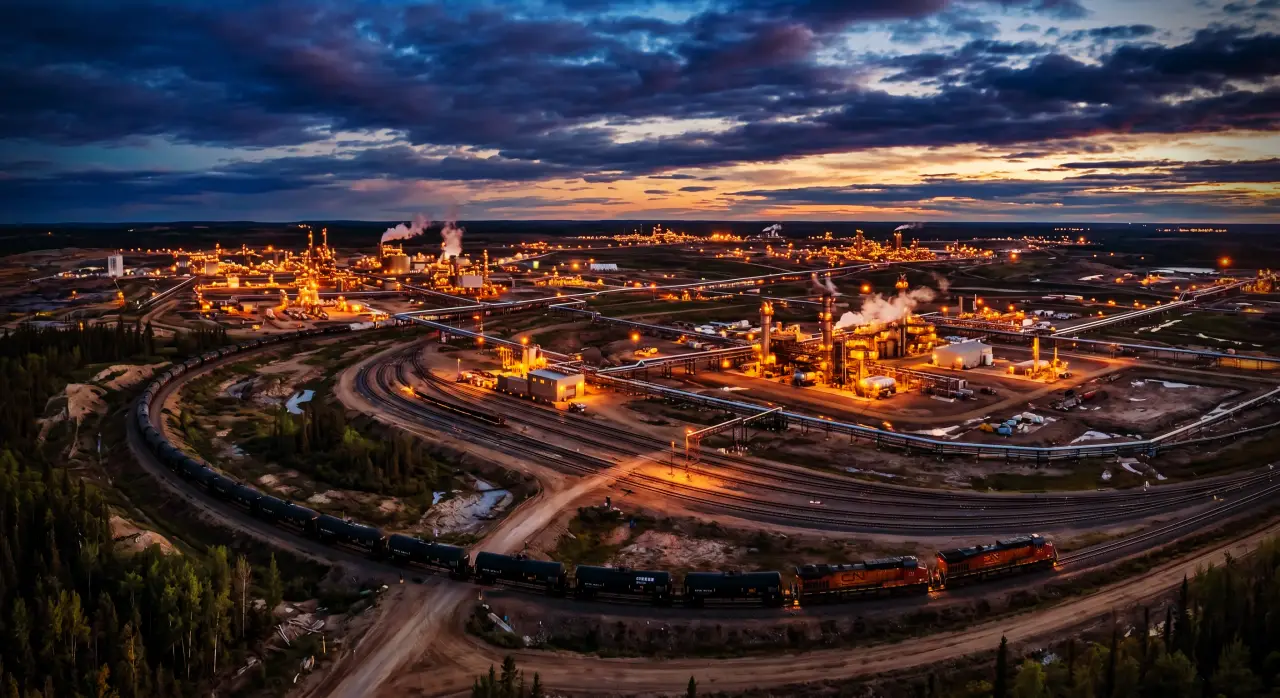
Canada holds the fourth-largest proven oil reserves on the planet. We sit on an energy endowment so vast that, in a rational economic system, we would not only be entirely self-sufficient but a dominant, stabilizing force in global energy markets. Yet, according to the Canada Energy Regulator's early 2025 Market Snapshot detailing 2023 import flows, Eastern Canadian refineries continue to import roughly 500,000 barrels of foreign crude every single day.
The most damning detail in that federal data is where the oil comes from. The CER explicitly notes that a staggering 80 percent of those imports now originate from the United States. We are entirely captive. Because we cannot move our own resources across our own country, we are forced to sell our oil to the Americans at a steep discount, only to have our eastern provinces buy foreign crude back at full market price.
This is not a failure of geography. It is not a failure of engineering or a depletion of our natural resources. It is an engineered dependency. Under the current administration, led by Prime Minister Mark Carney, the legislative scaffolding erected over the past several years remains entirely intact. Ottawa has deliberately severed the physical connection between Western Canadian producers and Eastern Canadian consumers, forcing our largest domestic refineries to bleed Canadian capital out of the country just to secure the feedstock required to keep the lights on and engines running.
To understand how a nation starves in a grocery store, you have to examine the laws that locked the aisles.
The Stated Justification and the Atlantic Reality
The government’s rationale for this regulatory framework is carefully polished for international climate conferences. Ottawa argues that sweeping federal legislation is necessary to ensure comprehensive environmental scrutiny and to align major infrastructure development with our international net-zero emissions targets. Furthermore, they justify the strict legislative blockade of the Pacific coastline as an essential, proactive measure required to provide unprecedented environmental protection to ecologically sensitive marine environments.
The government insists that by restricting domestic pipeline development and coastal shipping, they are saving the oceans from the catastrophic risk of a crude oil spill.
That is the official narrative. It is also an absolute fabrication when measured against physical reality, exposing a glaring, cynical double standard.
By using federal law to obstruct the construction of a high-capacity, west-east interprovincial pipeline, Ottawa has not eliminated Eastern Canada's demand for crude oil. The Irving Oil refinery in New Brunswick and the Valero facility in Quebec still process hundreds of thousands of barrels every day. Because our eastern refineries cannot access Alberta crude through a pipe, they must import their feedstock on massive maritime vessels.
The environmental risk of a marine spill has not been mitigated by this government. It has simply been outsourced. Under Ottawa's rules, it is treated as an unforgivable ecological crime to ship our own highly regulated crude off the Pacific coast. Yet, the federal government permits massive, daily foreign tanker shipments to travel right down the St. Lawrence Seaway and into Atlantic ports without a second thought. Banning tanker traffic where it would allow Western Canada to export, while eagerly waving tankers through where it allows Eastern Canada to import, is not an environmental strategy. It is a politically engineered double standard designed to suffocate one half of the country while leaving the other dependent on foreign supply chains.
We import crude from jurisdictions with vastly inferior environmental standards, transport it across the most dangerous waters on earth, and call it an ecological victory. One wonders whose environment we are actually protecting.
The Illusion of Regulatory Reform
The primary weapon used to suppress domestic infrastructure is the Impact Assessment Act, enacted in 2019. This legislation effectively killed the prospect of a west-east pipeline by replacing objective regulatory standards with subjective political discretion. It demanded that infrastructure proponents prove their projects aligned with abstract, shifting federal mandates regarding gender diversity and climate change before a shovel could touch the ground.
The overreach was so severe that it was successfully challenged in the courts. In October 2023, the Supreme Court of Canada delivered its ruling in Reference re Impact Assessment Act (2023 SCC 23). Chief Justice Richard Wagner, writing for the majority, struck down the designated projects scheme as unconstitutional. The Court ruled that the federal government was improperly using the broad concept of environmental impacts as a Trojan horse to regulate resource development and infrastructure projects that fall strictly under provincial jurisdiction.
Faced with a Supreme Court defeat, the federal government was forced to amend the legislation. Defending the government's response, Environment Minister Steven Guilbeault stated:
“The Supreme Court of Canada’s opinion on impact assessment means we now have clarity to better align the IAA to areas of federal jurisdiction while continuing to protect the environment.”
Translation? The government found a way to use the Budget Implementation Act, 2024, No. 1, to rewrite the jurisdictional preamble to satisfy the courts, while keeping the ultimate political veto firmly in the federal cabinet's hands. The core structural rot remains intact: Ottawa can still arbitrarily delay and kill major interprovincial projects.
Heather Exner-Pirot and Michael Gullo have thoroughly documented the devastating economic consequences of this regime for the Business Council of Canada. In their policy report Time to move from talk to action on regulatory reform, they point out that when a multibillion-dollar pipeline project can be suffocated by endless bureaucratic delays, the private sector simply stops trying. They note that under this framework, the value of Natural Resources Canada's major projects inventory plummeted from $711 billion down to $572 billion. Capital requires predictability. The Impact Assessment Act intentionally destroyed that predictability, triggering a massive, sustained capital flight from Canadian infrastructure.
The Northern Coast Blockade
While the federal government suffocates internal pipeline development, it has simultaneously moved to landlock Canadian resources from the outside. The companion piece to the Impact Assessment Act is the Oil Tanker Moratorium Act, originally passed as Bill C-48.
Section 4(1) of the Act strictly prohibits any oil tanker carrying more than 12,500 metric tons of crude or persistent oil from mooring, anchoring, or unloading at ports or marine installations along British Columbia’s north coast.
This is not a localized environmental protection measure; it is a structural blockade of the Canadian economy. By statutorily banning large-scale crude transport from the northern Pacific coast, Ottawa eliminated a critical maritime export corridor that would have allowed Western Canadian producers independent access to lucrative Asian markets.
When you forbid a producer from accessing global markets, their export optionality collapses. Because our producers cannot efficiently route excess capacity across the Pacific, they are forced into a captive market. We must sell the vast majority of our crude to the United States at a persistently discounted rate. We sell our natural wealth at a massive loss to the Americans, who eagerly refine it and capture the value-added margins for themselves.
The financial bleeding caused by Section 4 of the Oil Tanker Moratorium Act is staggering. The persistent price differential starves our domestic energy sector of the exact capital formation that would normally be used to fund major internal infrastructure projects. We cannot afford to build the west-east pipelines required to supply Eastern Canada precisely because the federal government is forcing us to sell our primary export at a steep discount to our only remaining customer.
Financing Our Own Decline
The consequences of this legislative architecture do not fall on the federal ministers drafting the bills. The costs are downloaded directly onto ordinary, working-class Canadians.
When Canada imports roughly half a million barrels of oil per day at prevailing global market rates, billions of dollars exit our domestic economy every year. That is wealth permanently stripped from our communities. It represents lost provincial royalties that could have funded hospitals in Calgary and Halifax. It represents lost corporate tax revenues that could have balanced federal budgets without inflating the currency. Most importantly, it represents tens of thousands of high-paying, union-grade construction and trades jobs that were never created because the pipelines were never built.
When we surrender our energy independence, we surrender our economic sovereignty. The workers in Fort McMurray and Estevan are told their industries must be phased out for the global good, while the refineries in Saint John and Lévis are forced to bankroll the economies of Texas, North Dakota, and overseas petrostates. It is a punitive redistribution of wealth, masked as environmental stewardship.
Instead of paying Canadian workers in Alberta and Saskatchewan to produce our energy, and paying Canadian tradesmen in Manitoba and Ontario to transport it, we send the cheques to foreign producers and international shipping conglomerates. We are actively subsidizing the economies of foreign nations while our own citizens struggle under the weight of an artificially high cost of living.
Every time a working family in New Brunswick or Quebec fills up their gas tank or pays their winter heating bill, they are paying a premium dictated by global maritime shipping rates and foreign supply chains. They are paying for Ottawa’s refusal to connect our own country.
The federal government has successfully engineered a negative trade balance in the one commodity where we should be an undisputed global superpower. They have weaponized the law against domestic prosperity, prioritizing an international climate image over the financial security of the citizens they were elected to serve. Until the Impact Assessment Act is structurally dismantled and the coastal blockades are lifted, Canadians will continue to pay full price for the privilege of leaving their own wealth in the ground.
The Hammer will be watching.