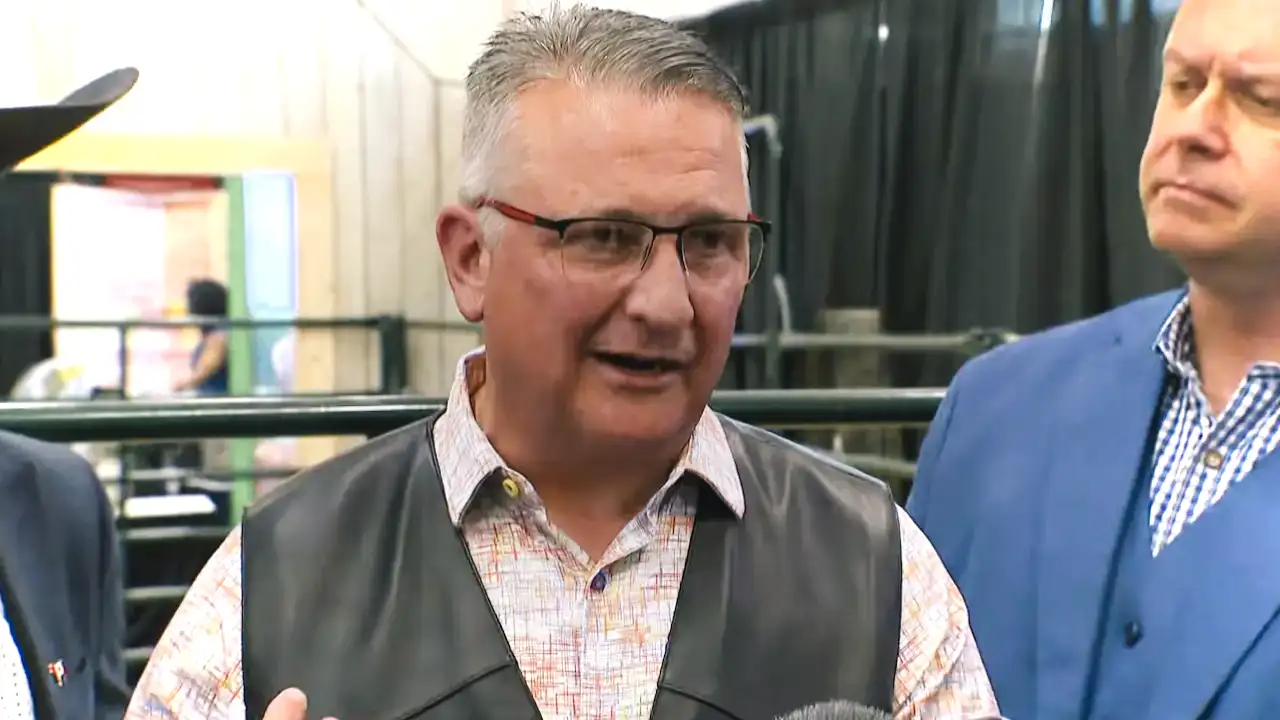
Today in Charlottetown, Agriculture Minister Heath MacDonald gathered the cameras—acting on behalf of Industry Minister Mélanie Joly—to announce that the federal government is finally doing something about the cost of food and the struggles of the Canadian agricultural sector. He did not announce a tax cut. He did not announce a reduction in the massive regulatory burden and compliance costs that are currently strangling the domestic supply chain.
Instead, MacDonald announced that the government is taking $50 million of your money and handing it to an industry-led, not-for-profit middleman called Natural Products Canada, to help establish a $94.8 million "Capacity Building Fund."
Every time you walk into a grocery store and look at the price of food, you are paying for the inefficiencies this government created. You are paying for the administrative compliance costs of the farms that grew it. You are paying for the supply chain bottlenecks they refuse to clear. And now, you are paying another $50 million so a third-party non-profit can play capital allocator with the remaining scraps of your paycheck.
The official reasoning for this capital extraction is a masterpiece of bureaucratic misdirection. This investment is being positioned as an extension of Canada's National Food Security Strategy—the government's own blueprint for the food system. In that Strategy, the government states plainly that it will "improve the way food is grown, moved, and sold to create more efficient supply chains and remove unnecessary costs." Elsewhere, the Strategy says its new initiatives are meant to address "the structural causes undermining a reliable and dependable food supply."
Stop and look at that admission. The government is publicly acknowledging that structural weaknesses and unnecessary costs are holding back the Canadian food sector. But rather than actually lowering those costs across the board—by getting out of the way and letting farmers farm—their solution is to write a $50 million cheque. They are extracting capital from the entire agricultural sector to fund a specialized cash pool for a select portfolio of companies they happen to like.
The Stated Rationale
To understand exactly what is happening here, you have to read what the ministers are actually saying on the record.
In the July 28, 2026 press release issued by Innovation, Science and Economic Development Canada, the government laid out its justification on behalf of Mélanie Joly, the Minister of Industry.
"Our investment in Natural Products Canada will help turn Canadian innovation into Canadian solutions by accelerating the commercialization of homegrown agri-food and bio-based technologies, creating well-paying jobs and further strengthening Canada's food security," Joly stated.
This is the standard language of corporate welfare. It sounds proactive and forward-thinking. But translate what she is actually saying into plain English: the government believes that private investors and banks are too slow to recognize a good agricultural investment, and that Canadian businesses are incapable of commercializing their own products unless the federal government forces taxpayers to foot the bill.
If a bio-based technology is actually going to revolutionize food security and generate a massive return on investment, private capital will fund it. Investors are desperate for high-yield returns. The only time a business absolutely needs a government grant to survive is when the underlying economics do not make sense, or when the government's own regulatory environment has made it too expensive to operate normally.
Subcontracting the Strategic Response Fund
The mechanism the government is using to move this money is just as revealing as the announcement itself. This $50 million is being pulled from the Strategic Response Fund.
The Strategic Response Fund operates under the general statutory authority of the Department of Industry Act. If you read the program guidelines, this massive fund was designed to handle large-scale, transformative industrial projects. It has a strict $10 million minimum contribution floor for projects over $20 million, instituted specifically to ensure the fund isn't drained by minor side projects. The public is told this fund exists to protect heavy manufacturing and build massive domestic facilities.
But the government built a deliberate allowance into the rules. The Strategic Response Fund explicitly permits funding to flow through "innovation networks."
This allowance changes everything. Instead of funding a single, massive, transparent industrial project where the public can see exactly what their money bought, the government is dumping $50 million into Natural Products Canada so the non-profit can distribute the cash downstream to its own hand-picked portfolio of companies. They are not breaking the rules of the Strategic Response Fund. They are using the rules to subcontract their corporate welfare distribution.
The Middleman Mechanic
This subcontracting allows the government to dodge direct accountability for where your money goes.
Under the Financial Administration Act, the federal government is bound by strict rules regarding transfer payments. Grants and contributions are supposed to have measurable outcomes, direct ministerial oversight, and rigorous reporting standards. When a government department hands out cash directly to a business, there is supposed to be a direct line of accountability back to the department that signed the cheque.
But listen to how Natural Products Canada views their role. In that same July 28 press release, Shelley King, the Chief Executive Officer of Natural Products Canada, explained exactly what they plan to do with the money.
"This $50 million investment provides the continued opportunity to evaluate, support and provide capital to those companies," King said.
The government's own press release confirms this is a $94.8 million total project to build a new Capacity Building Fund. So what is the federal government actually doing? They are using $50 million of your tax dollars to buy the steering wheel for an unelected third party. They kick in your money, let the middleman dictate the terms of the new fund, and shield the final corporate recipients behind an innovation network.
We are no longer watching the government fund a specific business; we are watching the government subsidize a capital pool. The government gets the positive headlines, and Natural Products Canada gets the power to pick the winners from among the hundreds of companies they work with. If one of these downstream companies fails and the money goes up in smoke, the Minister can simply shrug and point at the middleman. They have outsourced the capital allocation, but kept the political credit.
The Multiplier Fiction
To justify taking this money from you, the government relies on highly speculative economic modelling. The press release proudly declares that this capital injection will somehow "generate over $1.8 billion in GDP."
They want you to look at a $50 million federal investment and believe it will mechanically produce over a billion dollars in economic growth. But this figure is not a direct, immediate return on today's cheque. It is a projected cumulative GDP impact, built on modeling the long-term economic trajectory of the companies Natural Products Canada supports. It is a best-case scenario dressed up as a guaranteed return on your tax dollars.
Jack Mintz, writing for the Macdonald-Laurier Institute in the Financial Post on November 27, 2024, dismantled this exact kind of government accounting.
"Many Canadian businesses lobby for subsidies on the premise that each grant dollar will create multiple dollars of GDP," Mintz wrote. "In fact, if we added up all the multiplier effects subsidy-seeking businesses claim, our economy would be half the size of the American... Corporate welfare is one reason for Canada's poor productivity record."
Mintz is pointing out the massive blind spot in the government's math: opportunity cost. When the government extracts $50 million in taxes, that is $50 million that Canadian businesses cannot use to hire staff, buy equipment, or lower their prices. The government models assume that if they didn't take your money, it would just disappear into a void.
In reality, the government is taking money out of the hands of profitable, efficient businesses that have proven they know how to survive, and handing it to an unelected non-profit to subsidize ventures that need a federal lifeline to scale. You do not generate $1.8 billion in wealth by taxing the competent to subsidize the dependent. You just drag the entire economy down to the lowest common denominator.
Masking the Structural Failure
So why does the government do this? Why do they admit in their own Strategy documents that structural weaknesses exist, only to ignore them and hand out a $50 million cheque instead?
Because fixing the system requires hard work, and writing a cheque only requires a press conference.
Aaron Wudrick, also of the Macdonald-Laurier Institute, laid this tactic bare in the Globe and Mail on May 24, 2024. He pointed out that the "deluge of subsidies allows governments at all levels to drown out calls for necessary policy reforms."
That is the entire game explained in one sentence. The Canadian agricultural sector is suffocating under supply chain friction, processing limitations, and regulatory burdens. Industry groups spend years begging the government to lower the burden so they can compete globally.
If the government actually repealed the regulations and streamlined the compliance rules, they would solve the problem. But politicians cannot hold a ribbon-cutting ceremony for a repealed regulation. There is no giant novelty cheque to hand out when you simply let people keep their own money and run their businesses.
By keeping the structural barriers high, the government ensures that businesses remain desperate. And when an industry is desperate enough, the government can step in with a $50 million handout, route it through a middleman, and demand applause for saving the day.
The government publicly admits that regulatory costs and structural weaknesses are holding back our food supply. The obvious solution is to get out of the way so everyone can compete. Instead, they tax the productive economy, pour $50 million into a $94.8 million third-party fund, and let an unelected non-profit decide who gets the cash. They are making you pay for the privilege of watching them subsidize your competitors.
The Hammer will be watching.