The world is burning, and Mark Carney is trying to put out the fire with a wet memo.
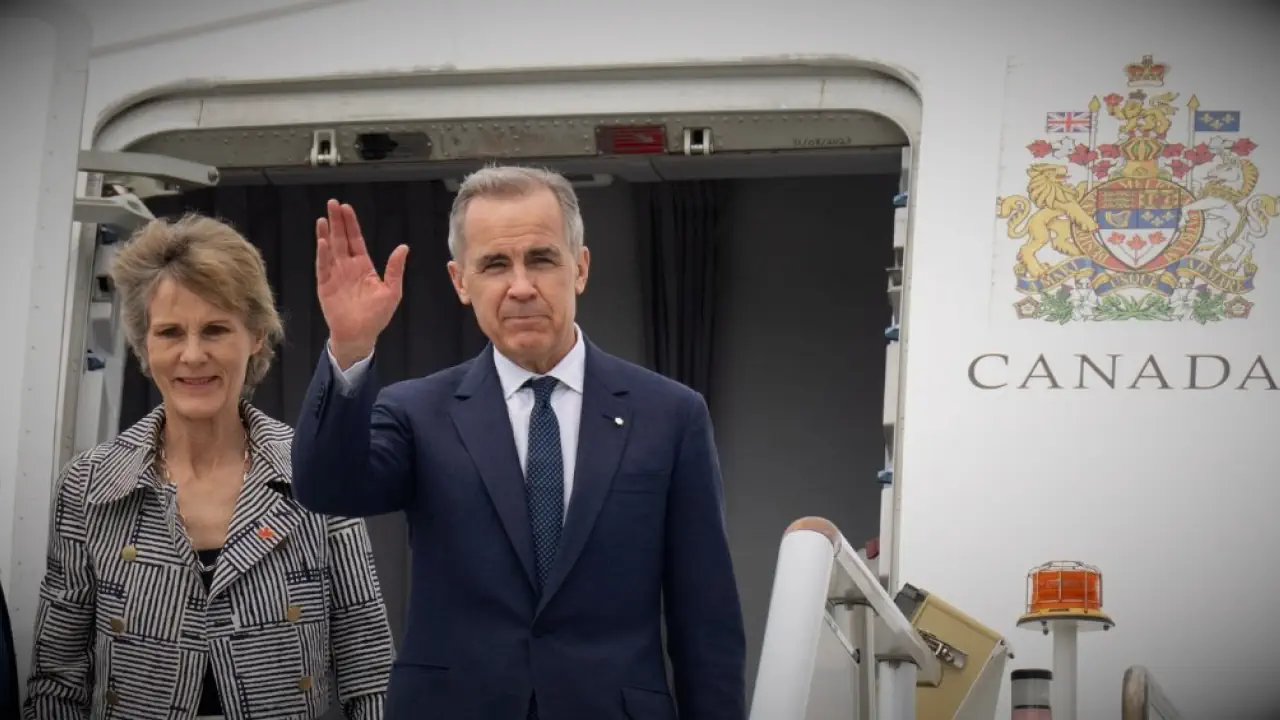
While the sky over Tehran still glows from the aftershocks of Operation Epic Fury, and while the U.S. Navy is actively trading blows with the remnants of the IRGC in the Persian Gulf, our Prime Minister is touring the Indo-Pacific like a visiting professor on a sabbatical. From the five-star comfort of Mumbai and Sydney, Carney has delivered his verdict: he supports the destruction of the world’s leading terror state, but he does it "with regret."
It is the Accountant’s Alibi. Carney views the death of the Supreme Leader and the dismantling of a nuclear threat not as a victory for civilization, but as a messy line item that disrupts the "rules-based order" he spent his life building at the Bank of England. To Carney, the world isn't a place of good and evil; it’s a ledger of interdependence. And right now, he thinks he can "offset" our alliance with Washington by offering a "regretful" apology to the ghosts of international law. He is treating a tectonic shift in global security as if it were a minor accounting error in a quarterly report.
The "Prima Facie" Betrayal and the Sydney Surrender
In Sydney, standing on the soil of an AUKUS ally that actually understands the price of security, Carney went a step further. He called the U.S.-Israeli strikes "prima facie" inconsistent with international law. This isn't just academic posturing from a man who misses the sound of his own voice at Davos. This is a deliberate signal to the globalist consultant class that Canada is a "reluctant" partner in the defense of the West. It is a desperate attempt to keep his "Governor of the World" credentials intact while our closest allies are actually doing the heavy lifting to ensure that a nuclear-armed theocracy doesn't hold the planet hostage.
By using the term "prima facie," Carney is playing a dangerous game of legalistic hedging. He wants to have it both ways: he wants to satisfy the Trump administration just enough to keep the borders open, but he wants to signal to the UN and the European Union that he finds the whole "war" thing rather distasteful. It is the posture of a man who wants to be protected by the shield but is too refined to look at the blood on the sword.
This isn't just an insult to our allies; it is a strategic catastrophe for our national interest. While Carney is busy "wordsmithing" his way out of a commitment, he is handing a loaded weapon to the protectionists in Washington. We are less than 120 days away from the July 1, 2026 CUSMA review. Donald Trump is currently looking at Canada and seeing a neighbor that enjoys the protection of the American nuclear shield while calling American actions "illegal" from a safe distance in Australia. If Carney thinks his "regret" will buy him favor in Paris or Brussels, he’s forgotten who actually buys our cars, our wheat, and our lumber.
The July 1st Cliff: Trump, Tariffs, and the Cost of Insolence
Let’s get down to the brass tacks that Carney’s spreadsheet conveniently ignores. The CUSMA review this summer isn't just a "check-in." It is a moment of existential peril for the Canadian economy. Trump has already threatened a 25 percent "Security Tariff" on any nation that doesn't pull its weight in the Western security architecture. He has specifically cited Canada’s failure to meet its NATO obligations and our "freeloading" on continental defense.
When Carney stands at a podium in Australia and questions the legality of Operation Epic Fury, he is confirming every suspicion the Americans have about the Laurentian elite. He is signaling that Canada is a fair-weather friend—a nation that will take the trade benefits but will "regret" the actions necessary to keep the world safe for that trade.
If the Trump administration decides that Canada is no longer a reliable security partner, the 25% tariff won't just be a negotiating tactic; it will be our new reality. Think about what that means for the auto workers in Oshawa, the steelworkers in Hamilton, and the farmers in the Pembina Valley. We are talking about the total liquidation of our manufacturing competitive edge. Carney is sacrificing the livelihoods of millions of working-class Canadians for the sake of a footnote in a Global Affairs briefing note. He is choosing his standing at the next "Global Governance" summit over the ability of a family in Red Deer to put food on the table.
The Ghost of the NDP and the Seven-Seat Circus
Not to be outdone in the race to irrelevance, the remains of the NDP have emerged from their basement to join the chorus of condemnation. Interim Leader Don Davies, presiding over a party that has been reduced to a pathetic seven seats, is currently acting as if he has a mandate from the people to dictate foreign policy.
The NDP’s near-death experience in the last election should have been a wake-up call. They lost their official party status because they traded the concerns of the factory floor for the grievances of the faculty lounge. Yet, here is Don Davies, calling for "de-escalation" and "dialogue" while American carrier groups are being targeted by Iranian missiles. It is a level of detachment that borders on the hallucinatory.
The NDP used to represent the men and women who built this country—people who understood that you don't "dialogue" with a regime that hangs dissidents from cranes and funds proxies to slaughter civilians. Now, they represent a fringe of activists who think that a "strongly worded letter" can stop a centrifuge. By condemning the strikes, Davies isn't standing up for peace; he is standing up for the status quo of a terror state. He is a ghost rattling chains in an empty attic, and the fact that Carney feels the need to hedge his own position to satisfy this fringe tells you everything you need to know about the current state of the Liberal-NDP "consensus."
The Green Party’s Historical Amnesia
Then we have Elizabeth May and the Green Party, who are currently mourning the Joint Comprehensive Plan of Action (JCPOA) as if it were a lost holy relic. May’s statement on the strikes was a masterclass in historical revisionism. She spoke of the Iran deal as a "masterpiece of multilateralism" that was "unilaterally ripped up" by Trump.
She ignores the reality that the deal was a sham from the start. It allowed the IRGC to keep its infrastructure, it didn't touch their ballistic missile program, and it provided billions of dollars in sanctions relief that were immediately funneled into the "Ring of Fire" around Israel and terror cells in the West. To May, "rigorous international monitoring" is a magical shield that can change the heart of a regime that views the West as the "Great Satan."
She warns that "history repeating itself" is a horror. No, Elizabeth, the horror was the last forty years of the Islamic Republic. The horror was the nuclear blackmail. The horror was the execution of the brave Iranian protesters who were literally dancing in the streets of Tehran this weekend at the news of Khamenei’s death. If the liberation of a people is a "horror" to the Green Party, then their brand of "peace" is nothing more than a polite word for surrender.
Energy Security: The Pipe vs. The Podium
The most galling part of Carney’s "regret" is the hypocrisy of our own energy policy. As the Strait of Hormuz becomes a shooting gallery and global energy prices surge toward 150 dollars a barrel, Canada should be the stabilizing force the world needs. We have the third-largest oil reserves on the planet. We have the LNG that Europe and Asia are begging for.
Yet, Carney’s government continues to treat our energy sector like a shameful secret. We are the only "Middle Power" that "regrets" a strike on a terror regime while simultaneously refusing to build the pipelines that would make that regime’s oil irrelevant. If we had a Prime Minister who cared more about the workers in Fort McMurray than he did about his standing at the next World Economic Forum, we wouldn't be worried about gas prices hitting 3 dollars a liter.
Carney’s "regret" is the ultimate luxury of the protected. He can afford to be "conflicted" about the death of a tyrant because he isn't the one paying the "Security Tariff" at the border, and he isn't the one watching his manufacturing job move to a country that actually stands with its allies. He wants the power of the podium, not the power of the pipe. He wants to be the man who talks about "global shifts" while ensuring we are completely unprepared for them.
The Middle Power Myth and the Price of Spectatorship
For decades, the Laurentian elite has comforted itself with the "Middle Power Myth"—the idea that Canada is a "broker," a nation that leads by "convening." Carney’s "regret" is the final gasp of this delusion. The reality of 2026 is that we are no longer a middle power; we are a spectator. We are a nation that sits in the bleachers, critiquing the players while our own equipment is rusted and our jersey is out of style.
This myth has been a convenient excuse for the systematic hollowing out of our national strength. Why invest in a military when you can invest in "diplomatic initiatives"? Why secure your own energy independence when you can rely on "global markets"? The answer is now staring us in the face. When the Strait of Hormuz closes, a "diplomatic initiative" won't bring the price of gas down in Brandon, Manitoba.
Carney’s "regret" is an admission of irrelevance. He is signaling that Canada is not a player in the new world, but a critic of it. And critics are the first ones to be discarded when the bill comes due. The Americans are looking for partners, not "reluctant" observers who quote international law while the bullets are flying. If we aren't all-in on the security of our own hemisphere and our own alliances, we are collateral damage in a trade war we can't win.
The Reckoning at the Border
Working-class Canadians need to understand what is happening here. This isn't just about foreign policy or a war on the other side of the planet. It’s about our ability to maintain a G7 standard of living in a world that no longer cares about Mark Carney’s "rules."
When the CUSMA review begins this July, the Americans are going to ask one simple question: "Are you with us or are you against us?" Mark Carney’s "regret" is a "No." It is an attempt to stay in the good graces of a dying European consensus while the North American economy is being reshaped by kinetic reality.
The early pioneers of this country knew that survival required a spine. They didn't "regret" the work of clearing the land or defending their homes. But our current leadership is made of paper and ink. They are technocrats who think they can negotiate with the tide.
It is time to stop apologizing for the victory of light over darkness. It is time to stop "regretting" the fact that our allies had the courage we lacked. The Accountant’s Alibi is over. The bill is coming due at the border, and "regret" isn't a legal tender that the Americans—or the reality of the 21st century—will accept.