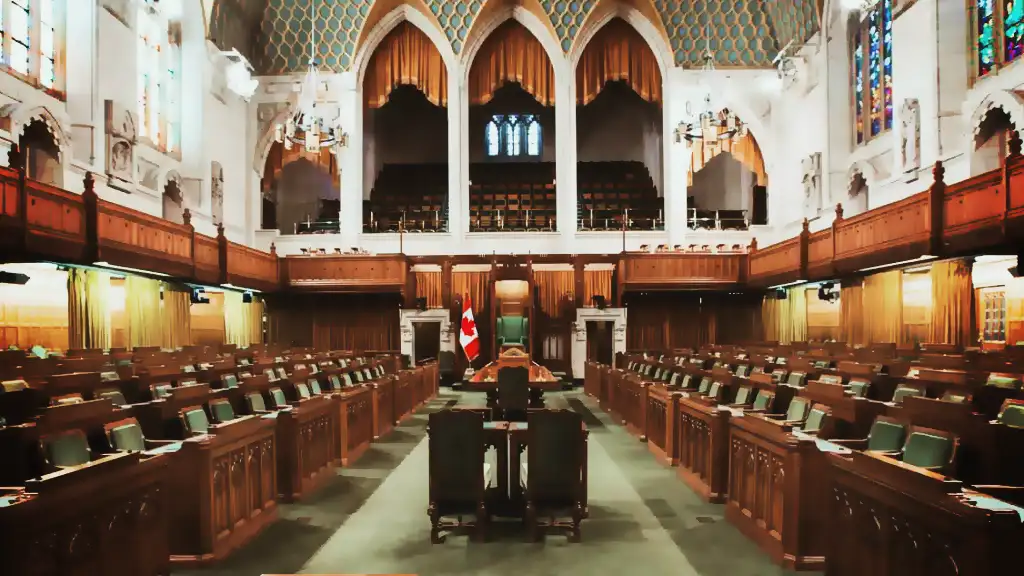
The government has a very specific idea of what constitutes a healthy workplace, provided they are not the ones who actually have to work in it. If you want a clear picture of how Ottawa views its own authority versus its own obligations, look no further than where people are allowed to sit.
For the hundreds of thousands of Canadians who work in the federal public service, the era of working from home is over. They have been ordered back to their desks. The government insists that showing up in person is non-negotiable for productivity and morale. But for the politicians passing the laws, the rules are entirely different. Six years after a global emergency first forced Parliament to operate over video screens, our elected representatives are still dialing it in.
The hypocrisy is entirely out in the open. The people running the country have decided that the exact same flexibility they loudly deny their own employees is a structural necessity for themselves.
The Public Service Mandate
Let us look at the rules applied to the people actually executing federal policy. On July 13, 2026, the Treasury Board of Canada Secretariat updated its directive titled "On-site presence in the public service." The instructions were absolute. Starting May 4, 2026, executive-level public servants were ordered back to the office five days a week. For all other eligible employees, the mandate took effect on July 6, 2026, forcing them back to their desks a minimum of four days a week.
The government did not mince words when justifying the crackdown. The official rationale from the Treasury Board was that "Increasing on-site presence is about increasing organizational performance, building stronger teams and culture, and ultimately being fully focussed on fulfilling our mandates and serving Canadians."
The logic is straightforward. If you want a strong team, you have to be in the same room. If you want to serve the public effectively, you cannot do it from your kitchen table. The government declared that the physical presence of its workforce is an essential foundation for doing the job.
If that standard applies to the people processing passport applications and writing policy briefs, you would think it applies to the people voting on national legislation. You would be wrong.
The Extended Pandemic
Back on March 13, 2020, as the COVID-19 pandemic shut down the country, the House of Commons unanimously adopted a necessary motion to suspend normal operations and eventually allow committees to meet virtually. It was a crisis measure. No reasonable person objected to it at the time. Parliament had to keep functioning while the country was locked down.
But the lockdowns ended. The vaccine mandates lifted. Life returned to normal. Parliament, however, decided it rather liked the convenience of not having to show up. Rather than returning to the standard practices of a G7 legislature, the government spent the next three years routinely passing special orders to extend remote participation. Then, they stopped pretending it was temporary. The hybrid sitting rules were formally incorporated into the Standing Orders of the House of Commons on June 24, 2023, structured to survive the current government and deliberately set to remain in force until a full year after the next Parliament opens.
What began as a public health imperative was seamlessly converted into a multi-year lifestyle perk for the political class.
The consequences are visible every time you turn on a parliamentary feed. We now have a system where members of Parliament can debate national policy while walking down the street, or cast votes that alter the Canadian economy while sitting in an airport lounge.
The Ministerial Exemption
If you want to see exactly how ridiculous this has become, look at what happened just two months ago. During the U.S.-Canada Summit in June 2026, Minister of Artificial Intelligence and Digital Innovation Evan Solomon was right in the middle of international duties. When it came time for a legislative vote back in Ottawa, he did not have to arrange a pair or miss the vote due to his diplomatic obligations. He simply paused his participation at the summit, pulled out his phone, and cast a binding vote on national law from a screen.
This is the state of our democracy. A cabinet minister taps an app between meetings in a foreign country, and a law is passed.
It is a remarkable double standard. Flexibility for the cabinet minister at a summit. Flexibility for everyone who wears a parliamentary pin. But when a mid-level manager at Health Canada asks for that exact same flexibility to balance their own family life, the Treasury Board tells them to get back to their cubicle because the culture demands it.
The Global Outlier
We are not just failing our own standards. We are failing basic international norms. Every other serious country figured out that running a national legislature requires the physical presence of its members.
Conservative MP Michael Chong laid this out perfectly during a House of Commons debate on February 6, 2026. He looked at the data and pointed out the obvious:
"We are the only national legislature amongst western Liberal democracies to remain in hybrid mode. The U.K. House of Commons ended hybrid sittings on July 22, 2021, five years ago. The U.S. House of Representatives ended hybrid sittings on January 9, 2023, and the Australian parliament ended hybrid sittings on July 25, 2022."
Read those dates again. The United Kingdom ended its hybrid system in the summer of 2021. Australia ended theirs in 2022. The United States ended proxy voting by early 2023. Canada is standing entirely alone in 2026, stubbornly clinging to a pandemic-era crutch because our politicians simply do not want to commute.
The Internal Mutiny and the Fiction of Savings
You do not have to take a conservative view to see the rot in this arrangement. The very public sector unions that usually provide reliable cover for this government are openly pointing out the absurdity.
In a public statement released to Global News on August 4, 2026, Nathan Prier, President of the Canadian Association of Professional Employees (CAPE), did not miss the irony of the situation.
"Parliamentarians have clearly seen the benefits of remote work with the way technology assists in connecting with colleagues and the savings it generates for Canadian taxpayers," Prier noted.
Prier is right about the hypocrisy, but his claim about the finances relies on outdated assumptions. To justify the arrangement, proponents point to a 2021 report from the Parliamentary Budget Officer that estimated the hybrid system would generate $6.2 million in net savings a year. But that estimate was built entirely on pandemic-era travel reductions, assuming parliamentarians were largely grounded and not billing flights to Ottawa.
Meanwhile, the actual, tangible costs of maintaining this remote infrastructure are quietly bleeding into the public ledger. Because the poor audio quality of remote feeds caused a massive spike in acoustic injuries among parliamentary interpreters, the government had to slash interpreters' working hours and scramble to fill the gaps. To absorb the strain, the 2024 federal budget handed the Translation Bureau an extra $31.9 million over five years, plus $3 million in permanent annual funding, explicitly to expand interpretation capacity. The union's "savings" argument ignores the massive, parallel financial machinery required to let politicians stay home.
The Professional Institute of the Public Service (PIPSC) stated the obvious logic that the Treasury Board refuses to acknowledge in their own statement to Global News on August 4, 2026: "Whether someone is a scientist, an IT expert or a member of Parliament, in-person attendance should be required when it serves the work — not simply for the sake of visibility."
The unions have correctly identified a caste system. If you are an IT expert keeping the federal servers running, you sit in an assigned seat because the Treasury Board claims it builds culture. If you are a Member of Parliament making over two hundred thousand dollars a year, you can vote on a multibillion-dollar spending bill while wearing sweatpants, and pass the multimillion-dollar technical bill on to the public.
The Evidence of Hypocrisy
The government has handed us its official explanation for ending remote work. The Treasury Board declared that forcing employees back into the office was entirely about increasing organizational performance and building stronger teams.
Let us test that claim. If we accept the government's premise that physical presence is the essential foundation for organizational performance, then the logical metric of success is straightforward: the most critical, high-stakes teams in the country should be the absolute first to mandate full in-person attendance.
If it is vital for a regional tax office to physically gather to build a strong team, it must be exponentially more vital for the House of Commons to physically gather to govern the nation. If face-to-face interaction is what guarantees focus and mandate fulfillment, then the federal cabinet—the highest executive authority in the land—should be leading by example, firmly chained to their desks in Ottawa.
But the observed data shows the exact opposite. The actual implementation of these rules runs completely backwards. The higher up the chain of command you go, the less the government cares about physical presence.
When a junior policy analyst is forced to commute four days a week, it is framed as a cultural necessity. When a minister votes from a coffee shop, it is framed as modern convenience. We have a Treasury Board that polices the seating arrangements of ordinary civil servants, while members of Parliament treat binding legislative votes like a distracted text message.
This collision of data proves that the government does not actually believe its own rationale. If they truly believed that remote work degrades performance and hurts Canadians, they would have ended the practice the moment the pandemic ended. They did not.
They kept it because the return-to-office mandate was never about building stronger teams. It is about control. They enforce attendance to manage their workforce, but they preserve the hybrid Parliament to spare themselves the inconvenience of showing up. It is an administrative cage built for the workers, designed by politicians who deliberately left the door unlocked for themselves.
The Collapse of Guardianship
This is what happens when a government forgets who it actually works for. The people making the rules have entirely insulated themselves from the consequences of them. They have constructed a segregated reality where the demands of physical presence apply only to the governed, never to the governors.
The Treasury Board directive proves they understand the value of showing up. They know that physical presence forces accountability. They know that a shared workspace prevents employees from hiding from difficult conversations. They know that actual, face-to-face friction is required to grind out functional decisions. They demand that friction from their employees because they know it works.
They simply refuse to subject themselves to it.
By keeping the hybrid system alive, the government has fundamentally weakened the institution of Parliament. A legislature is not a remote data-entry job. It is an adversarial chamber designed to test the mettle of the people proposing laws. When a minister can defend a failing policy from the safety of a curated webcam feed, immune from the physical pressure of an opposition bench shouting them down, the accountability mechanism of the country breaks.
They are treating the governance of a G7 nation like a casual video call. They mandate discipline for the public, while legally exempting themselves from the inconvenience of putting on a suit and walking into the room.
The Hammer will be watching.