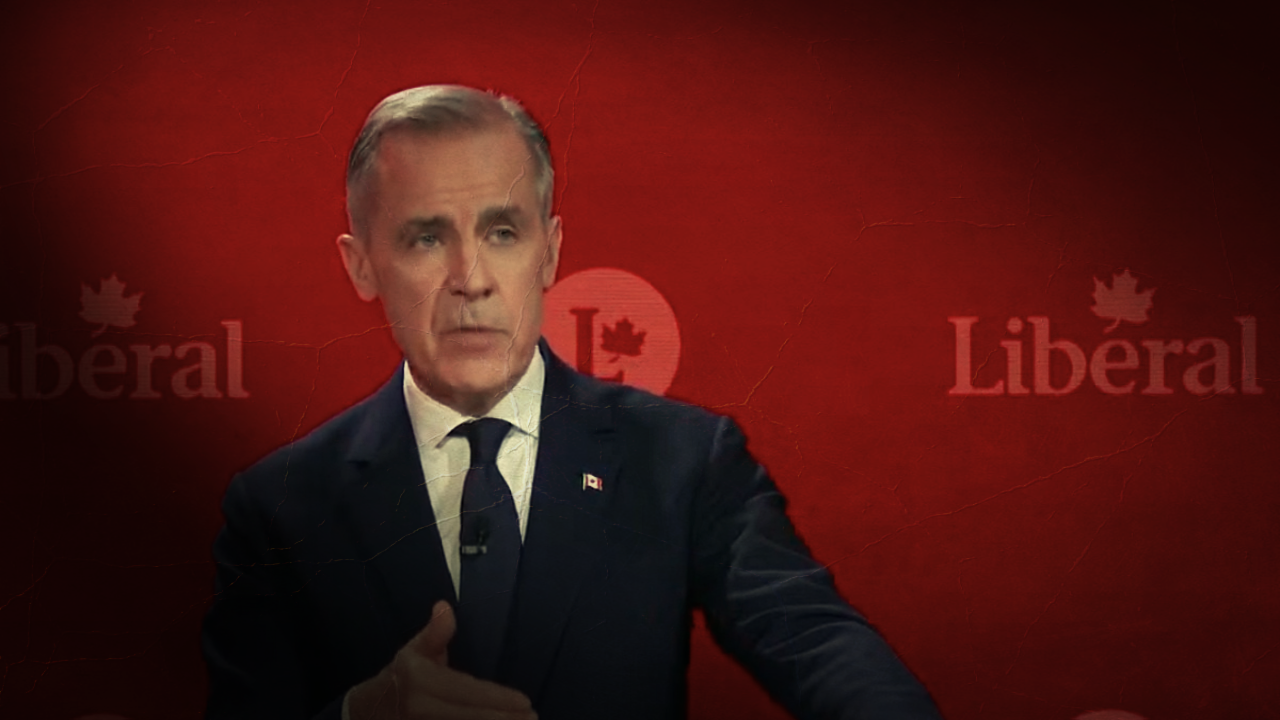
When Justin Trudeau finally read the dismal public opinion polls and stepped down in January 2025, the Liberal Party was staring at electoral oblivion. They needed a savior, and they found one in Mark Carney. He arrived with a carefully curated aura of international competence, promising to be the adult in the room. The pitch was simple and seductive. Donald Trump was returning to the White House, the trade threats were already flying, and Canada needed a leader whose resume commanded global respect.
During the final Liberal leadership debate in February 2025, Carney looked straight at the cameras and delivered his core justification for taking the top job. He leaned heavily on his time guiding the Bank of Canada through the 2008 financial crisis and managing the Bank of England during the chaos of Brexit. “In a situation like this, you need experience in terms of crisis management, you need negotiating skills, but you also need economic expertise,” Carney declared.
It was a comforting thought for a frightened political establishment. The former central banker was going to sit down with the Americans, flash his formidable credentials, and negotiate our way out of the crosshairs. He was the non-politician who understood the global machinery.
Sixteen months later, that resume is violently colliding with reality.
On Monday night, the White House announced an unprecedented 50 percent tariff on roughly $20 billion worth of Canadian goods, set to take effect on August 19. This is not a negotiating tactic or a starting bid for a new trade deal. This is a brick wall. From automotive manufacturing parts to cement, from hockey sticks to cheese, the Americans are slapping a massive, punitive tax on everything coming south. They are deliberately targeting our core export industries.
Carney was hired specifically to handle Trump. Instead, he is presiding over the most devastating American trade action against this country in modern history, and the Prime Minister looks completely out of his depth.
A Depression-Era Weapon
Faced with a devastating blow to the Canadian economy, the Prime Minister’s immediate response was to complain that the Americans were breaking the rules. On July 20, Carney released an official statement claiming the new 50 percent tariffs are the latest in a series of actions “in direct violation of the Canada-United States-Mexico Agreement (CUSMA)”.
He is technically correct, but the complaint proves how badly he has misread the board. The Americans are not using CUSMA. They are explicitly bypassing it.
The White House is executing this strike using Section 338 of the U.S. Tariff Act of 1930. This is a Great Depression-era law that gives the American president the unilateral legal authority to impose a maximum 50 percent duty on imports from any country he decides is discriminating against American commerce. By dusting off a ninety-year-old law, Trump is bypassing the continental free trade agreement entirely.
When Washington invokes Section 338, it does not matter if a Canadian product is fully CUSMA-compliant. The tax applies regardless. The Americans are taxing our goods not because they dispute a specific rule of origin on a car part, but because they have decided the entire Canadian trade posture is fundamentally hostile. The White House fact sheet released on Monday explicitly called out Canada’s own retaliation measures—specifically our tariffs on American vehicles and the provincial bans on selling American alcohol—as the legal justification for the tariffs.
Notice what the Americans excluded from the 50 percent tax: energy products, critical minerals, and potash. They carved out the resources they actually need to run their own economy, and hit everything else. It is a calculated, surgical strike designed to inflict maximum pain on Canadian manufacturing without disrupting American energy grids.
Carney acknowledges in his own statement that the U.S. has been transforming all of its trade relationships over the past eighteen months. He knows the Americans are tearing up the rulebook. While he claims to have made “detailed and comprehensive proposals” to resolve the dispute, those proposals amount to nothing more than pointing at that shredded rulebook and asking for a meeting.
Leverage Mismanagement
The Prime Minister’s failure is not a matter of bad luck. It is a masterclass in leverage mismanagement. A competent negotiator retains sovereign assets to use as hard bargaining chips at a formal negotiating table. Over the past twelve months, Carney has repeatedly surrendered those chips for nothing, bleeding out our leverage in a desperate bid for unreciprocated goodwill.
Consider the Digital Services Tax. On June 29, 2025, the Department of Finance formally announced the total repeal of the DST. In their own official press release, the government explicitly admitted they were killing the tax “in anticipation of a mutually beneficial comprehensive trade arrangement with the United States.” Carney gave away a massive piece of sovereign legislative leverage entirely for free.
Instead, the Americans laughed at him. U.S. Trade Representative Jamieson Greer mocked the surrender publicly, telling a security forum in Colorado that Canada "doesn't really get credit for doing something bad and then undoing it."
Having learned absolutely nothing from that humiliation, Carney did it again just last week.
On July 16, 2026, the government announced a new agreement for the Gordie Howe International Bridge. Canadian taxpayers fronted the entire $6.4 billion construction cost for this crossing. Under the original 2012 deal, Canada was set to retain 100 percent of the toll profits until that massive debt was fully repaid. But after Donald Trump complained on social media, Carney caved. Under the revised agreement, Canada surrenders 50 percent of the bridge's net revenues for the first 15 years directly into a U.S. economic development fund. As if that were not enough, Carney also handed the Americans veto power over future toll changes if Canada attempts to raise them by more than 10 percent.
The Prime Minister essentially paid Washington a tribute from a bridge we built ourselves. And what did that historic capitulation buy us? Four days later, Trump slapped us with a 50 percent tariff anyway. The bridge concession did not directly cause the new tariffs, but it was part of a consistent pattern of demonstrated weakness that emboldened Washington to strike. Carney stripped the copper wire out of his own house to appease a burglar, and the burglar burned the house down anyway.
The Retaliation Trap
While Carney was surrendering federal leverage for free, he was simultaneously executing a disjointed, chaotic retaliation strategy. Instead of coordinating a unified national response, he escalated federally and allowed the provinces to pile on uncoordinated bans of their own, handing Washington the exact legal pretext it was looking for.
When the Americans initially targeted our auto sector last year, the Canadian government matched the tariffs. They did it using Section 53 of the Customs Tariff, the Canadian law that allows the federal cabinet to slap retaliatory surtaxes on foreign goods without a vote in Parliament. At the provincial level, premiers decided to pile on for their own domestic audiences. In Ontario, Premier Doug Ford directed the LCBO to pull American alcohol off the shelves. The province ceased purchasing American products and cancelled existing orders wherever contractually possible. British Columbia did exactly the same thing.
Ford is still doubling down on this strategy. In a social media post on Monday, the Ontario Premier insisted that Canada needs to respond "tariff for tariff, dollar for dollar." Then, arriving in Prince Edward Island on Tuesday for a premiers meeting, he added that he is "tired of the bully trying to take our lunch money all the time."
Retaliation only works as leverage if it forces the other side to the table. Our retaliation did the exact opposite. Carney retaliated federally and let the provinces retaliate on top of that, with no unified national trade strategy tying the two together. That chaotic multi-front attack handed the White House the exact legal excuse they needed to declare that Canada was treating American commerce unfairly. This triggered the Section 338 nuclear option. We handed them the justification they wanted, and the people paying the price are the Canadians who actually make things for a living.
The damage is already happening. Dennis Darby, the president and CEO of Canadian Manufacturers and Exporters, called Monday’s announcement an “alarming escalation that will inflict serious damage on manufacturers, workers and consumers on both sides of the border.”
His organization has the receipts. The Canadian manufacturing sector has already bled roughly 61,000 jobs since its recent peak in January 2025. According to a July survey by KPMG, a staggering 42 percent of Canadian manufacturers have already moved or plan to move some or all of their production to the United States to survive the trade pressure. The same survey found 57 percent of manufacturers have slashed or cancelled vital capital investments entirely. Algoma Steel let go 1,000 workers in December 2025 alone directly because of American trade impacts.
When a manufacturer faces a 50 percent tax at the border, they do not just absorb the cost and keep running the assembly line. They stop producing in Canada. They pack up their machinery, fire their Canadian workers, and move their facilities south. A 50 percent tariff is a death sentence for Canadian industrial jobs.
Intensifying Failure
Faced with the imminent collapse of our export economy, what is the Prime Minister’s master plan?
In his July 20 statement, Carney told Canadians that the government has made detailed and comprehensive proposals to resolve the dispute. His official solution is to promise more talking. “We stand ready to intensify those discussions in the coming weeks,” Carney stated. He also boasted that his government is diversifying, noting that Canada has signed "more than 20 new economic and security partnerships".
You cannot intensify a discussion when the other party has walked out of the room and locked the door behind them. And bragging about secondary economic partnerships means absolutely nothing when the United States purchases three-quarters of everything we export. You cannot replace the American market with twenty smaller ones overnight.
When Carney ran for the leadership, his logical metric of success was simple: he was the expert negotiator who would protect the Canadian economy from American aggression. The data shows total isolation instead. His failure to hold federal assets as hard bargaining chips bled out our leverage, while his failure to manage a unified national trade strategy handed the Americans the exact legal excuse they needed to escalate under Section 338. Now, facing a 50 percent tariff on $20 billion worth of goods in less than thirty days, his only move is to ask the White House for another meeting.
Mark Carney spent his entire career in the polished, insulated halls of central banks, where serious people in expensive suits resolve their differences with carefully worded communiqués and gentleman's agreements. He fundamentally misunderstood what he was walking into. The Americans are not looking for a polite, data-driven negotiation over basis points. They are demanding submission, and they are using their massive market leverage to force it.
The Prime Minister thought he could manage Donald Trump by acting like the smartest guy in the room. But out here in the real world, where steelworkers are losing their livelihoods and factories are actively preparing to leave the country, an impressive resume does not pay the bills. You cannot pay a border duty with a glowing reference from the Bank of England.
Carney promised us economic expertise. He delivered a 50 percent tax on the Canadian working class.
The Hammer will be watching.