Prime Minister Mark Carney is undeniably a man in motion. Last week, the official feeds were saturated with carefully curated images of him observing NATO’s Cold Response military exercises in the frozen expanse of Bardufoss, Norway. By Monday morning, he had repositioned himself behind the heavy oak doors of 10 Downing Street, exchanging geopolitical pleasantries with British Prime Minister Keir Starmer before an obligatory, high-society audience with King Charles III. The Prime Minister's Office insists this relentless transatlantic velocity is essential for managing what they vaguely define as the global economic shift. But the raw data and the optics suggest something entirely different. Mark Carney is not managing a crisis; he is managing a supranational illusion. He is desperately peddling the aesthetics of a unified, elite-driven new world order while the actual foundation of the North American economy fractures beneath his feet.
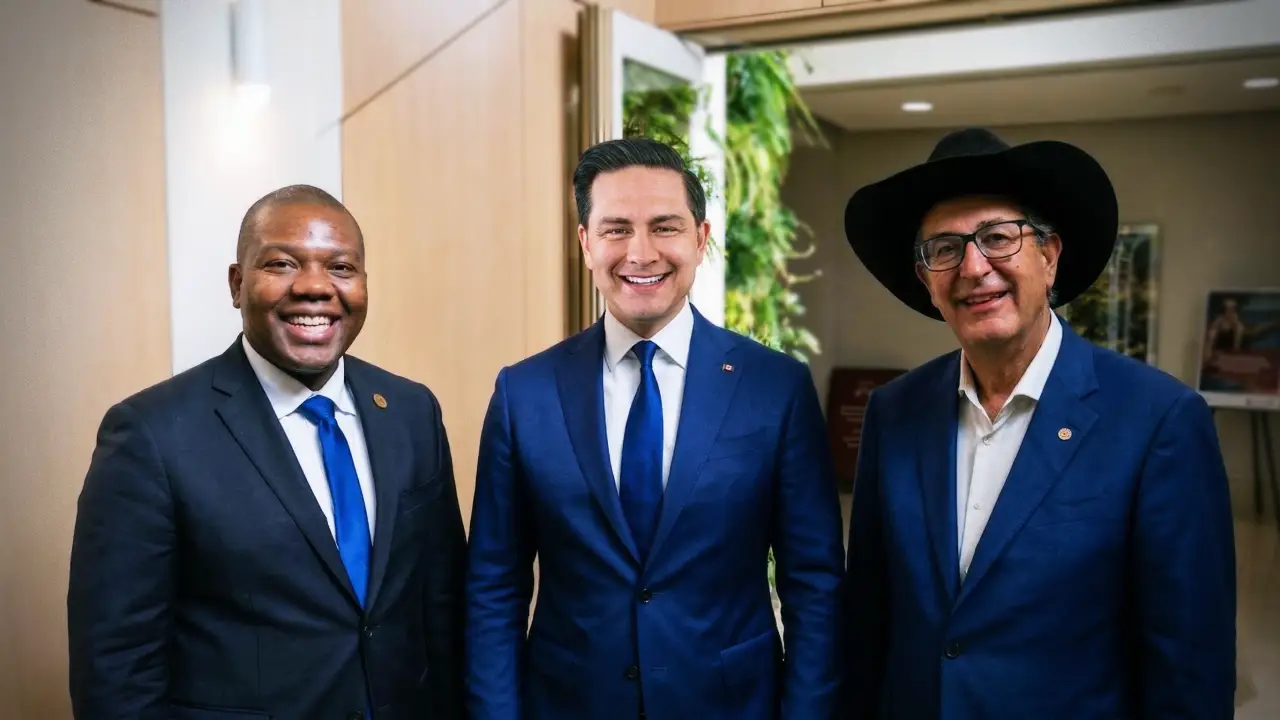
While the Prime Minister stages these high-gloss photo opportunities to broadcast a veneer of global influence, the Leader of the Opposition has deployed himself into the absolute trench warfare of continental logistics. Pierre Poilievre is currently executing a hostile, parallel foreign policy across the United States. He is not shaking hands with monarchs or issuing vague, multilateral declarations about climate transitions to European assemblies. He is on the ground where it actually matters. He spent the weekend in the boardrooms of Detroit and is currently navigating the energy corridors of Texas, grinding out the brutal arithmetic required to save a Canadian industrial base that is being actively choked out by American protectionism. The juxtaposition is no longer just geographic; it is existential. It is the clash between an administration addicted to the theater of international prestige and an opposition engaged in the raw, unglamorous mechanics of getting things done.
The Symmetrical Auto Pact: A Blueprint for the Assembly Line
The anchor of Poilievre’s ongoing rust-belt deployment is a highly calculated framework designated internally as the new Auto Pact. For an agonizing twelve months, the Canadian manufacturing sector has been suffocating under the blunt-force trauma of twenty-five percent American tariffs. The Carney administration’s default response has been to assemble domestic panels, consult academic tribunals, and push a localized system of import credits that completely ignores the visceral reality of cross-border trade flow.
Poilievre has abandoned the Ottawa playbook entirely in favor of structural economic leverage. The mechanism he presented to the executive leadership of Ford and General Motors in Michigan over the weekend is a strict, unyielding dollar-for-dollar tariff rule. For every single vehicle an automaker physically assembles within a Canadian facility, they secure the immediate right to import an equivalent monetary value of cars or trucks from the United States or Mexico completely free of punitive duties. The internal modeling suggests this symmetrical architecture will mathematically force the repatriation of production capital. It effectively neutralizes the primary grievance of the current United States Trade Representative by feeding the American industrial machine rather than attempting to circumvent it. It is a blueprint designed to restore Canadian manufacturing capacity to the benchmark of two million vehicles annually, relying on hard quotas and reciprocal market access rather than the ideological wish-casting currently favored by the federal cabinet.
The Fiscal Disarmament of the Supply Chain
To ensure this dollar-for-dollar math survives the brutal realities of the assembly line, the Conservative strategy requires a total disarmament of the federal tax burden currently suppressing domestic production. Poilievre has laid down a non-negotiable logistical commitment to strip the five percent federal Goods and Services Tax from all Canadian-made automobiles. This maneuver is fundamentally distinct from the consumer-side rebate models heavily favored by the current Liberal administration, which ultimately do nothing to alter the baseline cost of creating the product.
This is a structural dismantling of overhead. By functionally stripping five percent off the top of the production and retail cost, Poilievre is actively price-matching the output of right-to-work American jurisdictions. Crucially, he is achieving this parity without demanding a corresponding, devastating reduction in the wage standard of Ontario’s highly skilled labor force. The strategy serves as a direct repudiation of the Carney doctrine, which relies on billions in taxpayer-funded, government-directed industrial subsidies that invariably fail to deliver baseline production targets. The data confirms that capital flows where taxes do not. Poilievre is betting that the market requires a drastic reduction in federal interference, not an increase in government-appointed oversight. The proposition delivered to the automakers in Detroit was absolute: a Conservative government will immediately alter the fiscal environment to make Canadian assembly plants the most mathematically efficient operations within the entire North American trade framework.
Securing the Perimeter Against Chinese Telemetry
The most critical intelligence delivered to the automotive giants transcended standard trade economics; it struck at the absolute core of continental defense and data security. The ongoing friction surrounding the importation of state-subsidized Chinese Electric Vehicles remains a massive, bleeding liability for the Canadian negotiating team. The Carney government’s active effort to attract investment from Chinese electric-vehicle manufacturers, coupled with a deliberate hesitation to fully fortify the Canadian market against Beijing’s automotive sector, is viewed by the American intelligence apparatus as an unacceptable breach of the North American security perimeter.
Modern electric vehicles are heavily militarized data-collection platforms. They operate with advanced telemetry, persistent optical sensors, and continuous broadband uplink capabilities. Allowing subsidized Chinese hardware unhindered access to North American infrastructure provides an adversarial intelligence network with a mobile mapping system of critical power grids, military installations, and logistical arteries. Poilievre is weaponizing this alignment. He has explicitly promised a total, unified harmonization with the United States regarding Chinese tariff barriers. He is offering absolute regulatory and defensive harmony, demonstrating that securing the North American supply chain from foreign technological espionage and subsidized dumping requires locking the regulatory backdoor that the current administration has aggressively propped open. It is a commitment to a fortress continent, definitively rejecting Carney’s dangerous illusion that Canada can simply substitute the American auto market with overseas, state-controlled adversaries.
Bypassing the Beltway Bureaucracy
The tactical genius of this ongoing maneuver is its total, deliberate exclusion of Washington, D.C. Poilievre’s scheduling explicitly ignores the traditional diplomatic establishment. The logistical mapping of this tour recognizes a brutal reality of the 2026 political landscape: actual, actionable leverage no longer resides in the committee rooms of the Capitol or the cocktail circuits of the Beltway. The true centers of gravity in the current trade war are the governor's mansions of the rust belt and the corporate headquarters of the major regional employers.
By engaging directly with state-level officials in Michigan and Ohio, Poilievre is assembling a highly motivated coalition of regional power brokers. These are politicians and executives who possess a direct, mathematical dependency on an integrated, cross-border auto trade. They are the individuals who must answer to the American union worker, the local supply chain vendor, and the corporate shareholder. When the Conservative delegation bypassed the lobbyists and went straight to the source of American economic momentum, they instituted a fundamentally new diplomatic protocol. The objective is to convince the employers of the American voting public that the current tariff regime is actively destroying their own quarterly projections, forcing those corporations to apply the necessary, brutal pressure directly to the Oval Office. Poilievre is treating American corporate self-interest as a blunt instrument to shatter the tariff wall, a strategy infinitely more effective than politely asking for a reprieve at an international summit.
The Heavy Crude Equation in Texas
As the logistical operation transitioned to the Gulf Coast early this week, the strategic focus pivoted from the assembly line to the pipeline. Poilievre’s current itinerary in Houston and Austin is dominated by closed-door planning sessions with executives from the major American energy and refining conglomerates. This is where the structural failures of the Carney administration are exposed in precise, undeniable metrics.
Consider the current geopolitical reality: the ongoing war in Iran has triggered massive global oil price shocks, forcing the United States to place a desperate thirty-day waiver on its Russian oil sanctions just to stabilize domestic markets. Prime Minister Carney, speaking from his European tour, proudly announced that Canada will maintain its sanctions on the Russian shadow fleet. Morally, this is the correct posture. Economically, without a massive surge in domestic output to offset the global deficit, it is empty posturing. While Carney offers the world empty rhetoric regarding energy transitions, his official domestic policy remains the managed, deliberate decline of the Alberta oil patch, systematically starving the continent of a secure energy baseline at the exact moment it is most vulnerable.
The central pitch Poilievre is delivering in Texas is a hard, engineered proposal to optimize and expand existing infrastructure. He is offering to move a secure, uninterrupted flow of heavy Canadian crude directly into the highly specialized heavy-oil refineries of the American Gulf Coast. The data presented to Texas energy leaders highlights a critical vulnerability that global instability has laid bare: without a massive, stabilized flow of Canadian heavy crude, these multi-billion-dollar coastal refineries are forced to rely on volatile, embattled, and frequently hostile overseas regimes. Poilievre is offering absolute energy security. He is positioning Canadian resources as the non-negotiable foundation of continental energy dominance, directly contradicting the Carney government's treatment of the energy sector as a mere environmental liability.
The Calculus of Tactical Leverage
The culmination of this shadow summit will take place Thursday at the Harvard Club in New York City, where Poilievre will deliver a keynote to the Foreign Policy Association. This address is designed to synthesize these tactical strikes into a singular, undeniable reality. The era of polite, deference-based diplomacy is officially terminated. Canada can no longer rely on the historical illusion of the longest undefended border to act as a shield against aggressive American protectionism. Furthermore, it cannot survive under an executive branch that prioritizes the aesthetics of international relevance over the hard metrics of domestic survival.
The strategy Poilievre is executing across the United States is mathematically grounded and ruthlessly pragmatic. The American government prioritizes the security of its own supply chains, the isolation of its geopolitical adversaries, and the unassailable dominance of its own industrial base. The Detroit maneuver, the dollar-for-dollar tariff rule, the Texas heavy crude metrics, and the absolute hardline stance on Chinese data security are all born from this cold calculus.
Poilievre is presenting a strictly transactional model. The United States secures exactly what it demands: domestic manufacturing growth fueled by a symmetrical auto pact, a guaranteed baseline of heavy crude to weather Middle Eastern volatility, and a sealed technological border against adversarial intelligence gathering. But they only secure these assets if they abandon the tariffs currently strangling Canadian industry. It is a hostile takeover of bilateral relations, driven by the absolute certainty that in 2026, raw, calculated economic leverage is the only currency that commands respect. While the Prime Minister powers the illusion of his new world order from the drawing rooms of Europe, the actual architecture of Canada's economic survival is being hammered out on the ground where it matters.