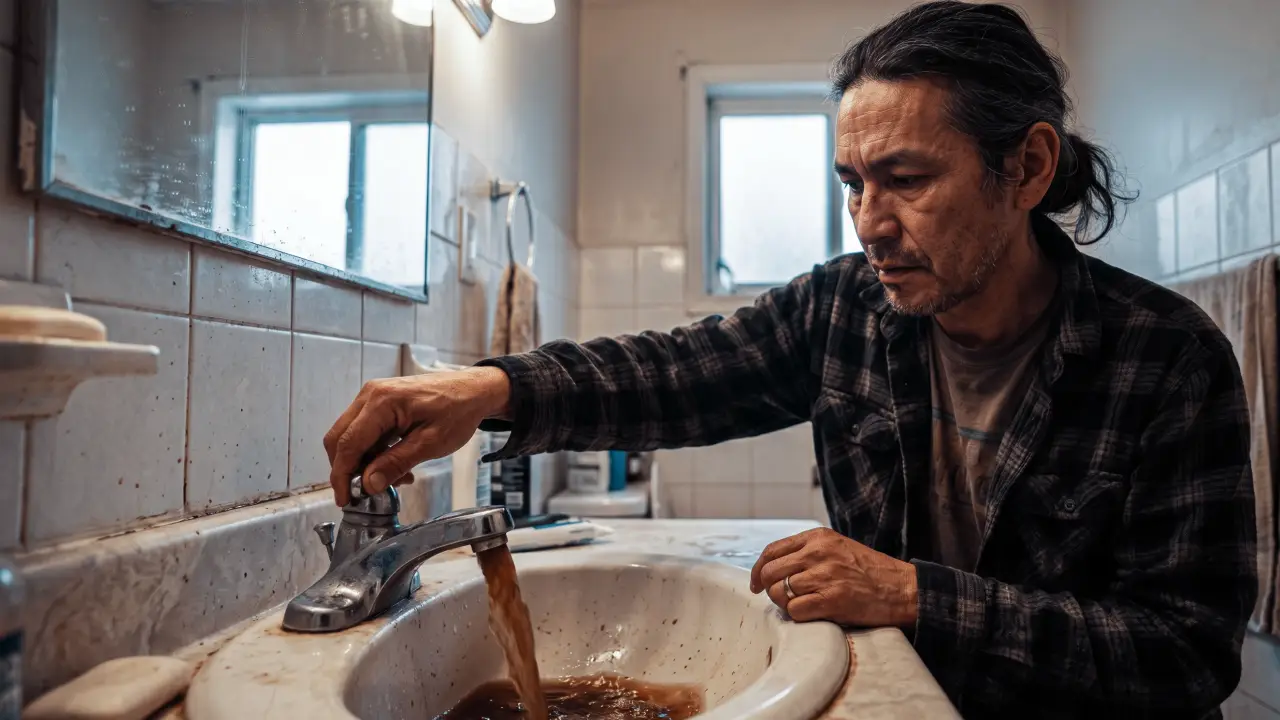
The definition of administrative cruelty is a state that measures its reconciliation in multi-billion-dollar announcements while its citizens measure their survival in boiling pots of contaminated water. For over a decade, successive federal administrations have treated the on-reserve drinking water crisis as a rhetorical asset—a convenient moral backdrop for progressive posturing and historic spending pledges. Yet on the final day of May 2026, the structural veneer of this state-sponsored benevolence shattered completely, exposing a sprawling bureaucratic pipeline designed to nourish the federal apparatus while leaving First Nations communities structurally starved.
The latest rupture occurred not in a remote northern pump house, but in the sterile offices of the legal establishment. Michael Rosenberg, a senior partner at McCarthy Tétrault LLP and lead class counsel representing roughly 260 First Nations under the historic 2021 drinking water class-action settlement, went public with a damning indictment of the Carney administration. According to Rosenberg, the federal government has completely frozen out his clients from the drafting and statutory design of its upcoming clean drinking water legislation. This is not merely an administrative oversight; it is a direct, flagrant violation of a court-approved settlement agreement that legally bound the Crown to co-develop this legislative framework alongside the very communities it has systematically poisoned for generations.
The political timeline is tightening like a vice. Indigenous Services Minister Mandy Gull-Masty sent a formal letter to the leadership of Curve Lake and Tataskweyak First Nations on May 8, 2026, explicitly promising that the long-awaited successor to the defunct Bill C-61 would be tabled before the House of Commons rises for summer recess on June 19, 2026. Yet, with less than three weeks remaining on the parliamentary calendar, the legislative text remains locked inside the backrooms of Indigenous Services Canada (ISC), hidden from the scrutiny of the communities whose daily lives it will govern. The message from Ottawa is as clear as it is ancient: we will draft the rules, we will manage the capital, and you will accept the scraps delivered at the final hour. Class counsel has already issued an ultimatum. If the Carney government misses the June 19 deadline, or if the tabled bill fails to codify the rigorous, binding water quality metrics mandated by the 2021 courts, the legal team is prepared to drag the federal government back before a federal judge for statutory non-compliance.
The Legislative Ghost Town
To understand how the federal government arrived at this point of structural paralysis, one must trace the legislative shell game that has defined the water portfolio for years. The regulatory framework governing on-reserve water is a legal vacuum. While provinces and territories maintain strict, enforceable statutory standards for water treatment and distribution within their jurisdictions, no such baseline has historically existed for First Nations lands under federal stewardship.
The previous legislative attempt to patch this void, the Safe Drinking Water for First Nations Act of 2013, was a paternalistic failure that imposed heavy regulatory burdens on communities without providing the structural funding required to achieve them. Under intense political pressure, that act was finally dismantled via the Budget Implementation Act, 2022, No. 1, which officially wiped the 2013 statute from the books. What followed was a masterclass in parliamentary foot-dragging.
On December 11, 2023, the government introduced Bill C-61, titled the First Nations Clean Water Act. The bill promised a grand reordering of the state's relationship with reserve infrastructure, pledging to affirm the inherent right of self-government over source waters under Section 35 of the Constitution Act, 1982. It advanced through its second reading and spent months languishing within the Standing Committee on Indigenous and Northern Affairs (INAN). Amendments were tacked on, committee transcripts swelled, and ministers patted themselves on the back. Then came the political transition. When the last federal election was called and Parliament was subsequently prorogued, Bill C-61 died quietly on the order paper, terminating two years of purported progress and plunging First Nations back into a regulatory void.
Now, in the spring of 2026, the Carney administration is attempting to resurrect this dead legislation under a self-imposed guillotine date of June 19. But rather than executing a transparent, collaborative redrafting process, the state has retreated into its preferred mode of operation: centralized, top-down bureaucratic control.
The Generosity Myth
The government’s defense of its record rests on a highly curated narrative of fiscal generosity and structural protection. In the halls of Parliament, the Carney administration argues that it has insulated the Indigenous Services portfolio from the fiscal austerity sweeping across other federal sectors. Under federal expenditure review guidelines, while core departments face sweeping operational budget reductions of up to 15 percent, the government capped ISC’s operational spending cuts at a nominal 2 percent to preserve essential programming.
Furthermore, the government points to Budget 2025’s flagship allocation: a promised $2.3 billion over three years, commencing in the 2026–27 fiscal year, specifically earmarked to renew the First Nations Water and Wastewater Enhancement Program. According to ministerial readouts, this multi-billion-dollar injection is actively backing approximately 800 local infrastructure projects across the country, slowly eroding the backlog of long-term boil-water advisories. The state’s logical metric of success is simple: if the federal government maintains a massive, centralized funding apparatus and protects it from spending cuts, that capital will efficiently materialize on the ground as functional treatment plants, certified local operators, and clean running water.
This official rationale, however, suffers a catastrophic collision when subjected to the hard, mathematical realities documented by the state's own independent watchdog. On May 4, 2026, Auditor General Karen Hogan released a blistering performance audit titled New Fiscal Initiatives With First Nations. Hogan’s forensic investigators examined the execution of more than $6.5 billion distributed via 10-year grants designed to provide stable, long-term, predictable funding to 160 First Nations communities up to the conclusion of the 2024–25 fiscal period.
The Auditor General’s verdict was an absolute condemnation of departmental incompetence. The audit revealed that Indigenous Services Canada "fell short" in nearly every core administrative duty. The department did not consistently monitor whether grant recipients remained eligible for the funds, and worse, performed zero data-driven assessments to verify if this $6.5 billion cash pool was actually closing socio-economic disparities or improving water infrastructure outcomes. In her opening statement to the national press theatre, Hogan noted that the bureaucracy had simply taken existing, dysfunctional funding streams and repackaged them into a long-term stable format, failing entirely to implement the transformative structural shifts required to ensure clean water delivery.
This May 2026 failure is the continuation of a systemic pattern. It matches the OAG’s October 2025 Follow-Up on Programs for First Nations report, which revealed that between the 2019–20 and 2023–24 fiscal years, the internal budget for Indigenous Services Canada expanded by an astronomical 84 percent, skyrocketing from $13.2 billion to nearly $24 billion annually. Yet, despite nearly doubling its financial footprint, the department made "unsatisfactory progress" on more than half of its core service delivery recommendations. The money is moving out of the Treasury Board, but it is stalling inside the administrative machinery of the state.
The Direct Cost of Gatekeeping
Where does the money actually go if it isn't solving the dirty water problem? The answer lies in an expanding empire of departmental overhead and short-term interim band-aids. While massive financial pipelines are authorized by the Treasury Board, deep-seated institutional habits consume extensive capital on internal administrative costs and departmental overhead. The state has built a thriving industry out of managing indigenous poverty, maintaining a vast layer of bureaucratic gatekeepers in Ottawa whose primary function is to review, delay, and audit the infrastructure applications submitted by desperate community chiefs.
While billions are absorbed by the imperial department, the actual physical infrastructure on the reserve is starved of the precise funding needed to keep taps running. The Parliamentary Budget Officer (PBO) has documented a chronic, structural deficit of $138 million per year allocated specifically to the day-to-day operations and maintenance of existing on-reserve water systems. Ottawa will happily write a multi-million-dollar check to build a flashy new treatment plant because it provides a lucrative photo opportunity for a visiting minister. But once the ribbon is cut, the federal government refuses to provide the sustained funding required to pay competitive salaries for local water operators or to maintain the highly sensitive filtration membranes.
As a direct result, local operators are chronically underpaid, leading to massive turnover rates as certified staff leave reserves for higher-paying municipal jobs. Deprived of operational funding, brand-new multi-million-dollar treatment facilities deteriorate rapidly, falling back into disrepair within years of construction. This is why, as of May 2026, official ISC tracking shows 39 active long-term drinking water advisories plaguing 37 different First Nations across this country, with live media wire feeds tracking a variance as high as 40 active advisories across 38 communities. In communities like the Neskantaga First Nation, the boil-water advisory has remained continuously active since February 1, 1995. For over 31 years, an entire generation has grown to adulthood without ever knowing the simple dignity of drinking safely from a kitchen sink. It is a damning indictment of a system that prioritizes bureaucratic self-preservation over the baseline biological needs of human beings.
The Alternative Vector
The systemic failure of the centralized federal model has completely shifted the political battleground, opening a massive policy flank for the Official Opposition. Conservative Leader Pierre Poilievre and Indigenous Services Critic Billy Morin have framed the water crisis not as a failure of funding, but as a predictable symptom of an "Ottawa-knows-best" gatekeeper state. The Conservative critique targets the very architecture of Indigenous Services Canada, arguing that forcing local chiefs to beg federal bureaucrats for capital allocations is a recipe for perpetual dependency and substandard infrastructure.
In place of that centralized model, the Opposition is championing a policy of direct economic autonomy: the First Nations Resource Charge. Developed by the arm's-length First Nations Tax Commission back in 2012 and later adopted by the Conservatives, the FNRC is voluntary and opt-in. A willing First Nation collects half of the federal corporate tax paid by industrial projects operating on its land, with Ottawa ceding the tax room and the company receiving an offsetting federal credit so its bill never rises. It does not replace the existing toolkit—communities can still strike Impact Benefit Agreements, or use the charge to supplement them. Poilievre’s logic is purely structural: route the resource revenue straight to the band council, cut the federal middleman out of the loop, and let a community that hosts development fund its own treatment plant instead of waiting on an ISC cheque.
On its own terms, the idea is sound. It names the real disease—the gatekeeper state—and it treats willing communities as the adults in the room, capable of managing their own money without an Ottawa chaperone. And it is worth being exact about what the charge does and does not do: it does not touch, reduce, or claw back a single dollar of anyone's court-ordered water settlement. It is an optional add-on, not a substitute. A community that refuses extraction on cultural or environmental grounds—as Neskantaga has, holding a moratorium over the mineral-rich Ring of Fire and sending a delegation to hand-deliver a cease-and-desist letter to an exploration camp this past December—loses nothing it was already owed. It simply stays inside the existing federal system. That is the consequence of a sovereign choice, not a punishment written into the policy.
The limit of the charge is not in what it does, but in who it can reach. A resource charge needs a resource. The community that most wants out from under Ottawa—but sits on no mine, no industrial activity, no corporate tax to skim—gets nothing from it. For them the door is welded shut, and they are left precisely where they started: inside the broken default system, denied the freedom to build on their own terms that their resource-rich neighbours would enjoy.
The fix is not to scrap the charge but to build a floor beneath it, using Indigenous-led institutions that already exist under the First Nations Fiscal Management Act. The first piece is regional pooling—a model that works regardless of whether a community has a single resource to its name. The Atlantic First Nations Water Authority, the first Indigenous-owned water utility in the country, already runs the water and wastewater systems for 13 First Nations across the territories of Mi'kma'ki and Wolastoq, backed by roughly $257 million in total federal funding, including $173 million over ten years from Budget 2022. Its real innovation is leverage: instead of 13 communities each bargaining with ISC alone, one Indigenous-owned authority negotiates for all of them at once. The second piece would be converting Ottawa's discretionary infrastructure transfers into a fixed, rules-based statutory formula—money a community can count on rather than petition for year after year. A predictable transfer stream is something a First Nation could then pledge through the First Nations Finance Authority, which has now moved more than $4 billion in capital-market financing, with the First Nations Infrastructure Institute supplying the technical planning to convert it into low-interest, upfront bond financing. Stack those tools on top of the FNRC and the result is a genuine anti-gatekeeper floor: the resource-rich build out of their own industry, and the resource-poor get the very same power to step around the Ottawa bureaucracy and fund their own survival.
The Hammer's Verdict
The ongoing exclusion of First Nations from their own clean water legislation is the final, logical outcome of a state that values control more than competence. The Carney government can continue to parade its $6 billion legal commitments, its protected budget lines, and its three-year enhancement programs before the national media. But the numbers do not lie, and the taps do not run clean. When an 84 percent budget increase yields an "unsatisfactory" progress rating from the Auditor General, and when heavy administrative overhead continues to sap institutional momentum while a 31-year boil-water advisory persists in Neskantaga, the diagnosis is no longer inefficiency. It is systemic institutional rot.
Ottawa has proven entirely incapable of policing itself. It has broken its promises to the courts, it has frozen out the class-action litigators, and it has left thousands of Canadians living under conditions that would be deemed intolerable in any major urban centre. If Minister Gull-Masty thinks she can quiet this storm by dropping a half-baked, unconsulted piece of legislation onto the floor of the House of Commons hours before the summer recess, she has severely misjudged the room. The courts are waiting, the opposition is circling, and the communities have run out of patience.
The Hammer will be watching.