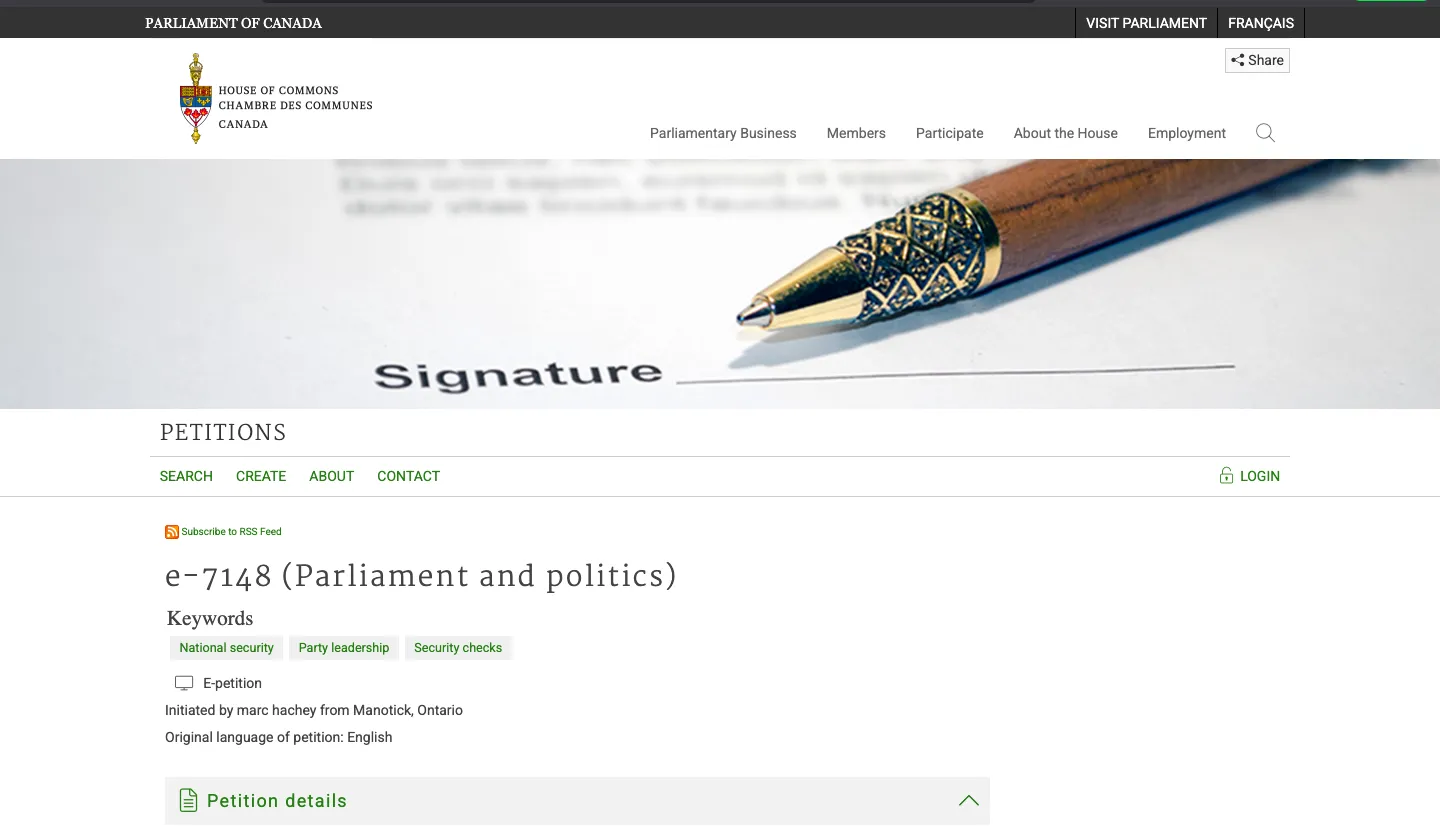
The latest maneuver from the Liberal benches isn’t a policy shift; it is a declaration of war on the very concept of an independent Opposition. On February 6, 2026, e-petition e-7148 was launched, ostensibly calling for a law to force all federal party leaders to obtain top-secret security clearance. To the uninitiated, it sounds like common sense—a baseline requirement for those who might one day hold the keys to the kingdom. In reality, it is a surgical attempt at "legal capture," designed to neutralize the most effective critic of the current administration.
The sponsorship of the petition tells you everything you need to know about its intent. It was authorized by Liberal MP Bruce Fanjoy, the man who narrowly took the riding of Carleton from Pierre Poilievre in the last general election. While Poilievre has since returned to the House via a by-election in Battle River—Crowfoot, the Liberal machine is clearly not finished with him. Having failed to keep him out of Parliament, they are now attempting to legislate a muzzle onto his face.
This is not about protecting the nation. If it were, the government would be using the existing tools at its disposal. Instead, they are attempting to weaponize the security apparatus to create a "managed democracy," where the only people allowed to lead are those who have first been vetted, approved, and silenced by the permanent bureaucracy.
The Architecture of Legal Capture
The primary mechanism of this trap is the Security of Information Act (SOIA). When a political leader accepts a top-secret clearance, they are not just gaining access to information; they are entering a state of permanent legal liability. The SOIA doesn't differentiate between a whistle-blower acting in the public interest and a foreign spy when it comes to the disclosure of "special operational information." Once you are briefed, you are "permanently in secret."
For an Opposition Leader, this is a death sentence for accountability. If the government briefs a cleared leader on a specific threat—perhaps one involving Liberal insiders or gross bureaucratic negligence—that leader is effectively paralyzed. They cannot use that information to demand public action. They cannot even hint at the nature of the rot without risking a 14-year prison sentence.
This is what we call legal capture. By forcing a leader into the "secret" circle, the government ensures that their most potent critic becomes a legal accomplice to their silence. Poilievre isn't refusing the information; he is refusing the draconian legal terms attached to it. He understands that in a Westminster system, the Opposition's duty is to the public, not to the government's vault.
The PCO-PMO Conflict of Interest
The petition frames the vetting process as a neutral, administrative hurdle. This is a profound misrepresentation of how power works in Ottawa. Security clearances are managed by the Privy Council Office (PCO). While the PCO likes to present itself as a non-partisan arm of the civil service, the Clerk of the Privy Council serves at the pleasure of the Prime Minister.
The PCO is the administrative engine of the Prime Minister’s Office (PMO). By making security clearance a legal requirement for party leadership, e-7148 would effectively give the Prime Minister’s own department the power to "de-certify" a political opponent. If a future leader is denied clearance—perhaps for having "unacceptable" political views or past associations that the PCO deems a "reliability risk"—that individual would be legally barred from leading their party.
This creates a closed-loop system of governance. The incumbent government, through its control of the PCO, gets to vet its own challengers. It is a conflict of interest so massive it would be laughed out of any court, yet it is being presented to the Canadian public as a "safety measure." We are being asked to trust that a government mired in its own foreign interference scandals will act as a neutral arbiter of who is "safe" enough to oppose them.
The CSIS Act: A Solution Ignored
The most damning evidence that e-7148 is a partisan hit job lies in the existence of Section 12.1 of the CSIS Act. Under this section, the Canadian Security Intelligence Service already has the authority to take "measures to reduce threats to the security of Canada." This includes the power to provide "threat reduction briefings" to elected officials.
These briefings are designed to warn a leader about specific threats—such as a candidate being targeted by a foreign power—without requiring that leader to sign a lifelong gag order under the SOIA. CSIS can provide the necessary intelligence to protect a party’s integrity while allowing the leader to remain an independent public actor.
The government’s refusal to lean on Section 12.1, and their insistence on the "top-secret" trap instead, proves that their goal is not security. It is control. They don't want to protect Poilievre from foreign actors; they want to protect themselves from Poilievre. By ignoring the existing "threat reduction" tools, the Liberals are admitting that they are more interested in muzzling the critic than in securing the state.
Responsibility Without Redaction
The Liberal counter-argument is predictable: they claim a leader cannot delegate the "ultimate responsibility" for national security to a staffer. This is a deliberate misunderstanding of how a functional office works. In any high-stakes environment—whether it's a multi-billion dollar corporation or a national political party—there is a division of labor.
The Conservative Party already employs cleared personnel, including the leader’s Chief of Staff. These individuals handle the technical secrecy and ensure the party’s internal vetting is robust. This allows the Leader to focus on the role they were actually elected for: public accountability. The staff handles the secrets; the Leader handles the truth.
By maintaining this wall, the Leader of the Opposition remains the only person in the room who can look the Prime Minister in the eye and demand answers on behalf of the taxpayers. If that wall is breached, the public loses its advocate. We would be left with a Parliament where everyone in the room knows the truth, but no one is legally allowed to tell it to the people who pay for it all.
The End of Independent Opposition
If petition e-7148 results in legislation, the Canadian democratic experiment will enter a dark new phase. We will have effectively codified a system where the Prime Minister’s Office holds a veto over who is "fit" to lead an opposing party. It is a move toward a "managed democracy," where the appearance of choice remains, but the ability to actually challenge the state is restricted to a pre-vetted, silenced elite.
The Liberals aren't trying to fix a security loophole; they are trying to fix a political problem. That problem is an Opposition Leader who refuses to be brought into the "fold." Pierre Poilievre is right to stay outside the door. Once you step into the room where the Liberals keep their secrets, you never truly get to speak for the public again.