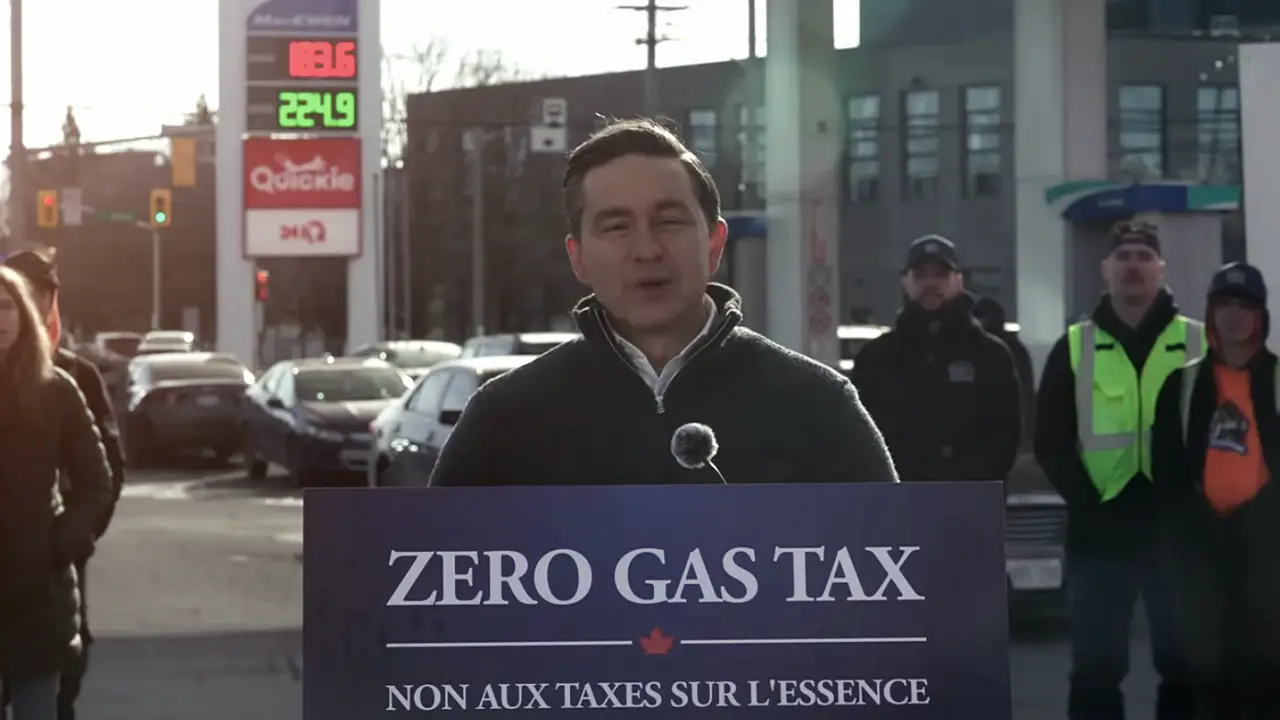
The Conservative Party’s "Zero Tax on Fuel" proposal, recently introduced by Leader Pierre Poilievre and defended by House Leader Andrew Scheer, represents a deliberate recalibration of the opposition’s fiscal strategy. By proposing an immediate, temporary suspension of the federal fuel excise tax, the Goods and Services Tax (GST) on fuel, and the Clean Fuel Regulations, the opposition is moving past generic affordability rhetoric and targeting the specific statutory architecture that drives domestic energy costs. The proposal is strictly time-limited to the remainder of 2026 and aims to save Canadians approximately 25 cents per litre, translating to an estimated $1,200 in retained liquidity for a family of four over the course of the year.
This policy pivot occurs against a backdrop of acute global price volatility, largely triggered by geopolitical conflict in the Middle East. However, a structural analysis of the federal revenue framework demonstrates that domestic price at the pump is not exclusively a product of global crude valuation. It is fundamentally shaped by a compounding federal tax structure that structurally penalizes the consumer while insulating the federal treasury from market shocks.
The Compounding Effect of Section 165
To understand the fiscal mechanics of the Conservative proposal, one must examine the specific architecture of fuel taxation under the Excise Tax Act. The federal government currently levies a fixed excise tax on gasoline under Part III of the Act, amounting to 10 cents per litre. Independently, the Clean Fuel Regulations—enacted under the authority of the Canadian Environmental Protection Act, 1999—impose stringent carbon-intensity reduction requirements on primary suppliers. These compliance costs are universally passed downstream to the consumer, functioning as a regulatory levy integrated directly into the retail price.
The core structural flaw in this regime is found in Part IX, Section 165 of the Excise Tax Act, which governs the application of the GST. The GST is calculated based on the final consideration paid for the property or service. Because the fixed excise tax and the embedded costs of the Clean Fuel Regulations are integrated into the base price of the fuel before the GST is applied, the federal government effectively collects a percentage-based tax on its own fixed and regulatory taxes.
This creates a perverse fiscal incentive. When global crude prices surge due to supply chain disruptions or international conflict, the base price of fuel rises. Because the GST is applied to that inflated base price, federal GST revenues automatically expand. The current statutory framework structurally guarantees that the federal government profits from the very inflationary pressures that erode household purchasing power. Eliminating the GST on fuel for the remainder of 2026 neutralizes this compounding effect, removing the federal treasury's implicit statutory interest in high energy prices. Continuing to allow this tax-on-tax framework ensures that the state’s revenue growth remains directly decoupled from the economic health of the private sector.
International Precedent and Comparative Fiscal Regimes
Canada’s resistance to domestic tax relief places it outside the current consensus of comparable advanced economies. In response to the identical global supply shocks affecting the Canadian market, numerous international jurisdictions have utilized temporary tax reductions to stabilize their domestic energy floors.
Spain recently enacted a multi-billion-euro package that reduces the value-added tax (VAT) and applies direct subsidies to lower fuel costs by up to 30 cents per litre. The Italian Ministry of Economy and Finance has authorized a measure expected to cost at least 500 million euros to explicitly cut the excise duty on petrol and diesel, drawing funding directly from VAT revenues and the freezing of carbon auctions. Ireland and Australia have similarly leveraged their statutory authority to reduce fuel taxes, prioritizing immediate consumer relief over the maintenance of short-term revenue streams.
The Canadian government’s refusal to adopt a similar intervention suggests a specific fiscal prioritization: the preservation of central revenue over the optimization of private-sector liquidity. While international peers have recognized that exceptional global volatility necessitates exceptional statutory relief, Canada has maintained its compounding tax structure unmodified. This reliance on an inflexible revenue model exposes domestic supply chains to unmitigated price shocks, structurally incentivizing inflation across the broader retail economy as transport costs are inevitably passed down to end consumers.
The Government’s Rationale and Executive Discretion
The administration, led by Prime Minister Mark Carney and Finance Minister François-Philippe Champagne, defends the current taxation framework by citing the necessity of long-term fiscal planning and collective international action. When pressed on the possibility of a gas tax reduction, the Prime Minister has publicly deferred any commitments, stating that the upcoming spring fiscal update "would be the right time to fully answer that question." In the interim, Ministers Champagne and Transport Minister Steven MacKinnon have emphasized that domestic price stabilization is best achieved through international coordination, specifically pointing to Canada's participation in the release of strategic oil reserves orchestrated by the International Energy Agency (IEA).
Furthermore, the administration contends that the continuous revenue stream generated by fuel taxes is required to finance the transition toward a lower-carbon economy, including the extensive capital subsidies promised under the government's national automotive strategy. From the government’s perspective, sacrificing $5.25 billion in near-term revenue would compromise its capacity to manage the deficit while executing its long-term industrial policy.
This rationale reveals a clear preference for executive allocation of capital. The government argues that maintaining current tax levels allows the state to pool resources and deploy them toward strategic, future-oriented industries. However, this approach structurally risks severe fiscal drag. By taxing the essential energy inputs of current economic activity to subsidize theoretical future productivity, the administration restricts the working capital available to current logistics, agriculture, and manufacturing sectors.
The Fiscal Offset and Structural Reallocation
The Conservative proposal acknowledges the $5.25 billion reduction in federal revenue that a 2026 tax holiday would precipitate. In a high-interest-rate environment, unfunded tax cuts present a legitimate risk of widening the structural deficit and further fueling baseline inflation. To address this, Poilievre has stated that the shortfall must be offset entirely through targeted expenditure reductions, specifically identifying the cancellation of the federal gun buyback program and the "Alto" high-speed rail project.
This is the most critical structural component of the proposal. The "Alto" project—a Crown corporation initiative aimed at connecting the Toronto-Quebec City corridor—currently carries cost estimates ranging between $60 billion and $90 billion. By explicitly linking the $5.25 billion tax holiday to the cancellation of this infrastructure megaproject, the opposition is forcing a necessary debate on capital allocation. The directional risk of executive power is fully apparent here: a government possesses the discretion to authorize massive, debt-financed capital projects in the name of the public interest, but that same executive discretion can be structurally reversed to prioritize household solvency when economic conditions deteriorate.
Funding a tax holiday by canceling discretionary megaprojects does not merely offset the revenue loss; it structurally alters the government's fiscal posture. It restrains the executive branch's capacity to initiate legacy infrastructure during a period of acute consumer distress. This enforces a model of state prioritization that places private-sector liquidity ahead of long-term, speculative state assets. A government that refuses to apply this fiscal scalpel to its own bureaucracy implicitly demands that the taxpayer absorb the entirety of the economic contraction.
The Clean Fuel Regulations and Industrial Competitiveness
The third pillar of the proposed tax holiday is the suspension of the Clean Fuel Regulations. Unlike the consumer-facing carbon pricing mechanism, which the government pairs with household rebates, the Clean Fuel Regulations operate exclusively as a direct cost-driver on the supply side under the Canadian Environmental Protection Act, 1999.
Fiscal watchdogs recognize this regulatory framework as highly detrimental to affordability. Franco Terrazzano, Federal Director of the Canadian Taxpayers Federation (CTF), has consistently classified these regulations as a "hidden carbon tax" that functions without a rebate system. Analyzing projections from the Parliamentary Budget Officer (PBO), Terrazzano notes that this secondary levy acts as a strictly regressive cost, projected to extract up to $1,157 annually from average households by 2030 while increasing the baseline price of gasoline by up to 17 cents per litre. Because there is no offsetting rebate mechanism within the statutory framework for this specific regulation, the entire compliance cost is absorbed by the logistics chain and ultimately the end consumer.
This framework actively suppresses Canadian industrial competitiveness. The United States, Canada’s primary trading partner, does not impose a federal equivalent to the Clean Fuel Regulations. The resulting divergence in the baseline cost of diesel and gasoline directly penalizes Canadian trucking, agriculture, and manufacturing. When a domestic regulatory framework structurally ensures that moving goods costs materially more in Canada than in the United States, it structurally incentivizes capital flight southward. Suspending these regulations for the remainder of 2026 is a necessary intervention to recalibrate the baseline operating costs of the Canadian economy.
Assessing the Fiscal Trajectory
The current federal approach to fuel pricing treats statutory taxation levels as immutable, requiring the consumer to absorb the entirety of global price shocks. The compounding nature of the GST on excise taxes ensures that the government is shielded from, and in fact benefits from, this volatility.
Implementing a strict, time-limited suspension of the fuel excise tax, the GST on fuel, and the Clean Fuel Regulations for 2026 dismantles this structural inequity. By requiring that this $5.25 billion relief package be funded through the cancellation of specific, multi-billion-dollar discretionary programs like Alto, the proposal respects the constraints of a high-debt environment. It removes the perverse incentive embedded within the Excise Tax Act, aligns Canada with the relief measures already adopted by its international peers, and initiates a necessary contraction of executive spending authority. The structural health of the Canadian economy requires lowering the energy floor, and this proposal provides the necessary statutory correction.