Outside the gates of the Stellantis assembly plant in Brampton, the shift change does not look the way it did even five years ago. There is a distinct, heavy lack of urgency in the parking lot. Following the implementation of the brutal twenty-five percent automotive tariff by Washington in April of last year, thousands of jobs vanished from this specific facility alone. You can observe similar scenes playing out in Oshawa, where General Motors shed hundreds of positions, or down the highway in London, where specialized parts suppliers are quietly locking their doors forever. The men and women walking out of these gates are not statistics on a spreadsheet in a think tank; they are highly skilled tradespeople watching their entire industrial ecosystem evaporate.
For the past year, Prime Minister Mark Carney has managed this catastrophic industrial decline with a strategy that borders on deliberate sabotage. Instead of fighting tooth and nail in Washington to secure an exemption for the Canadian manufacturing sector, the current administration has pivoted its focus entirely overseas. The managerial class running the federal government has decided that the North American automotive supply chain is a relic, and their new obsession is flooding the domestic market with subsidized foreign imports under the guise of an environmental transition.
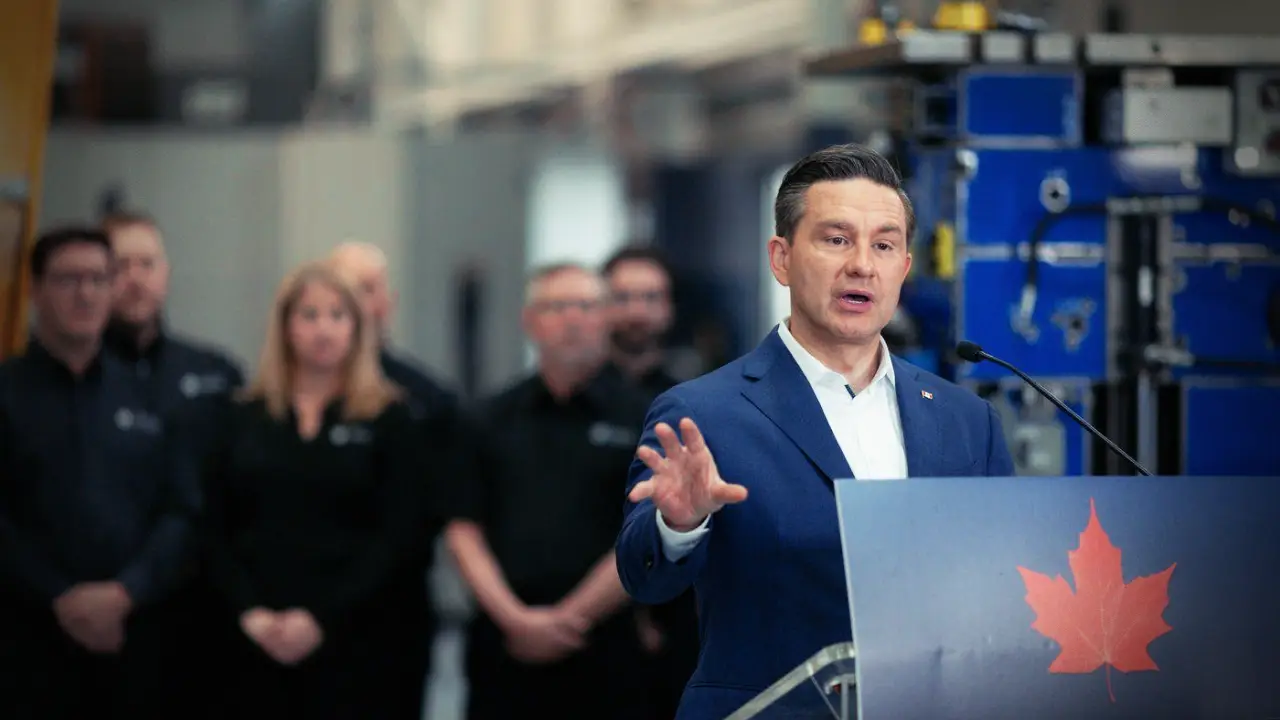
This weekend, Conservative Leader Pierre Poilievre arrived in Windsor to offer a direct, aggressive countermeasure to the current government's surrender. After spending time meeting with automotive executives in Detroit, Poilievre crossed back over the border to pitch what is rapidly becoming known as the Windsor Manifesto. It is a comprehensive, hard-nosed industrial policy designed not just to stop the bleeding, but to actively force manufacturing back onto Canadian soil using the only language multinational corporations actually respect: market leverage.
The Dollar-for-Dollar Ultimatum
The centerpiece of Poilievre’s proposal is a brutal, effective piece of economic mechanics. He is pitching a strict, dollar-for-dollar production-to-sales matching rule, modeled directly on the historic 1965 Auto Pact. The premise is entirely straightforward, stripping away the bureaucratic double-speak that usually accompanies federal trade announcements drafted by the laptop class. If a major automaker wants the privilege of selling their vehicles to Canadian consumers without facing massive, prohibitive duties, they must build vehicles on Canadian soil.
This is not a polite request for corporate investment, nor is it a massive taxpayer handout. It is an ultimatum. For every vehicle a manufacturer produces within the borders of this country, they earn the right to sell one vehicle here, duty-free, from a North American trade partner. It mathematically links the right to profit from the Canadian consumer base directly to the obligation of employing the Canadian working class.
Under the Carney administration, the federal government has completely abandoned this kind of leverage. Canada currently produces roughly zero-point-six vehicles for every one it buys, a pathetic ratio that essentially turns the nation into a consumer colony for foreign factories. Mexico, by contrast, produces two-and-a-half vehicles for every one it consumes. The Windsor Manifesto is designed to violently correct that imbalance, setting a hard target of doubling domestic production to two million vehicles over the next decade. It is a mandate for domestic industrial output, completely rejecting the current government's preference for managing a steady decline from the comfort of a seminar room.
The Beijing Bait-and-Switch
To fully grasp why Poilievre’s protectionist pivot is gaining such massive traction on the factory floors, one must look at the devastating betrayal executed by the Prime Minister this past January. While the American government was actively hardening its borders against dumped, heavily subsidized foreign products, Mark Carney was shaking hands with President Xi Jinping in the Great Hall of the People.
Carney signed an agreement that intentionally opens the Canadian market to an annual quota of forty-nine thousand Chinese-manufactured electric vehicles, slaps them with a negligible six-point-one percent tariff, and invites state-backed foreign conglomerates to completely undercut domestic production. When the Prime Minister attempted to sell this disastrous deal to the public, his press secretaries relentlessly framed it as a victory for the working class. They promised that these imported vehicles would serve as affordable, thirty-five-thousand-dollar options for families struggling under the weight of inflation.
That promise was entirely hollow. When the final regulations for the Chinese import quota were quietly published in the Canada Gazette on March 11, the fine print revealed a staggering deception. There are absolutely zero affordability requirements mandated for the first quota year. The foreign automakers face no pricing constraints whatsoever as they establish their beachhead. The federal government essentially handed over a massive slice of domestic market share to a foreign adversary without securing a single, tangible benefit for the Canadian consumer. It is a masterclass in bureaucratic deceit, negotiated by officials who will never have to face the devastating reality of a plant closure in their own communities.
The Spy on the Dashboard
The economic implications of Carney’s overseas pivot are disastrous, but the Windsor Manifesto also addresses a severe, glaring national security threat that the current government completely ignores. Modern vehicles are no longer just engines attached to a chassis; they are highly sophisticated, rolling supercomputers. They are equipped with advanced telemetry, persistent internet connections, and dozens of cameras that map infrastructure, track movements, and harvest immense amounts of personal data.
By intentionally opening the domestic market to tens of thousands of vehicles manufactured by companies legally beholden to the Chinese state apparatus, the Carney administration is essentially importing an armada of foreign surveillance devices. These vehicles map the roads around military bases, track the daily routines of citizens, and feed that data directly back to servers controlled by a hostile foreign power.
Poilievre’s plan attacks this vulnerability directly. The Conservative leader is pledging to implement a harmonized North American cybersecurity and data standard that explicitly and permanently bans vehicles using Chinese or Russian-connected software from operating on Canadian roads. This is not just a matter of protecting consumer privacy; it is a vital strategic maneuver. Washington will never agree to lift the twenty-five percent tariff and restore seamless automotive trade if they believe Canada is serving as a Trojan Horse for foreign espionage. Aligning our cybersecurity standards with the United States is the absolute prerequisite for restoring the continental supply chain.
Subsidizing the Adversary: The Two-Billion-Dollar Grift
Perhaps the most absurd element of the current administration's industrial policy is the taxpayer-funded incentive scheme that replaced the scrapped electric vehicle sales targets. Just last month, Carney formally capitulated on his highly unpopular federal EV mandate, abandoning the hard adoption targets that were mathematically impossible to meet. However, to appease the NGO circuit and environmental lobbyists, he immediately replaced the mandate with a massive, two-point-three-billion-dollar consumer rebate program.
This program offers up to five thousand dollars to individuals purchasing an electric vehicle. But because Carney simultaneously opened the floodgates to Chinese imports, this rebate program is now perfectly positioned to act as a taxpayer-funded welfare scheme for foreign automakers.
Consider the sheer economic lunacy of this arrangement. The federal government is aggressively taxing the paychecks of the Canadian tradespeople who build internal combustion engines in Ontario, and using those exact tax dollars to subsidize an affluent urbanite purchasing a heavily subsidized BYD rolling off a cargo ship in Vancouver. It is a direct wealth transfer from the domestic working class to the Chinese state, facilitated by the laptop class in the nation's capital.
Poilievre is promising a complete demolition of this regulatory and financial overreach. He is pledging to axe the EV subsidies entirely, rightfully calling them a handout to foreign manufacturers that kills Canadian jobs. Instead of taking money out of the pockets of workers to fund overseas corporations, Poilievre is proposing a massive, immediate tax break for the domestic working class: the total removal of the federal GST on all Canadian-made vehicles.
This policy shift achieves two critical objectives simultaneously. It provides massive, tangible financial relief to consumers struggling with the cost of living, and it redirects domestic purchasing power directly toward the products rolling off domestic assembly lines. It is a system that rewards domestic production rather than subsidizing foreign imports. It is an acknowledgment that the government should not be forcing a fundamentally flawed, infrastructure-dependent technology down the throats of people whose livelihoods depend on heavy industry and internal combustion.
The Arteries of the Engine
When the policy advisors in the capital discuss the automotive sector, they view it entirely through the lens of the final assembly plants. They remain completely blind to the sprawling, incredibly complex supply chain that actually keeps the national economy functioning. The auto sector is not just the massive Stellantis or General Motors facilities; it is the thousands of independent tool-and-die shops, the plastics molders, the steel stampers, and the logistics operators scattered across the country.
Take a drive through the industrial parks of southwestern Ontario or the manufacturing hubs of Quebec. These peripheral businesses operate on razor-thin margins. They do not build the entire car, but they manufacture the essential components that make the car possible. When Mark Carney alienates Washington and the twenty-five percent tariff slams the border shut, these independent operators are the first to bleed.
The independent truckers who haul axles and transmissions across the Ambassador Bridge are currently sleeping in their cabs, waiting for freight that is no longer moving. If the Americans permanently harden the border because they refuse to accept Canadian vehicles built with dumped foreign parts, the trucking routes dry up completely. The local machine shops are forced to lay off their highly skilled machinists. The ripple effect guts the hardware stores, the local diners, and the municipal tax bases of dozens of communities. The Windsor Manifesto recognizes that protecting the final assembly line is the only way to protect the thousands of small businesses that form the arteries of the industrial engine.
The Continental Ultimatum
The Canadian automotive sector is standing at a cliff edge, staring down a very steep, very permanent drop into irrelevance. The current administration has made its priorities perfectly clear. They are perfectly willing to sacrifice the North American manufacturing base in order to pursue a green energy fantasy subsidized by the Chinese state. They have written off the domestic working class as an acceptable casualty in their quest for global climate accolades.
The Windsor Manifesto offers a stark, aggressively pragmatic alternative. It is an admission that Canada cannot survive as a weak, unaligned middleman in a world dominated by industrial giants. The nation must choose a side. By aligning our data security standards with Washington, reviving the proven mechanics of the 1965 Auto Pact, and replacing government subsidies for foreign imports with strict production requirements, Poilievre is demanding that the country carry its own weight.
The tradespeople walking out of the gates in Brampton, Oshawa, and Windsor do not want government retraining vouchers, and they certainly do not want to be managed into obsolescence by politicians who view manual labor as a relic of the past. They want the leverage to build the best vehicles in the world, and they want a government willing to fight the trade wars necessary to let them do it. The Windsor Manifesto is a declaration that the era of managed decline is over, and the era of the production mandate has begun.