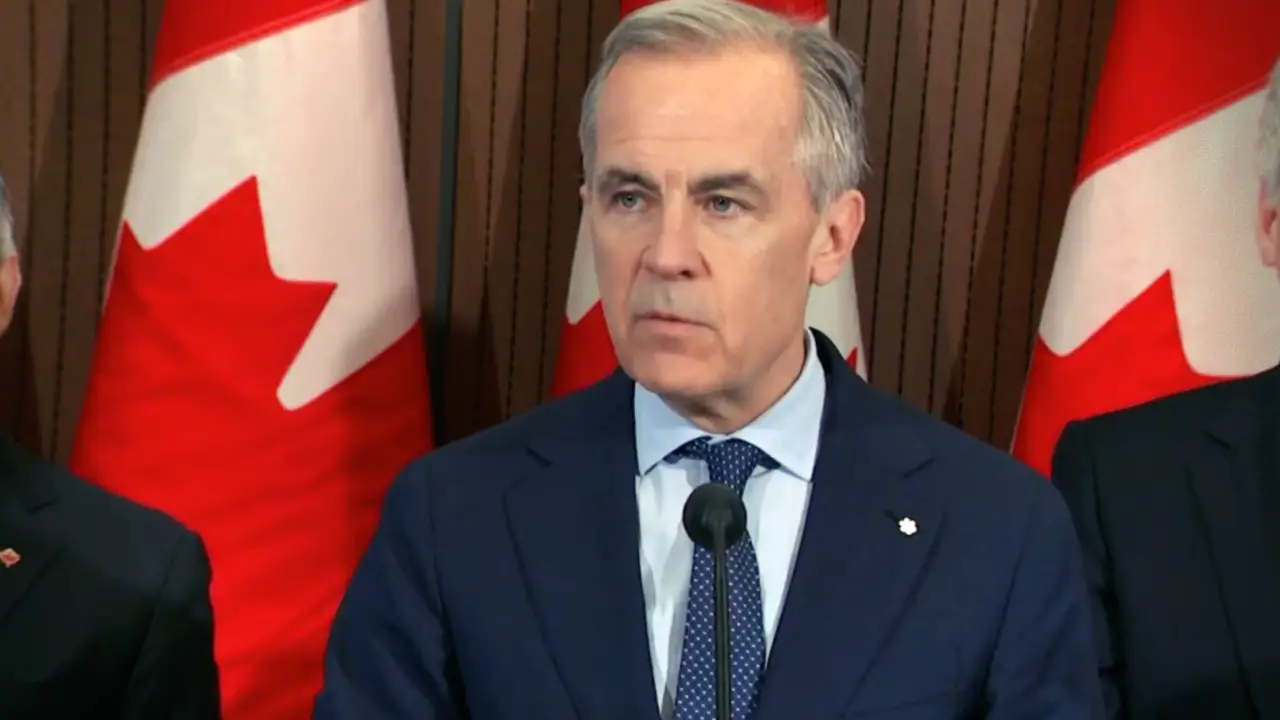
Mark Carney went to bed last weekend leading a minority government that had to justify its existence to the House of Commons, and he woke up on Tuesday commanding a parliamentary majority that answers to no one. He did not achieve this by presenting a vision to the nation. He did not achieve this by dissolving Parliament, looking the Canadian public in the eye, and asking for their trust at the ballot box. He achieved it through backroom deals, political defection, and the cynical manipulation of electoral statutes.
We have just witnessed the hostile takeover of the Canadian Parliament. Through the absorption of five floor-crossing opposition MPs—four former Conservatives and one New Democrat—and a sweep of three carefully orchestrated by-elections in Scarborough Southwest, University–Rosedale, and Terrebonne on Monday, the Prime Minister has secured 174 seats. He has effectively rewritten the results of the 2025 election without the inconvenience of asking the electorate for permission.
The Manufactured Mandate
The government's defense of this maneuver is as predictable as it is arrogant. Appearing on CTV’s Question Period this past Sunday, Government House Leader Steven MacKinnon openly stated the party had “a light on and a door open” for defectors. MacKinnon insisted that consolidating power is exactly what the country needs, arguing that protecting Canada against Donald Trump’s "America First" trade posture requires an ironclad, unified front. The government’s formal position is that absorbing willing opposition members while winning isolated by-elections provides the stability required to secure international investment, freeing the executive from the exhausting daily barter of a minority parliament. As MacKinnon framed it, this isn't a subversion of the electorate; it is a unifying government building a mandate to protect the national interest.
Efficiency is a generous word for a backroom heist that bypasses the ballot box. It is the language of a corporate boardroom applied to a democratic legislature.
When a voter casts a ballot, they are entering into a moral and political contract. For a working-class family in a contested riding, that vote is often the only real leverage they possess against a federal apparatus that taxes their income, regulates their industry, and dictates their energy costs. They are trusting that the name on the ballot and the party banner beside it represent a fixed set of principles. When four Conservatives and one New Democrat decided to cross the floor to sit on the government benches, they tore up that contract. In the private sector, taking a job based on one set of promises and immediately defecting to work for the direct competitor is treated as corporate espionage or fraud. It results in a lawsuit. In Ottawa, it earns you a committee chair, enhanced office budgets, a guaranteed pension, and a pat on the back from the Prime Minister.
As Sean Speer argued in his Tuesday podcast for The Hub, this newly engineered majority completely frees Carney from opposition leverage. He no longer has to negotiate with the Bloc Québécois or placate the Green Party to pass a budget. He has absolute control over the legislative agenda. But as Conservative Leader Pierre Poilievre correctly pointed out on social media Monday night and continued to argue in the House of Commons on Tuesday following his double-digit byelection defeats, a parliamentary majority built through defections and strategically timed by-elections is not a democratic mandate. Poilievre has vowed continued resistance, but the cold reality is that the mathematical constraints that previously kept this government in check have been erased. The House of Commons has been reduced from a chamber of accountability to a rubber stamp for the Prime Minister's Office.
The Statutory Shell Game
We have laws in this country designed to dictate how power is legitimately acquired, but they are only as strong as the integrity of the people wielding them. Under Section 56.1 of the Canada Elections Act, we have a fixed-date election framework. The fundamental spirit of that provision is that a government serves its term, faces the general electorate, and accepts the collective judgment of the nation. Mark Carney looked at that statutory framework, looked at his own vulnerability in a minority parliament, and decided the Canadian people were too unpredictable to be trusted with a general election.
Instead, he turned to Section 57(1.1) of the Canada Elections Act, which explicitly states that "The Governor in Council shall make an order in order for a by-election to be held." This provision was designed as a necessary administrative tool to ensure democratic representation when a single seat becomes vacant. Carney weaponized it. He used the unfettered discretion of the Governor in Council—which is simply the Prime Minister and his cabinet—to time three specific by-elections to his maximum political advantage, dropping the writ only when his backroom deals with the five defecting MPs were fully secured. He stacked the deck, played his hand, and declared himself the undeniable choice of the nation. This is not statesmanship. It is political engineering of the most cynical variety.
There is no mechanism in the Parliament of Canada Act to trigger an automatic by-election when a Member of Parliament betrays their party banner. The voters in the five ridings whose MPs defected are now literal hostages to their representatives' career ambitions. They voted for the opposition because they wanted the government held to account. They are now represented by the government they explicitly voted against. They have no statutory recourse, no recall mechanism, and no voice until the Prime Minister decides he is ready to face them in a general election of his own choosing. This is a fundamental failure of our democratic architecture, exposed by a Prime Minister willing to exploit every loophole to maintain his grip on power.
The Illusion of Protection
The hypocrisy of this government is staggering when you place Monday's power grab next to their own legislative priorities. Just weeks ago, on March 26, Government House Leader Steven MacKinnon introduced Bill C-25, the Strong and Free Elections Act, with immense self-congratulation. This sprawling package of amendments to the Canada Elections Act is supposedly designed to protect our democratic institutions from evolving threats and foreign interference.
Among the core provisions of the Strong and Free Elections Act is a dramatic expansion of enforcement powers, specifically increasing the maximum Administrative Monetary Penalties under the Canada Elections Act from $1,500 to a crippling $25,000 for individuals who spread false or misleading information about the electoral process.
Read that again and consider the reality of what it means. The government is demanding the statutory authority to fine a working-class Canadian citizen $25,000—more than a third of the median household income, enough to bankrupt a family—for publishing a misleading tweet about an election. They claim this heavy-handed penalty is an absolute necessity to "protect our democracy."
Meanwhile, the Prime Minister engineers a parliamentary majority by encouraging sitting elected officials to outright lie to their constituents about the principles they represent, and faces zero consequences. They will ruin a citizen for a digital falsehood, but they will hand the keys to the treasury to an MP who commits the ultimate democratic betrayal. It is a dual system of political morality where the rules only apply to the governed, never to the governors. A citizen who makes a mistake on social media faces financial ruin; a politician who betrays their voters gets a promotion.
The Future of the Franchise
What does this mean for the future of Canadian politics? It establishes a toxic precedent. Mark Carney has drawn a roadmap for every future Prime Minister who finds themselves hamstrung by a minority parliament. He has proven that you do not need to win the argument in the public square. You do not need to build a national consensus. You simply need to exploit the timing provisions of the Canada Elections Act, find a handful of opposition politicians whose loyalty has a price tag, and bypass the general electorate entirely.
Who benefits from this sleight of hand? Mark Carney, his cabinet, and a class of opportunistic political operators who traded their integrity for a guaranteed seat on the government benches.
Who pays? The Canadian taxpayers, who will now foot the bill for an unimpeded Liberal economic agenda that no longer requires even the pretense of parliamentary compromise or fiscal restraint. When the government no longer fears a non-confidence vote, the first casualty is respect for public money. We can expect an acceleration of deficit spending, sweeping new regulatory frameworks, and a doubling down on the aggressive climate policies that have already punished resource communities, all pushed through without a single meaningful amendment.
And who wasn't asked? The working and middle-class voters in the hundreds of ridings across this country who went to bed with a minority parliament holding the executive to account, and woke up to an unearned majority ruling over them. They were sidelined by a Prime Minister who decided democracy was simply too risky to be left to the voters.
The Hammer will be watching.