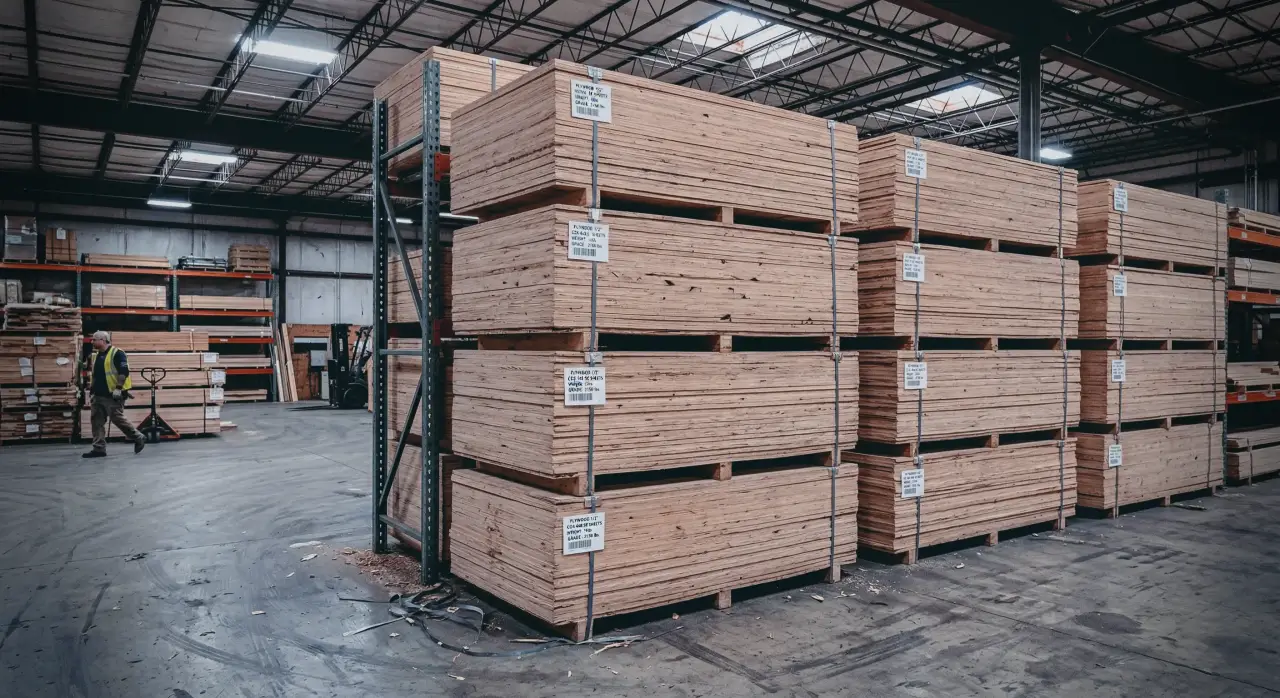
On April 10, 2026, the Canada Border Services Agency (CBSA) issued a Notice of Initiation of Investigations regarding the alleged injurious dumping and subsidizing of decorative and other non-structural plywood originating in or exported from the People’s Republic of China. This administrative action was prompted by a formal complaint from Columbia Forest Products and the Canadian Hardwood Plywood and Veneer Association. Three days later, on April 13, the Canadian International Trade Tribunal (CITT) initiated its parallel preliminary injury inquiry.
This is not a novel regulatory action. The CBSA conducted an extensive investigation into the exact same category of Chinese plywood in 2020. While the CBSA reached final determinations of dumping and subsidizing in January 2021, the CITT issued a formal finding of "no injury" on February 19, 2021. Consequently, no anti-dumping or countervailing duties were finalized, and all provisional duties collected during the investigation period were refunded. The fact that domestic producers are compelled to trigger a secondary investigation five years later into identical trade practices demonstrates the functional limitations of Canada’s trade architecture.
The Statutory Burden of Proof
The Special Import Measures Act (SIMA) governs Canada’s response to unfair trade practices. The framework is structurally reactive. It does not permit the state to proactively monitor and penalize subsidized foreign imports upon entry based on known global market distortions. Instead, the statutory design places the evidentiary and financial burden of activating the state's defence mechanisms entirely on the domestic industry.
Under Section 31(1) of SIMA, the CBSA cannot initiate an investigation unless a domestic industry files a properly documented complaint. The legal threshold for standing is severe. The complaint must be supported by domestic producers representing more than fifty percent of the total production of those expressing an opinion, and at least twenty-five percent of total domestic production. This requirement creates an immediate collective action problem. In fragmented manufacturing sectors, coordinating a unified legal front requires immense capital expenditure and precise data aggregation across competitors.
Firms must absorb measurable, empirical financial damage—quantified through lost sales, price depression, and underutilization of production capacity—before the CBSA will recognize the complaint. The state effectively requires the domestic industry to finance its own regulatory defence against foreign state-subsidized competitors by hiring trade economists and specialized legal counsel just to meet the initiation threshold.
Once the CBSA initiates the investigation, the temporal lag structurally advantages the dumping entity. Section 38(1) of SIMA grants the CBSA up to 90 days to issue a preliminary determination of dumping. During this administrative window, foreign exporters operate without restriction, often accelerating shipments to clear inventory into the Canadian market before provisional duties take effect.
The mechanism shifts the financial risk entirely onto the domestic producer. The foreign state-backed enterprise absorbs the eventual tariff as a deferred cost of acquiring market share, while the Canadian firm bleeds private capital to fund the legal process necessary to secure temporary tariff relief.
The Government Rationale
The government defends the reactive structure of the SIMA framework as a necessary safeguard against the inflationary shock of preemptive protectionism. The rationale asserts that while foreign market distortions are real, trade remedies must remain strictly empirical and compliant with World Trade Organization (WTO) disciplines to avoid escalating retaliatory trade wars.
Prime Minister Mark Carney articulated this exact balance during his January 20, 2026, address to the World Economic Forum in Davos. While acknowledging that state actors are increasingly using "supply chains as vulnerabilities to be exploited," the Prime Minister explicitly warned against the reflexive imposition of sweeping trade barriers, declaring that "a world of fortresses will be poorer, more fragile and less sustainable." Furthermore, on April 3, 2026, Minister of Finance François-Philippe Champagne concluded a trade mission to Beijing aimed at diversifying partnerships to build a more resilient Canadian economy.
Within this governing philosophy, the statutory delays and rigorous evidentiary thresholds embedded within SIMA are not administrative defects; they are deliberate shock absorbers. They force the domestic industry to empirically prove material injury before the state acts, ensuring that tariffs are only applied as a last resort. The government argues this prevents arbitrary executive interference that would disrupt global supply chains, penalize downstream manufacturing sectors reliant on low-cost imported inputs, and inflate consumer costs.
The Attrition of Domestic Capital
The government’s rationale relies on a fundamental miscategorization of the market participants. It treats the foreign exporter and the domestic producer as equivalent commercial entities operating under identical capital constraints. They are not.
Chinese manufacturing of non-structural plywood is heavily subsidized by the state apparatus, insulating producers from standard market pressures regarding profitability and capital retention. Their objective is volume displacement and long-term market dominance, not immediate margin optimization. Conversely, Canadian firms operate on private capital, which is highly sensitive to margin compression and jurisdictional risk.
Writing for the C.D. Howe Institute, trade lawyer Lawrence Herman outlines the disparity in this enforcement model. He notes that building a case for trade remedy action requires domestic firms to compile vast amounts of supporting evidence and spend immense sums on specialized legal and economic expertise to convince Canadian agencies that relief is warranted. While the laws are highly effective when applied, the structural cost of accessing that success is staggering.
The 2020–2021 plywood investigation perfectly illustrates this capital drain. The domestic industry successfully funded the complex litigation required to prove to the CBSA that Chinese state-backed entities were dumping subsidized products. Yet, because the statutory framework requires a separate, stringent finding of material injury by the CITT, the industry ultimately secured zero tariff protection in February 2021. They bled private capital to enforce the state's trade laws, only to have the provisional duties refunded to the foreign exporters.
When the statutory framework requires a domestic industry to repeatedly self-fund complex litigation against foreign state enterprises with the high probability of securing no lasting relief, private capital calculates the jurisdictional risk. Investors structurally avoid jurisdictions where the state outsources the enforcement of fair trade to the injured party. The recurring necessity to litigate under SIMA disincentivizes long-term domestic capital expenditure in manufacturing capacity, automation, and workforce expansion. The capital simply migrates to jurisdictions with proactive tariff enforcement or abandons the sector entirely, leading to hollowed-out domestic capacity.
The Statutory Injury Threshold
The administrative resolution of the 2021 SIMA investigation exposes the structural vulnerability embedded in Canada's dual-phase trade defence process. The CBSA determines if dumping is occurring; the CITT determines if that dumping is causing material injury. This separation treats foreign state dumping not as an inherent violation of market integrity, but as a permissible activity until it causes catastrophic, measurable financial damage to domestic firms.
Because the CITT found no material injury or threat of injury in February 2021, no specific "normal values" or ongoing duty constraints were placed on Chinese exporters. The domestic industry's victory at the CBSA phase was functionally erased. The statutory framework essentially signals to foreign state enterprises that they can dump subsidized goods into the Canadian market with impunity, provided they carefully calibrate their pricing and volume to stay just below the CITT’s stringent threshold for material injury.
The domestic industry is then forced to wait until the financial damage is severe enough to pass the Tribunal's test, at which point they must file another complaint under Section 31(1) and restart the entire costly cycle. The April 2026 investigation is the direct administrative result of this vulnerability. The framework guarantees a perpetual cycle of retroactive litigation, constantly attempting to enforce trade disciplines under a system that demands domestic firms suffer near-fatal financial harm before the state will intervene.
The Directional Risk of Executive Discretion
The structural fragility of the SIMA framework extends beyond the stringent injury threshold of the CITT. Even if domestic producers successfully navigate both the CBSA dumping determination and the CITT injury finding, the legislation contains discretionary mechanisms that allow the executive branch to nullify the mathematical enforcement of dumping penalties, exposing domestic producers to immense political risk.
If the CBSA makes a final determination of dumping, and the CITT issues a finding of material injury, duties are theoretically finalized. However, Section 45(1) of SIMA permits the Tribunal, either on its own initiative or upon request from an interested party, to initiate a "public interest inquiry." This statutory provision allows the Tribunal to evaluate whether the imposition of the full anti-dumping or countervailing duty would not be in the public interest. If the Tribunal reaches this conclusion, it issues a report to the Minister of Finance recommending a reduction or elimination of the duty level.
This mechanism structurally pits domestic industries against one another. Downstream industries—such as furniture manufacturers or residential developers utilizing non-structural plywood—can petition the CITT, arguing that the duties artificially inflate their input costs and harm broader economic productivity.
The directional risk of this discretion is acute. It places the ultimate enforcement of trade discipline directly in the hands of the current government. The Carney administration has explicitly prioritized the reduction of consumer inflation through supply chain optimization, and the Prime Minister has publicly stated his aversion to tariff fortresses. The Section 45(1) mechanism provides the executive with the legal authority to subordinate domestic manufacturing protection to these broader macroeconomic or geopolitical objectives.
If the Minister of Finance accepts a public interest recommendation to reduce or waive a tariff, the entire capital expenditure undertaken by the domestic industry to prove both dumping and injury under Section 31(1) is functionally voided. The statute contains no structural floor preventing the executive from diluting the penalty to a nominal level.
This discretionary power signals to foreign state enterprises that dumping penalties in Canada are not rigid mathematical certainties, but variables subject to political negotiation. It encourages continuous dumping by establishing the possibility that aggressive geopolitical lobbying, combined with domestic downstream pressure, can successfully circumvent the SIMA enforcement mechanism.
The initiation of the April 2026 plywood investigation is not an indicator of a robust trade defence strategy. It is the administrative documentation of a system operating exactly as structurally designed. The framework guarantees that the domestic industry absorbs the initial financial damage, funds the state's investigative apparatus, and remains permanently vulnerable to executive nullification. A regulatory environment that requires cyclical, reactive litigation to maintain baseline market integrity structurally ensures the long-term attrition of domestic manufacturing.