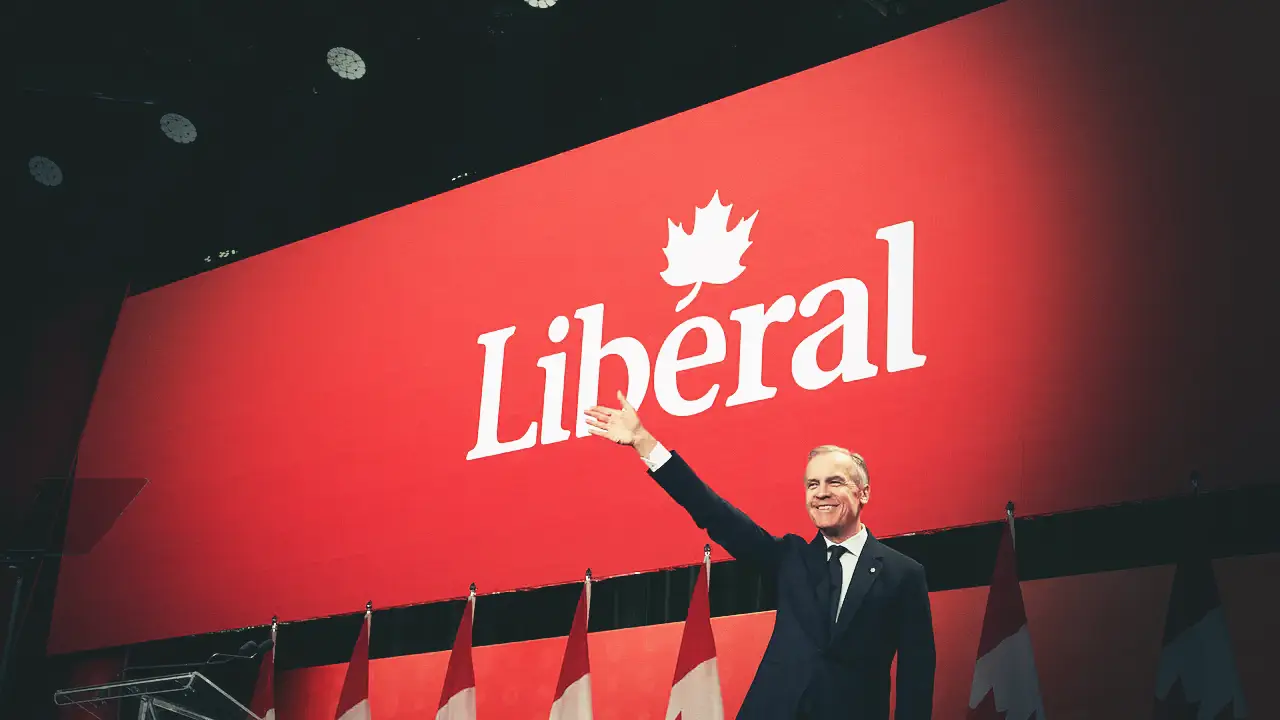
They dimmed the lights in downtown Montreal this weekend so the Prime Minister could sell a feeling. Mark Carney stood before the party faithful at the Liberal National Convention and delivered what his office branded a "unity" call. The message was simple: the international order is crumbling, the Americans are squeezing us, and the only thing standing between the Canadian middle class and economic ruin is a Liberal majority.
He promised an end to "petty differences." He introduced a new slogan, "Build Canada Strong." And with three federal by-elections arriving this Monday—including a fiercely contested race in the Quebec riding of Terrebonne—Carney made it clear that giving him a majority government is not just a political choice, but a patriotic duty.
It is a masterful piece of political theatre. But theatre does not pay the grocery bill. Theatre does not keep the blast furnaces running in Sault Ste. Marie. When the Prime Minister demands unity in the face of adversity, ordinary Canadians must look past the podium and ask what, exactly, they are being unified to support. Because behind the soaring rhetoric of national resilience lies a stark reality: a government willing to rewrite the rules of political accountability to insulate itself from the consequences of its own economic mismanagement.
The Price of "Canada Strong"
To understand the Prime Minister’s maneuver, we must first examine his justification. The government argues that its "Build Canada Strong" mandate and the associated "Buy Canadian" procurement policies are necessary, defensive measures against unpredictable U.S. tariffs imposed by the second Trump administration. By repatriating military and infrastructure spending, the Prime Minister insists his government is insulating the Canadian middle class from foreign economic coercion. He argues that maintaining strict retaliatory measures preserves Canadian sovereignty and ensures that taxpayer dollars remain within our borders during a time of global instability. At the convention, Carney declared to a standing ovation:
"The days of Canada's military sending 70 cents of every dollar to the United States are over."
It is a potent, nationalist argument. It is also a fiscal illusion paid for by the working class.
When the federal cabinet exercises its authority under Section 53 of the Customs Tariff to impose retaliatory surtaxes on imported goods by Order in Council, it does not punish Washington. It taxes you. Those surtaxes are baked into the cost of construction materials, consumer goods, and industrial components. The government calls it "standing up for Canada." The single mother in Halifax calls it a grocery bill she can no longer afford.
The evidence is already in. According to a comprehensive economic review published this week by RBC Economics assessing one year of these tariff shocks, consumer confidence plunged in the spring of 2025. And while the Prime Minister boasts about saving military procurement dollars, the retaliatory trade environment has devastated our exporters. RBC notes that the subset of Canadian products hit by U.S. tariffs have suffered severely, with exports of Canadian steel products plummeting by a staggering 30 percent.
That is not an abstract macroeconomic statistic. That is 30 percent fewer shifts for steelworkers. That is overtime canceled. That is a community economic engine stalling out while the Prime Minister takes a victory lap in a Montreal convention centre. The government’s "insulation" protects the political class in Ottawa, while the actual cost is downloaded onto the very workers Carney claims to be shielding.
The Floor-Crossing Shell Game
This brings us to Monday’s by-elections. Currently, the Liberal government sits at 171 seats in the House of Commons. The magic number for a majority is 172. If Tatiana Auguste, the Liberal candidate in Terrebonne, or either of the other two candidates pull through, the Prime Minister will secure the absolute control he craves.
David Coletto, founder of the polling and market research firm Abacus Data, laid out the stakes plainly this week:
"For a minority government, every piece of legislation is a negotiation. You need opposition support, which means compromise and delay. With a majority, the government passes what it wants on its own timeline."
The Prime Minister does not want to negotiate. He does not want to compromise. He wants total authority, and he has utilized every lever of the state to engineer it. Consider the deployment of the Canada Elections Act. Under Section 57(1.2)(c), the legislation grants the Governor in Council—effectively, the Prime Minister and his Cabinet—the statutory authority to fix the polling date for a by-election anywhere between 36 and 50 days after the Chief Electoral Officer issues the writ. The government did not choose this Monday by accident. They chose it because it aligns perfectly with the post-convention media bump, maximizing their structural advantage.
But the most glaring example of this government’s disregard for working-class voters is how they arrived at 171 seats in the first place. Over the past five months, the Liberal government has welcomed five floor-crossing Members of Parliament. Four of these individuals were elected as Conservatives; one was elected as a New Democrat.
At the convention, Carney paraded four of these MPs across the stage, framing their defection as proof that the Liberal tent is expanding. Among them was Marilyn Gladu, the MP for Sarnia—a region heavily dependent on the energy and manufacturing sectors that are currently being battered by the government's trade war. Gladu, who was elected by her constituents to hold this government to account, stood before the press on Thursday and pledged:
"I will vote with the government."
When an MP abandons the mandate given to them by their voters to join the ruling party, it fundamentally subverts the democratic contract. The people of Sarnia did not vote for a Liberal. They did not vote for Carney’s retaliatory trade war. They voted for an opposition member. Yet, through backroom deals and the allure of government perks, the Prime Minister has effectively acquired their parliamentary voice without ever having to face them at the ballot box.
The Parliament of Canada Act contains strict procedures for notifying the Speaker when a seat becomes vacant, triggering the by-election process. But it contains no mechanism to trigger a by-election when an MP completely abandons the platform they were elected on. The Prime Minister is perfectly happy to exploit this legislative silence. He speaks of unity, but his actions demonstrate a profound contempt for the agency of the Canadian voter. He is assembling a majority government out of spare parts and broken promises.
The Working Class Pays the Bill
As Canadians head to the polls in Terrebonne and two other ridings on Monday, the stakes extend far beyond the math of the House of Commons. A majority government under Mark Carney will not bring stability to the working class. It will bring an entrenched framework of policies that actively harms them.
Without the restraint of a minority parliament, there will be no check on the government’s taxation-by-tariff scheme. There will be no committee investigations into how the "Buy Canadian" military procurement contracts are being awarded, or who is profiting from the mandated domestic premiums. There will only be the unchecked imposition of the Prime Minister’s vision—a vision where the economy is managed from the top down, where dissenting voices are absorbed or marginalized, and where the ordinary Canadian is left to absorb the cost of Ottawa's ideological posturing.
The Prime Minister concluded his convention address by claiming that a united Canada is one that "no one can ever take away." But what he is really asking for on Monday is the power to take away the opposition’s ability to stop him. He wants the unchecked authority to dictate the economic future of this country, without the inconvenient requirement of parliamentary consensus.
The working men and women of this country are already paying the price for his policies at the checkout counter, the gas pump, and the factory floor. If he secures his majority on Monday, the bill is only going to get larger.
The Hammer will be watching.