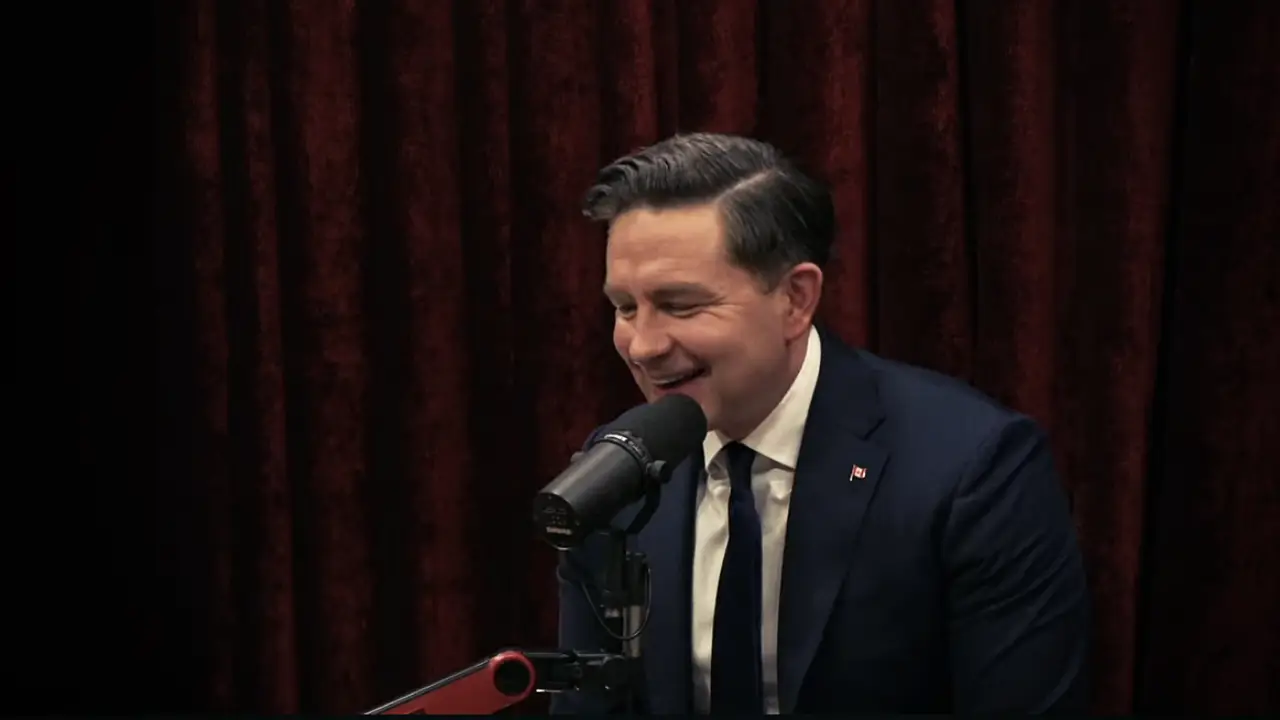
The physical geography of Austin, Texas, currently operating as the undisputed nerve center for alternative media syndication, served as the launchpad for a profound disruption in North American political communication. When Conservative Leader Pierre Poilievre committed to a marathon two-and-a-half-hour session on the Joe Rogan Experience, the initial dialogue camouflaged its true intent behind accessible discussions regarding martial arts conditioning, physical endurance, and domestic dietary staples. However, observing the broadcast through an investigative lens reveals a highly orchestrated maneuver engineered to project Canadian political objectives directly into the American electorate. By circumventing the legacy networks of international diplomacy and the established parliamentary press gallery, Poilievre opted to transmit his message to an audience commanding tens of millions of active listeners. This deliberate bypass acknowledges a stark reality of the modern era: digital podcasting empires now wield a magnitude of reach and institutional trust that traditional broadcasting conglomerates are failing to sustain.
This calculated deployment materializes during a period of extreme volatility in cross-border relations. The United States executive branch, actively steering a return to aggressive protectionist trade doctrines under Donald Trump, has repeatedly weaponized the threat of universal tariffs against Canadian exports. Compounding this economic anxiety are the provocative, albeit informal, suggestions regarding the integration of Canada as a fifty-first state—a narrative that injects severe instability into the continental partnership. Confronted with this precarious diplomatic climate, Poilievre utilized the vast reach of the Rogan platform to categorically dismantle the annexation rhetoric, dismissing the concept as a "crazy thing to say" while forcefully reaffirming the inviolability of Canadian sovereignty. By litigating these escalating tensions on a medium celebrated for its vast and ideologically diverse demographic, the Conservative leader is maneuvering to shape American public perception directly from the ground up, bypassing conventional ambassadorial corridors that historically fail to resonate with the working-class American electorate.
The fundamental pillar of his argument rested on the indispensable nature of Canadian energy assets, specifically the oilsands and critical mineral sectors. Diverging from the traditional framing of resource extraction as a purely domestic economic driver, Poilievre elevated the industry to a matter of supreme continental security. He positioned Canadian heavy crude as the absolute prerequisite for American energy independence and a vital shield against reliance on hostile overseas energy cartels. By characterizing the oilsands apparatus as the most rigorously regulated and ethically managed extraction environment on earth, he confronted the environmental skepticism routinely amplified by critics, including passing concerns raised by Rogan himself. This rhetorical evolution transforms raw Canadian resources into a formidable geopolitical instrument—a tangible asset engineered to neutralize the looming threat of catastrophic trade barriers.
US Trade and Shadow Diplomacy: A United Front on Trump Tariffs
The most consequential revelation of this media offensive, however, involves the covert bilateral maneuvering occurring far beyond the public eye. In a contemporary political arena defined by relentless partisan warfare and the continuous pursuit of electoral advantage, the prevailing expectation is a refusal to yield ground to the governing party under any circumstance. Yet, Poilievre explicitly articulated a steadfast allegiance to the doctrine of "one prime minister at a time," a historic convention dictating that domestic political hostilities must be suspended when addressing foreign powers. He issued a firm, on-air refusal to criticize Prime Minister Mark Carney while operating on foreign soil, a display of institutional discipline that provides a jarring contrast to the combative theater of the House of Commons.
This articulated restraint is not a hollow rhetorical gesture; it is backed by an active, subterranean channel of cooperation. Poilievre disclosed that he is engaged in ongoing, direct text-message correspondence with Prime Minister Carney concurrently with the hostile United States trade negotiations. This admission pulls back the curtain on a vital layer of shadow diplomacy—a concealed mechanism of governance where bitter political adversaries align to shield the national interest from external economic aggression. This operational dynamic indicates that, despite a mandate to ultimately defeat the current administration, the Leader of the Opposition possesses a clear-eyed recognition of the existential danger posed by indiscriminate American tariffs. A fractured Canadian negotiating posture would inevitably be exploited by a transactional American administration, guaranteeing disastrous economic fallout for domestic industries ranging from automotive manufacturing to provincial agriculture.
By funneling strategic intelligence and atmospheric observations from the populist frontlines back to Carney’s inner circle, Poilievre is effectively operating as an unofficial, high-level envoy. He is leveraging his credibility within alternative media spaces to extract insights and project influence that the formal diplomatic corps is culturally unequipped to manage. This bifurcated strategy—aggressively courting the American populist base on camera while privately reinforcing the Canadian diplomatic shield via encrypted messaging—demands a rigorous moral and strategic calculus. It requires the acknowledgment that the sovereign integrity and economic survival of the populace must absolutely preempt the immediate gratification of partisan point-scoring.
The MAID Controversy: Ethics, Mental Health, and State Power
Moving beyond the theater of macroeconomic trade, the Austin interview penetrated deeply into the moral architecture of the Canadian state, focusing intensely on the ethical crisis surrounding Medical Assistance in Dying. This specific segment of the broadcast illuminated the philosophical boundary lines defining the Conservative approach to human vulnerability and state overreach. Rogan, manifesting visible shock, cited statistics illustrating the rising percentage of Canadian mortalities facilitated by this apparatus, specifically highlighting horrific anecdotes of citizens seeking state-sponsored death to alleviate conditions akin to severe seasonal depression or poverty-induced despair. Poilievre navigated this moral minefield by acknowledging the autonomy of individuals facing imminent, terminal physical agony, before delivering a devastating indictment of the system's mission creep into the realm of mental illness and psychological anguish.
The counter-argument presented was anchored in a profound, unyielding duty of care. Poilievre articulated the stance that a just society bears a sacred obligation to offer treatment, structural rehabilitation, and tangible hope to those enduring profound emotional suffering, rather than presenting clinical termination as a viable, cost-effective administrative solution. He exposed a deeply concerning bureaucratic reality where desperate citizens interacting with social services or veteran support networks have been preemptively offered the termination of their lives by public servants. This forensic critique targets the absolute core of how a nation values its most defenseless populations. It systematically questions the moral legitimacy of an administrative state that appears to prioritize the swift alleviation of its own fiscal and systemic burdens over the demanding, resource-intensive mandate of psychological healing and human preservation.
By stressing the imperative of fostering purpose and dignity in the lives of the marginalized, Poilievre tapped into a rising tide of moral revulsion regarding the creeping commodification of human life. This transcends a standard policy dispute; it represents a foundational conflict over the inherent sanctity of human existence against the cold calculus of state efficiency. He committed to implementing strict legislative barriers to criminalize the unsolicited suggestion of Medical Assistance in Dying by public sector employees, seeking to dismantle the perverse incentives that normalize the ending of life for non-terminal, remediable distress.
Inflation and Economic Scarcity: Fighting the Cost of Living Crisis
In delineating his framework for national economic resurrection, Poilievre dedicated significant broadcast time to dissecting the catastrophic impacts of modern monetary theory and the historical punishment inflicted by unrestrained deficit spending. He engineered a methodical deconstruction of the inflationary crisis defining the 2020s, refusing to attribute the crushing cost of living to unpredictable global supply shocks. Instead, he placed the blame squarely on the deliberate, systemic expansion of the fiat money supply by central authorities. By deploying highly relatable economic analogies—contrasting the finite, physical reality of the housing stock against an artificially inflated currency pool—he successfully translated abstract macroeconomic theory into a visceral reality for the working-class listener. This translation strips away the academic obfuscation relied upon by central banks, defining inflation not as an accidental phenomenon, but as a silent, regressive tax that systematically vaporizes the purchasing power of the working public.
The core legislative remedy introduced during the interview focuses on the resurrection of absolute fiscal discipline within the federal apparatus. Poilievre championed the enactment of rigorous 'Pay-As-You-Go' statutes, a legal mechanism that would constitutionally mandate that any new federal expenditure be entirely funded by an equivalent, simultaneous reduction in spending elsewhere in the bureaucratic machinery. The philosophical intent is to forcibly reacquaint the political class with the inescapable law of economic scarcity—a daily reality endured by every private citizen and independent business owner, yet perpetually ignored by governments armed with a printing press. By confining federal administrators within hard financial parameters, the strategy aims to arrest the unseen taxation of inflation and re-anchor the national currency to a foundation of reality.
This relentless focus on fiscal restraint is inextricably bound to his broader assault on the sprawling administrative state. The permanent bureaucracy is characterized not merely as a hub of inefficiency, but as a hostile entity actively suffocating national prosperity. He documented specific cases where the approval mechanisms for vital industrial infrastructure, notably energy export terminals, are intentionally dragged out over decades, killing capital investment and driving domestic innovation across the border. The pledge to enact sweeping deregulation is presented as a moral imperative to liberate the productive capacity of the citizen.
The Populist Playbook: Courting the Politically Homeless
The overarching tactical objective of this extensive media engagement is the political consolidation of a rapidly expanding demographic accurately defined as the politically homeless. These are the millions of citizens who find themselves entirely alienated from legacy political parties, profoundly distrustful of the homogenization of corporate journalism, and hostile toward the highly engineered cultural mandates imposed by state institutions. By dominating a platform that explicitly rewards unscripted, long-form, and adversarial dialogue, Poilievre is transmitting a clear signal that he is prepared to bypass the sanitized filters of the traditional establishment to reach voters exactly where they reside.
Rogan’s explicit, on-air endorsement—stating unequivocally that he would cast a ballot for the Conservative leader if he possessed Canadian citizenship—operates as a high-yield validator within this decentralized ecosystem. It broadcasts a signal to a massive global audience that Poilievre transcends the archetype of the rehearsed, poll-tested politician, positioning him as an authentic entity capable of diagnosing the systemic frustrations of the working class. This specific outreach is laser-focused on the crushing economic realities facing a younger generation that recognizes traditional milestones of success, such as property ownership, have been structurally blockaded. Poilievre diagnosed this generational disenfranchisement not as a symptom of a shifting market, but as the direct, intended consequence of a bloated regulatory state that inherently protects established wealth while suffocating emerging enterprise.
Bypassing the Press Gallery: The New Architecture of Political Power
As the 2026 electoral horizon comes into sharp focus, the structural consequences of this specific media deployment are impossible to ignore. The legacy boundaries governing how political leaders interact with the public are being aggressively torn down and replaced. The most vital battles for public mandate are no longer constrained to the highly moderated debates of the parliamentary precinct or the predictable interrogations of the Ottawa press corps. Instead, the actual war for the consensus of the electorate is being executed across borderless, digital syndication networks that entirely marginalize the traditional gatekeepers of information.
The execution of this interview reveals a mastery of modern, asymmetric public relations. By weaponizing an American entertainment platform to directly influence continental trade dynamics and pressure the White House, Poilievre is exercising a caliber of geopolitical leverage usually restricted to the executive branch. The concurrent reality of his encrypted, cooperative diplomacy with the Prime Minister highlights an environment where brutal domestic campaigning must run parallel to the non-negotiable demands of national defense.
This maneuver fundamentally shatters the archaic assumptions regarding the role of the Official Opposition in a digitized landscape. It forces a complete reassessment of the mechanisms required to forge a modern governing coalition. By fusing rigorous economic critique, ethical philosophy, and strategic international posturing into a singular, unfiltered broadcast event, Poilievre has laid down a comprehensive blueprint for his eventual assumption of power. The ultimate test remains whether this aggressive circumventing of the media establishment will yield a definitive electoral majority. However, the indisputable reality is that the infrastructure of mass persuasion has been permanently rewired, rendering the political strategies of the previous decade entirely obsolete.