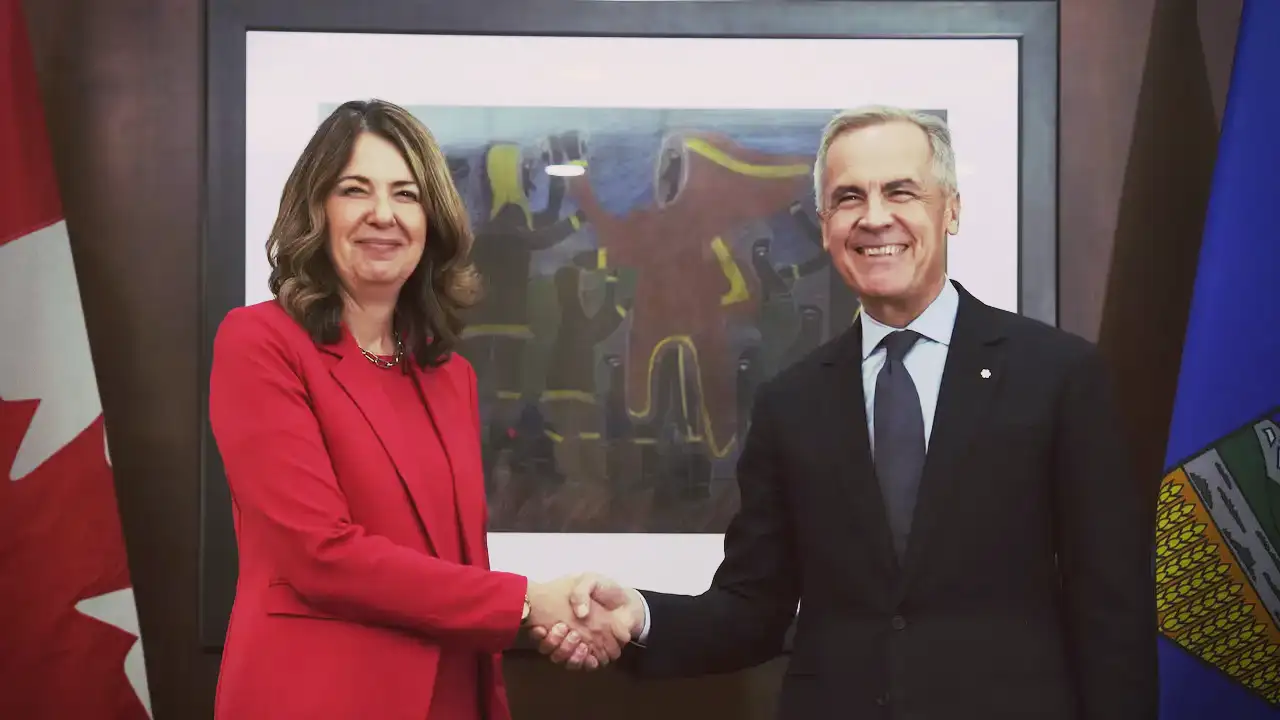
The July 2, 2026, Canada-British Columbia Cooperative Prosperity Agreement commits over $200 billion to a broad framework of regional initiatives, ranging from LNG permitting to childcare. Buried within that massive headline figure, however, is a localized $13 billion infrastructure premium. This premium is the direct fiscal consequence of a federal regulatory barricade. The agreement commits $10 billion in federal funding to the Roberts Bank trade corridor and up to $3 billion for the Fraser River Tunnel replacement. These are not standalone capital improvements; they are taxpayer-funded compliance payments designed to accommodate the geographic inefficiencies mandated by the Oil Tanker Moratorium Act (Bill C-48).
The Statutory Barricade
The government's stated rationale for forcing energy export capacity south rests entirely on the Oil Tanker Moratorium Act. In his June 21, 2019, statement following the bill’s Royal Assent, then-Minister of Transport Marc Garneau declared the legislation necessary to "protect the pristine north coast" and its vulnerable marine ecosystems from the risk of a catastrophic spill. To achieve this objective, Section 4(1) of the Act prohibits vessels carrying more than 12,500 metric tonnes of crude oil or persistent oil from mooring, anchoring, loading, or unloading at any port in northern British Columbia, effectively sealing off the Dixon Entrance, Hecate Strait, and Queen Charlotte Sound.
This statutory cap eliminates the viability of commercial-scale crude export from the northern coast. Modern commercial energy logistics rely on economies of scale that cannot be achieved in shipments capped at 12,500 tonnes. Consequently, the legislation severs Canadian energy exports from their most direct and economically efficient path to Asian markets, mandating a southern reroute. The $13 billion in combined port and transit subsidies is the precise fiscal price of forcing massive export volumes through the complex, congested logistics network of the lower mainland. Every additional kilometre of pipeline forced south, and every additional federal dollar required to upgrade the Metro Vancouver transport grid to handle the throughput, flows directly from the tonnage limit imposed by the federal government.
The Directional Risk of Executive Discretion
The legal constraint forcing this massive public expenditure is entirely discretionary. While the Oil Tanker Moratorium Act is presented as a permanent environmental safeguard, Section 6(1) of the Act grants the Minister of Transport the unilateral authority to exempt any vessel from the ban if the Minister believes it is in the public interest. The legislation mandates a one-time five-year parliamentary review, but it offers no permanent, repeating structural check on the 12,500-tonne threshold. This leaves the executive branch with total, ongoing discretionary power over the moratorium's application.
From a directional risk perspective, this framework is highly vulnerable to rapid reversal. The threshold for judicial review of such a ministerial waiver is minimal, and the legislative structure requires no parliamentary vote to activate an exemption. If a global energy supply disruption or a severe domestic revenue crisis demanded an immediate surge in northern export capacity, the executive could instantly authorize the exact tanker traffic the legislation currently prohibits. The risk here flows entirely in one direction: the government has locked taxpayers into subsidizing a $13 billion alternative logistics corridor while holding the administrative key to open the much cheaper northern route whenever political expediency dictates. Taxpayers are assuming a generational liability simply to route around a locked door that the executive branch can unlock at a moment's notice.
Concentrating the Marine Risk
The core justification for maintaining the moratorium and subsidizing the southern reroute is marine safety. If the objective of the federal government is to protect the coast from an oil spill, the mandated southern reroute must be evaluated objectively against the operational realities of the alternative. The federal government’s own framework fails to meet its stated safety objectives.
The northern route, terminating at ports like Kitimat or Prince Rupert, involves navigating deep, wide channels into the open Pacific. The Oil Tanker Moratorium Act regulates port docking, loading, and unloading, but it does not, and legally cannot, suspend the international right of innocent passage. American tankers routinely transit the Pacific waters adjacent to the Canadian coast, carrying crude from Valdez, Alaska, down to refineries in Washington State and California. The legislation prevents Canadian oil from reaching the market via the shortest geographic route, while leaving the coastline exposed to the identical environmental risk from foreign vessels over which Ottawa exercises zero jurisdiction.
Routing the pipeline south requires pushing the entirety of the new crude volume through the Salish Sea and the 83-nautical-mile Strait of Juan de Fuca. This corridor is Canada's most congested marine chokepoint. It is shared intimately with the massive container ports of Seattle and Tacoma, an intensive network of BC Ferries, bulk freighter traffic from the Port of Vancouver, and dense recreational boating.
The southern corridor is governed by strict, federally mandated tug escorts and advanced local piloting requirements. These existing risk-mitigation frameworks are highly advanced, but they are increasingly strained by the sheer density of vessel traffic. The northern approach via the Douglas Channel into Kitimat offers deep, wide fjords with minimal cross-traffic, where navigational challenges are primarily related to weather—variables that modern tethered tug protocols are explicitly designed to manage. Conversely, the Strait of Juan de Fuca introduces the unpredictable variable of extreme traffic density.
A marine incident in the Salish Sea would instantly impact critical habitats that are already under severe ecological stress, as well as disrupt billions of dollars in active commercial trade. Relying on the compliance and competence of thousands of independent foreign operators sharing the same narrow waterway mathematically elevates the risk profile. By barring development in the low-density northern waters, Bill C-48 functionally concentrates the export volume into an urban corridor where the statistical probability of a vessel collision is structurally higher. Substituting geographic isolation for traffic density forces heavy crude carriers into an environment where human error across a vastly larger pool of vessels is the dominant risk factor.
The Internal Control Collision
To enable this southern route without collapsing existing logistics networks in the lower mainland, the federal government must heavily subsidize backlogged coastal infrastructure. By bundling local transit and port upgrades into a national energy agreement, the government effectively bypasses its own standard procurement gating.
The Treasury Board Directive on the Management of Projects and Programmes strictly governs capital gating, mandating that major projects pass rigorous, evidence-based reviews. Section 3.2.2 requires that decisions are made throughout the life of a project with a view to "maximizing efficiency" and ensuring the realization of benefits for Canadians.
The arithmetic of the July 2 Cooperative Prosperity Agreement directly contradicts this directive. Ottawa has committed up to $3 billion in direct federal funding to replace the aging George Massey Tunnel with a new Fraser River Tunnel along Highway 99. The federal commitment is explicitly structured to cover one-third of the total construction costs. Basic arithmetic dictates that a $3 billion federal share representing one-third of the cost yields an implied total project cost of $9 billion. However, the provincial Crown corporation responsible for the project, the Transportation Investment Corporation, officially lists a baseline budget of $4.15 billion.
Delta Councillor Dylan Kruger publicly observed this massive discrepancy. In a statement following the announcement, Kruger noted the federal commitment means "simple math suggests a project cost of at least $9 billion. That's more than double the province's stated $4.15-billion budget."
The federal government is funnelling billions of dollars into a provincial transit asset based on a valuation that more than doubles the province's official estimates. Similarly, the agreement commits $10 billion in federal funding to the Roberts Bank trade corridor. This is not simply a revised procurement budget for the Terminal 2 expansion, which was originally estimated at $3.5 billion by the Vancouver Fraser Port Authority. Rather, it is a massive public injection to build out the sprawling road, rail, and port infrastructure required to absorb the capacity displacement caused by shutting down the north coast. The state is buying its way out of its own geographic bottleneck.
Funnelling capital into an infrastructure network at this scale to facilitate an export route that should never have been required represents a severe departure from the Treasury Board control framework. The government is attempting to solve a self-imposed supply chain crisis by opening the federal treasury to provincial capital projects without the requisite cost-benefit appraisals that would normally flag such extraordinary budget inflation.
Industry Compliance and Economic Distortion
The sheer scale of this federal intervention distorts the regional economy to the point where industry actors must publicly applaud the very interventions that signal a broken regulatory environment. When private capital cannot execute a project due to arbitrary geographic barricades, industries are forced to rely on state subsidies to build the enabling infrastructure.
Following the announcement of the agreement, Laura Jones, President & CEO of the Business Council of B.C., stated, "The Premier has been telling the Prime Minister to look west. Today's announcement shows that he is listening, and that is great news for all Canadians."
Industry associations are rational actors; they operate within the regulatory boundaries drawn by the state. They welcome state-funded infrastructure expansions because they are absolute prerequisites for moving bulk commodities in a bottlenecked province. But relying on multi-billion-dollar federal-provincial memorandums of understanding to secure basic logistical capacity confirms that the baseline investment climate is dysfunctional. The state has engineered a regulatory environment so constrained and hostile to private infrastructure development that the only viable path forward is massive public subsidization. Private capital has been priced out of the risk equation, leaving the taxpayer to underwrite the foundational infrastructure required to move Canadian products to market.
The Trans Mountain Precedent
The financial mechanics of the Carney-Eby agreement mirror the structural failures of recent federal energy interventions, amplifying them to a staggering scale. When the state absorbs the cost of geographic and regulatory inefficiency, the fiscal exposure strictly disadvantages the taxpayer. The precedent is thoroughly documented and serves as the baseline for evaluating federal intervention in energy logistics.
In its November 8, 2024, report, the Parliamentary Budget Officer confirmed that the federally owned Trans Mountain Expansion Project cost $34.2 billion to construct. Yet, the PBO estimated the maximum valuation of the asset at only $33.4 billion. By carrying the premium of regulatory delays, mandated reroutes, and intense stakeholder accommodation, the government locked in a guaranteed multi-billion-dollar loss on the public ledger. The discrepancy between the capital sunk into the ground and the market value of the operating asset demonstrates the profound fiscal drag created by government intervention.
The $13 billion directed at the Salish Sea logistics network radically expands this model of state-absorbed financial penalties. Private energy capital was initially prepared to finance northern export capacity entirely off the public balance sheet. Instead, the federal government chose to preserve an ineffective environmental policy that fails to stop foreign tankers, increases the mathematical probability of a collision by routing traffic through the highly congested Strait of Juan de Fuca, and requires a $13 billion public subsidy to execute.
The ultimate outcome is the transformation of a profitable private enterprise model into an unprecedented public liability. The taxpayer is left paying for the tunnel, paying for the port corridor, and absorbing the geographic penalty of an export route designed by political decree rather than operational efficiency.