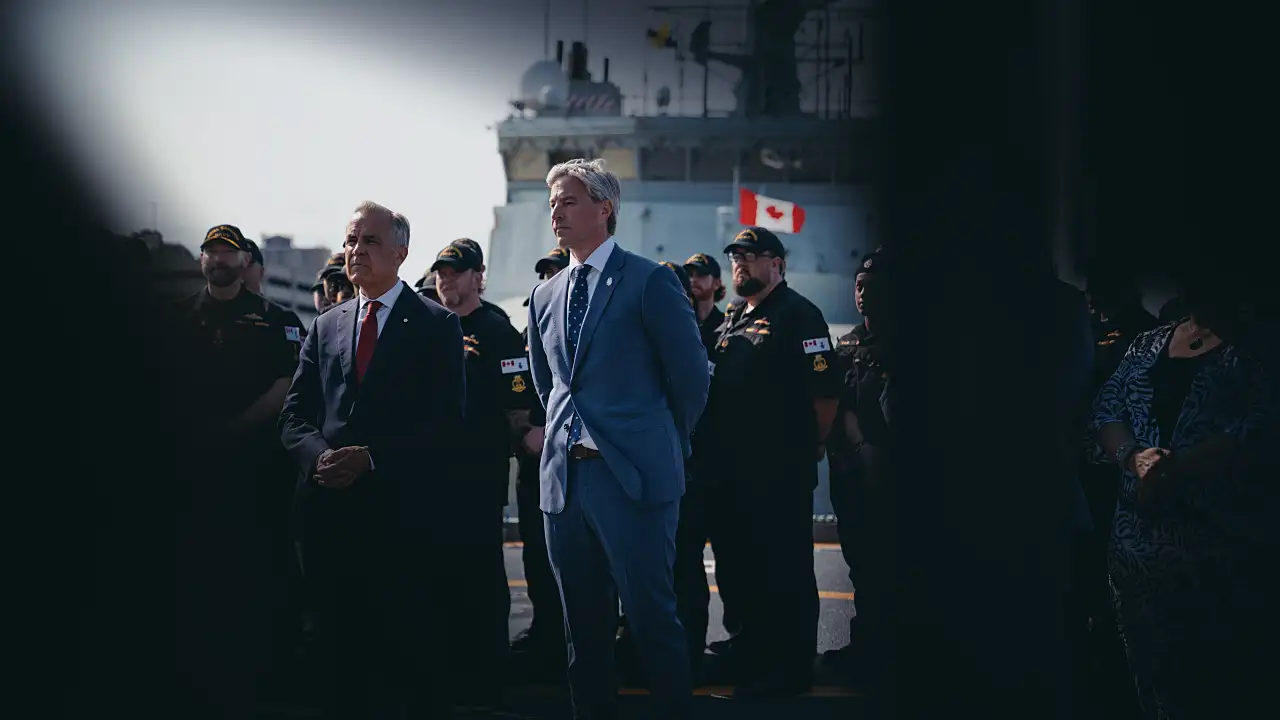
The federal government has finally ended its agonizing search for a new submarine fleet. Prime Minister Mark Carney stood in front of microphones at Canadian Forces Base Halifax on July 6 to declare that Canada has selected the German firm ThyssenKrupp Marine Systems as the "preferred supplier" for up to 12 new Type 212CD submarines. The projected arrival for the first batch is 2034. That is eight years from today, assuming a federal procurement timeline holds perfectly without a single delay—which is an assumption that has never once materialized in Canadian history.
The financial scale of this decision is staggering. Prime Minister Carney refused to provide a hard acquisition figure at the Halifax announcement. We know from detailed reports in The Globe and Mail that the upfront acquisition costs for the vessels alone are expected to land between $20 billion and $30 billion. But that is only the down payment. When you add the multi-decade sustainment, training, and maintenance requirements necessary to keep these boats in the water over their lifespan, CBC News reports the overall program cost will reach $100 billion CAD or more. That is a generational financial commitment, finalized behind closed doors, without a single parliamentary vote to authorize the final envelope.
To understand the sheer depth of this failure, you have to look past the dollar figures and examine the operational timeline. We are currently operating exactly four Victoria-class submarines. These are secondhand vessels purchased from the United Kingdom back in 1998, built with 1980s technology. They have been plagued by fires, electrical failures, and structural fatigue since the day we bought them. As of this week, independent defense reporting confirms that three of those four vessels are currently undergoing maintenance. The Royal Canadian Navy does not possess a functional, deployable underwater fleet right now. Yet, the government is asking Canadians to celebrate a theoretical delivery date of 2034 as a massive victory for our national security posture.
The Build-Partner-Buy Defense
To justify bypassing faster options and committing the Canadian taxpayer to a decade-long waiting room, the Prime Minister’s Office has constructed an elaborate rhetorical defense around a new procurement framework they call "Build-Partner-Buy." If you read the official backgrounder released on July 6 by the newly formed Defence Investment Agency, the logic is laid out in plain, bureaucratic English.
The government claims that selecting TKMS falls squarely under the "Partner" approach of this new framework. By choosing the Type 212CD platform, Canada is buying into an existing European coalition. TKMS is already contracted to build six of these specific submarines for the German Navy and another six for the Norwegian Navy. The official line from the Prime Minister's July 6 press release is that this procurement will "bolster Canadian security through a platform shared by Germany and Norway, two of Canada’s closest Allies."
The argument from Ottawa is that by purchasing the exact same submarine design as our NATO allies, we achieve total interoperability. Our sailors can train on their control systems, our maintenance supply chains can merge, and we can share operational intelligence seamlessly across the North Atlantic. Furthermore, the government insists this trilateral partnership will bring critical technology transfers and specialized skills development to Canadian workers, tying our domestic industries directly into the broader European defense manufacturing ecosystem.
But the most audacious claim in the entire July 6 communications package concerns the schedule itself. The official Defence Investment Agency backgrounder states verbatim: "The RCN’s current submarine fleet will remain operational into the mid-to-late 2030s. To ensure a smooth transition between classes without a capability gap, the first four submarines will be delivered ahead of schedule, in 2034." Furthermore, the Prime Minister’s release notes that Canada will "conclude contracting no later than the end of 2027."
That is the official cover story. The government wants you to believe they are forging a brilliant strategic alliance with trusted NATO partners that will deliver stealth ships ahead of schedule and perfectly prevent any gap in our maritime defenses. It sounds highly responsible, until you look at the physical reality of how submarines are actually built.
The Capacity Collision
The government’s promised timeline is structurally incompatible with the reality of European shipyard production. The Type 212CD submarine does not exist in the real world yet. It has not entered operational service anywhere. It is a brand new, significantly enlarged platform, and it remains in the very early stages of production. The shipbuilder, TKMS, is operating out of its facilities in Kiel, Germany. They currently have an immediate backlog of twelve submarines to build for the German and Norwegian navies before they even look at a Canadian order.
This is where the official narrative completely collapses. Germany’s production capacity is highly constrained, while other competitors could deliver much more quickly and efficiently. We are getting in line behind two other sovereign nations at a shipyard that is already physically saturated.
This massive delay is entirely self-inflicted by the Prime Minister's cabinet. The government ran a competitive process and shortlisted two companies. The other bidder was South Korea’s Hanwha Ocean. The South Koreans were offering their KSS-III submarine. Unlike the German bid, the KSS-III is a proven platform that is already in the water and operating today. More importantly, Hanwha Ocean publicly projected they could deliver their first submarine to Canada by 2032. They have the massive shipyard capacity to build fast and deliver early.
Prime Minister Carney and his cabinet looked at two distinct options: a South Korean firm that could put a functioning submarine in Canadian waters in six years, and a German firm with a massive production backlog that promised a delivery in eight years. They actively chose the slower option, and then had the gall to issue a press release claiming the 2034 delivery is "ahead of schedule." They intentionally bypassed a competitor capable of cutting two full years off our strategic vulnerability window, simply to align with a European procurement bloc.
The Contractual Void
The timeline gets worse when you examine what actually happened in Halifax. Canada did not buy any submarines yesterday. They merely selected a "preferred supplier." The government’s own release openly admits that they have allotted a year and a half—until the end of 2027—just to negotiate the final contracts.
Why do they need eighteen months just to sign a piece of paper for a product that another nation is already building? Because in Ottawa, the priority is not putting hardware in the hands of the military. The priority is forcing a foreign defense contractor to satisfy a domestic jobs program.
The Prime Minister’s official July 6 release explicitly states that this procurement will be subject to Canada’s "modernised Industrial and Technological Benefits Policy." For anyone unfamiliar with federal procurement rules, that policy mandates a 100 percent economic value match. If the government is going to spend $100 billion over the life of this program, the winning contractor must legally guarantee they will inject an equal amount of economic activity back into Canadian industries. The Prime Minister practically bragged about this burden in Halifax, celebrating that the deal will force "tens of billions of dollars" in domestic investments.
To win this bid, TKMS had to make promises they are now legally required to negotiate into a binding contract. And the promises are astronomical. According to their own corporate releases, TKMS is publicly projecting their proposal will generate $167 billion in total economic activity across Canada and create more than 650,000 job-years over the lifespan of the project.
Think about the sheer scale of those numbers. They are promising to run the equivalent of a mid-sized provincial economy through a submarine contract. TKMS is a German shipbuilder whose primary manufacturing capability sits in Kiel. They now have eighteen months to sit in Ottawa boardrooms and map out exactly how they are going to redirect $167 billion into the Canadian supply chain. They have to find Canadian companies to build non-magnetic steel, Canadian tech firms to write combat system code, and Canadian facilities to assemble components, all while keeping the price tag acceptable to the Treasury Board.
This is the exact bureaucratic mechanism that guarantees the 2034 delivery timeline is pure fiction. You cannot execute an industrial wealth-transfer scheme of this magnitude without breaking the schedule. The government and TKMS will spend the next year and a half arguing over regional job quotas and intellectual property rights before a single piece of steel is cut in Germany. Every time a Canadian subcontractor cannot meet a specialized manufacturing standard, the schedule will slip. Every time the government demands more jobs in a specific electoral riding, the price will go up.
If negotiations stall, or if TKMS realizes they cannot possibly meet the Canadian domestic content requirements at the demanded price point without bankrupting themselves, the timeline will easily slip from 2034 to 2036, or 2038. The government even left themselves an out: the release quietly notes that if negotiations with TKMS fail, they "may designate Hanwha Ocean as the preferred supplier." They know the German bid is high-risk, and they are already preparing the legal ground for a failure.
In the real world, when you have a critical vulnerability in your security, you buy the tool that works and you buy it from the person who can hand it to you the fastest. You do not spend a decade trying to turn a defense crisis into a regional stimulus package.
Living in the Gap
The final insult in the government’s presentation is their ridiculous claim about the "capability gap." The Defence Investment Agency backgrounder promises that the current Victoria-class fleet will remain operational into the mid-to-late 2030s to ensure a smooth transition. That statement requires a profound detachment from the operational reality of the Royal Canadian Navy.
A transition implies you are moving from a working system to a newer system. We do not have a working system. As previously noted, independent reporting confirmed on July 6 that three of our four submarines are currently undergoing maintenance. They cannot patrol the Arctic. They cannot deter Russian or Chinese incursions into our northern waters. They are simply massive drains on the defense budget, sidelined from duty while we pour endless funding into their repairs.
The government claims 2034 will prevent a capability gap. The gap is not coming in the next decade. The gap is here right now. We are currently relying on our allies to patrol our own sovereign waters because our equipment is broken. Deciding to wait until 2034—or much later, once the inevitable delays occur—means we are consciously choosing to remain completely defenseless in the Arctic for another decade.
Prime Minister Carney went to Halifax to celebrate a milestone. But all he actually delivered was a promise to spend $100 billion to maintain the exact same state of vulnerability we have today, for ten more years. If you paid someone to fix your roof and they told you they needed ten years to source the shingles while rain poured into your living room, you would throw them off your property. In Ottawa, they hold a press conference and ask for a round of applause.
The Hammer will be watching.