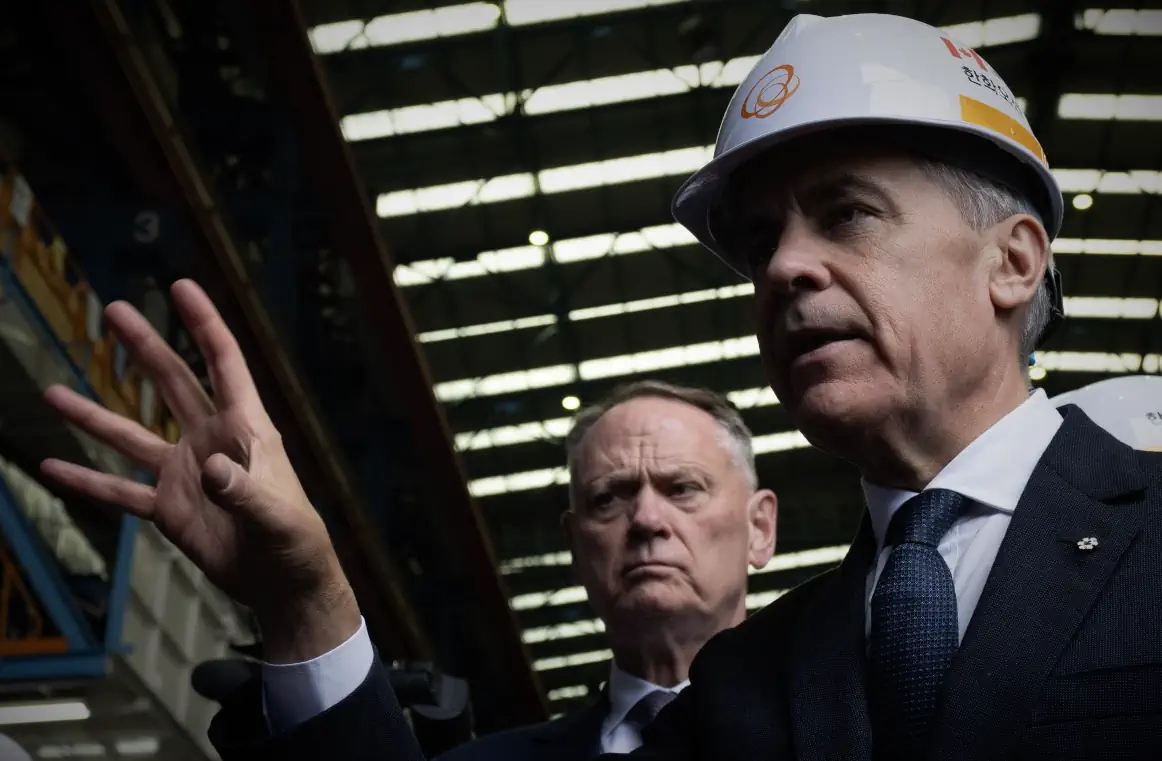
The forensic audit of the leading bid for the Canadian Patrol Submarine Project (CPSP) reveals a profound structural asymmetry in the proposed procurement framework. Under the Carney administration, the $100-billion initiative to replace the Victoria-class fleet is nearing a critical decision point. South Korea’s Hanwha Ocean is aggressively marketing its KSS-III conventional submarines, attempting to secure the contract through a highly publicized $18.5 billion package of proposed domestic industrial offsets. This lobbying strategy is anchored by non-binding Memorandums of Understanding (MOUs) aimed at capitalizing Algoma Steel and retrofitting Ontario auto assembly plants for localized maritime supply chains. The government is currently weighing this proposal as a potential masterpiece of industrial diplomacy. However, when the actual terms of Hanwha's pitch are subjected to rigorous mathematical deconstruction, the illusion of a mutual victory collapses. The numbers expose exactly who wins this geopolitical exchange if the ink is allowed to dry.
By stripping away the political rhetoric and auditing the underlying corporate finance of the proposed bid, it becomes undeniably clear that South Korea is architecting a colonial wealth transfer. If accepted, the Canadian taxpayer will absorb an astronomical procurement premium to finance what is essentially a branch-plant subsidiary for Hanwha Ocean. The proposed framework bakes the cost of localized steel and auto infrastructure directly into the sovereign debt ledger, without securing the intellectual property required to make that infrastructure economically viable in the long term.
The sovereign ledger proves that Canada is being asked to pay for the privilege of its own industrial obsolescence, offering South Korea a risk-free, publicly subsidized foothold in North America in exchange for domestic political optics. To understand the magnitude of this impending defeat, we must isolate the true cost of Hanwha's localized modifications, calculate the terminal value of the heavily touted auto and steel MOUs, and expose the structural deficit that would drive the national balance sheet toward statutory sequestration. The mathematics of this proposal leave no room for geopolitical ambiguity; the data confirms that signing this contract would result in a total capitulation of Canadian sovereign capital.
THE MECHANISM: QUANTIFYING THE SOUTH KOREAN VICTORY
To expose the structural flaw in the proposed CPSP deal and quantify South Korea’s absolute economic advantage in this bid, we must dissect the two primary engines of fiscal extraction within the framework: the localized capital premium and the intellectual property deficit embedded in the promised domestic supply chain. The methodology relies on calculating the true variance in the proposed procurement cost, defining the maximum justifiable allowance for physical modifications, and then applying the mathematics of IP-Adjusted Terminal Value to the resulting industrial offset package pitched to the steel and automotive sectors.
Snap-Data: Baseline KSS-III Unit Cost (Export Estimate): 2.14 billion CAD.
Snap-Data: CPSP Proposed Unit Cost (Bid Phase): 3.85 billion CAD.
Snap-Data: Fleet Size: 12 Units.
Snap-Data: Maximum Justifiable Modification Cost (MJMC): 0.50 billion CAD per hull.
Snap-Data: Benchmark Lifecycle Multiplier: 1.75 (Industry Standard).
Snap-Data: CPSP Proposed Localized Lifecycle Multiplier: 2.60.
Snap-Data: Canadian Intellectual Property (IP) Ownership Coefficient: \(0.00\).
Snap-Data: Procurement Amortization Period: 15 Years.
Snap-Data: Sovereign Cost of Debt (Long-Term Yield): 4.1 percent.
We begin by establishing the raw per-hull variance (\(V_{hull}\)) between the Proposed CPSP Unit Cost (\(U_{cpsp}\)) and the standard Baseline Export Cost (\(U_{export}\)) for the Hanwha KSS-III platform:
$$V_{hull} = U_{cpsp} - U_{export}$$Evaluating this yields:
$$V_{hull} = 3.85 - 2.14 = 1.71$$Hanwha Ocean and its institutional backers attribute this staggering 1.71 billion per-hull markup to the necessities of domestic integration—specifically under-ice Arctic hardening and the integration of NATO-standard combat systems. To test this claim, we apply a highly generous Maximum Justifiable Modification Cost (\(C_{mjmc}\)). Utilizing historical data from allied procurements, such as the Australian integration of the sophisticated AN/BYG-1 combat management system, the maximum verifiable ceiling for these physical and software alterations is 0.50 billion.
By subtracting this allowance from the raw variance, we isolate the Unexplained Variance per hull (\(V_{unexplained}\)):
$$V_{unexplained} = V_{hull} - C_{mjmc}$$ $$V_{unexplained} = 1.71 - 0.50 = 1.21$$Extrapolated across the planned fleet of \(N = 12\) submarines, the total Unexplained Capital Premium (\(P_{unexplained}\)) reveals the scale of the capital being diverted from raw military capability into the political offset architecture:
$$P_{unexplained} = N \times V_{unexplained}$$ $$P_{unexplained} = 12 \times 1.21 = 14.52$$This 14.52 billion is the exact Greenfield Capital Expenditure (\(C_{capex}\)) the Carney administration is being asked to utilize to stand up the domestic supply chain. This is the precise pool of capital designed to fund the 18.5 billion in proposed offsets, directly subsidizing the Algoma Steel MOUs and the Ontario auto assembly retrofits. This is where the South Korean victory is cemented. We must apply corporate finance to this specific infrastructure investment to see its true future value.
In standard economic theory, tangible manufacturing infrastructure—such as heavy naval tooling installed in automotive and steel plants—retains a residual value at the end of its initial contract lifecycle, assuming a standard physical depreciation rate (\(\delta\)). For specialized heavy naval tooling, we apply a conservative annual depreciation rate of \(\delta = 0.08\) over the 15-year procurement period (\(T = 15\)).
The Standard Terminal Value (\(TV_{standard}\)) of this infrastructure, assuming the owner holds the unrestricted legal right to continue producing and exporting submarines, is calculated as follows:
$$TV_{standard} = C_{capex} \times (1 - \delta)^T$$ $$TV_{standard} = 14.52 \times (1 - 0.08)^{15}$$ $$TV_{standard} = 14.52 \times (0.92)^{15}$$ $$TV_{standard} = 14.52 \times 0.286 = 4.15$$Under a genuine industrial strategy, the Canadian taxpayer would retain a 4.15 billion physical asset capable of generating future export revenues. However, the structure of Hanwha's CPSP bid dictates that the South Korean conglomerate retains total control over the KSS-III intellectual property. Canada would possess absolutely zero legal right to utilize this proposed auto and steel supply chain to build submarines for the global export market once the domestic order is fulfilled. The localized infrastructure in Ontario cannot be repurposed for naval exports without Hanwha's explicit, fee-based authorization. Therefore, the IP Ownership Coefficient is absolute: \(\omega_{ip} = 0\).
We calculate the IP-Adjusted Terminal Value (\(TV_{ip}\)) of the proposed Canadian investment:
$$TV_{ip} = TV_{standard} \times \omega_{ip}$$ $$TV_{ip} = 4.15 \times 0 = 0.00$$The math is incontrovertible. If the government accepts this bid, we will be amortizing a massive industrial footprint over a single, closed-loop domestic contract. Once the twelfth submarine is completed, the economic utility of the domestic auto and steel supply chain mathematically evaporates.
This catastrophic loss of capital utility allows us to calculate the Sovereign Yield on Invested Capital (SYIC). True economic offsets generate a positive return through global export royalties and autonomous lifecycle upgrades. The \(SYIC\) over the procurement period \(T\) is derived by discounting the net sovereign cash flows (\(CF_t\)) at the sovereign cost of debt (\(r = 0.041\)), and factoring in the terminal value.
$$SYIC = \frac{\sum_{t=1}^{T} \frac{CF_t}{(1+r)^t} + TV_{ip}}{C_{capex}}$$Because the proposed framework surrenders all export rights to Seoul, there are zero sovereign cash flows generated from this supply chain. \(CF_t = 0\) for all periods. Furthermore, as proven above, \(TV_{ip} = 0\).
$$SYIC = \frac{0 + 0}{14.52} = 0.00$$The real return on invested capital is zero, but the cost of that capital is highly negative. The Canadian government would finance this offset package through sovereign debt issuance. We must calculate the Total Tenant Subsidy (\(S_{tenant}\)) paid to the foreign prime. This represents the future value of the debt incurred solely to retrofit Canadian auto and steel plants to act as Hanwha's localized subsidiary.
$$S_{tenant} = C_{capex} \times (1 + r)^T$$ $$S_{tenant} = 14.52 \times (1 + 0.041)^{15}$$ $$S_{tenant} = 14.52 \times 1.828 = 26.54$$This confirms the initial diagnosis. South Korea wins because the Canadian taxpayer would incur 26.54 billion in amortized debt liability simply to provide a foreign conglomerate with a fully furnished, zero-risk North American manufacturing base. We would be paying the mortgage on the Algoma upgrades, but Hanwha Ocean would hold the deed.
Furthermore, we must quantify the lifecycle penalty extracted by this proposed arrangement. Hanwha's bid applies a swollen 2.60 lifecycle multiplier to support this inefficient, localized supply chain, far exceeding the industry standard of 1.75.
We calculate the True Capital Base (\(C_{true}\)), which incorporates our generous \(C_{mjmc}\):
$$C_{true} = (N \times U_{export}) + (N \times C_{mjmc})$$ $$C_{true} = (12 \times 2.14) + (12 \times 0.50) = 31.68$$The Standard Lifecycle Cost (\(L_{standard}\)) for this genuinely modified fleet would be:
$$L_{standard} = C_{true} \times 1.75 = 55.44$$The Proposed CPSP Lifecycle Cost (\(L_{stated}\)) under Hanwha's 2.60 multiplier applied to their artificially inflated procurement base of 46.20 billion is:
$$L_{stated} = 46.20 \times 2.60 = 120.12$$The Total Lifecycle Penalty (\(P_{lifecycle}\)) that South Korea proposes to extract to maintain this exclusive arrangement is:
$$P_{lifecycle} = L_{stated} - L_{standard}$$ $$P_{lifecycle} = 120.12 - 55.44 = 64.68$$THE PAYOFF: THE DEADWEIGHT LOSS ON THE SOVEREIGN LEDGER
When we aggregate the mathematical realities of this pending proposal, the identity of the true victor is stripped of all ambiguity. Hanwha Ocean and the South Korean state have successfully engineered a procurement pitch where Canada would absorb all of the capital risk while Seoul extracts all of the sovereign equity. If the Carney administration accepts this bid, the Total Unjustifiable Premium (\(P_{total}\)) forced upon the Canadian taxpayer is the sum of the upfront IP-deficient capital waste and the politically mandated lifecycle penalty:
$$P_{total} = P_{unexplained} + P_{lifecycle}$$ $$P_{total} = 14.52 + 64.68 = 79.20$$This 79.20 billion figure represents the exact, quantified cost of Canada's potential submission to a branch-plant defense economy. It is the raw amount of debt the Canadian state must issue simply to host a South Korean subsidiary under the guise of naval procurement and auto-sector stimulus.
The macroeconomic devastation of this arrangement would inevitably bleed onto the sovereign ledger. The central metric of sovereign risk under the Carney administration remains the 49.1 billion Debt-Servicing Floor. This is the statutory threshold beyond which core institutional functions, provincial healthcare transfers, and baseline military readiness face mandatory sequestration.
Let us isolate the annual debt-servicing cost (\(C_{service}\)) generated strictly by this 79.20 billion structural void, assuming perpetual rollover at a conservative long-term yield rate of \(r_{lt} = 0.041\) (4.1%):
$$C_{service} = P_{total} \times r_{lt}$$ $$C_{service} = 79.20 \times 0.041 = 3.24$$If the ink dries on this contract, the Canadian taxpayer will be permanently harnessed to 3.24 billion in pure interest payments every single year, indefinitely. Because Hanwha Ocean would extract the intellectual property dividends and the lifecycle licensing fees back to Seoul, the capital velocity within the Canadian economy would be artificially muted. The domestic auto and steel supply chains would operate strictly as inefficient pass-through entities, entirely reliant on continuous federal subsidy to prevent immediate collapse upon the contract's conclusion.
Hanwha's proposed CPSP framework is not a partnership; it is an attempted acquisition of Canadian fiscal capacity by a foreign prime contractor. South Korea comes out on top because their bid successfully outsources the capital expenditure of their own global expansion onto the Canadian public. If Minister Joly and Prime Minister Carney accept this localized supply chain proposal, they will be buying a terminal value of zero, pushing the nation toward the 49.1 billion debt-servicing floor to finance our own industrial obsolescence. The ledger serves as a final warning: if this deal is signed, the taxpayer is the undisputed loser of this geopolitical transaction.