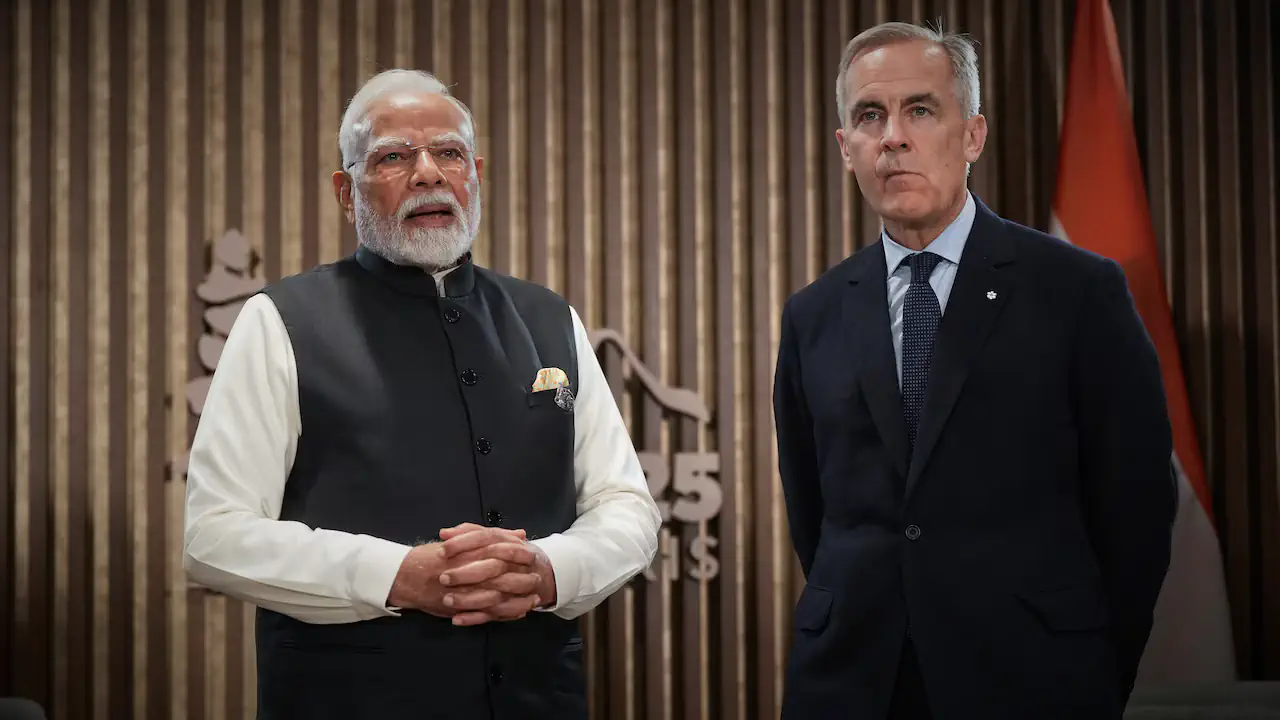
On Friday, February 27, 2026, Prime Minister Mark Carney touched down in Mumbai, ostensibly to inaugurate a new era of bilateral cooperation. The Prime Minister's Office has aggressively branded this expedition as a "historic reset" of Canada-India relations, projecting an image of statesmanship and diplomatic prowess. Yet, a rigorous examination of the preceding hours reveals a deeply cynical institutional maneuver designed to clear the political runway for this hollow diplomatic realignment. For years, the federal government asserted with grave certainty that it possessed credible allegations of foreign interference, extortion, and targeted assassinations orchestrated by Indian state actors on Canadian soil. This intelligence was presented to the public as an unassailable breach of our national sovereignty.
However, the geopolitical arithmetic has abruptly changed, and so too has the federal government’s intelligence assessment. In a hastily convened technical briefing, senior officials executed a breathtaking reversal, declaring with newfound confidence that India-linked violent crime is magically "not continuing." To ensure the narrative was properly sanitized before the Prime Minister's jet reached the subcontinent, an official flatly stated, "I really don't think we'd be taking this trip if we thought these activities were continuing." This is an astonishing institutional pivot, wherein grave breaches of domestic security are rhetorically vanished to accommodate a trade delegation.
The immediate domestic reaction has been one of legitimate outrage. Advocacy organizations, most notably the World Sikh Organization, have categorically rejected this bureaucratic revisionism, asserting that the climate of intimidation and the underlying realities on the ground remain entirely unchanged. The state apparatus, however, is no longer interested in their security. The federal government has made a calculated decision to overwrite its own national security doctrine, effectively erasing the documented grievances of a targeted diaspora community. This is not diplomacy; it is the deliberate suppression of inconvenient domestic truths to facilitate a sudden, desperate pivot in our foreign trade architecture. We must interrogate the true catalyst for this unseemly haste.
The Laurentian consensus has long prided itself on upholding the rule of law and defending the inviolability of Canadian citizenship. Yet, when confronted with severe macroeconomic headwinds, these foundational principles were jettisoned with alarming speed. The institutional elite are attempting to convince the public that this diplomatic thaw is the product of resolved tensions and mutual understanding. In reality, the erasure of foreign interference allegations was a necessary prerequisite, a required sacrifice, to unlock a desperate economic escape hatch. The state is treating national security not as an absolute imperative, but as a flexible variable to be manipulated when the economic ledger demands it.
Section 122 of the Trade Act: The Tariff Driving the Asia Pivot
To properly diagnose the frantic, undignified rush toward this Mumbai reset, one must divert their gaze from the Indo-Pacific and focus entirely on the machinations of Washington, D.C. The Prime Minister’s heralded "Pivot to Asia"—a grand strategic realignment ostensibly aimed at diversifying our trade matrix across India, Japan, and Australia—is a masterclass in institutional gaslighting. It is not an assertion of Canadian economic independence, but rather an exercise in functional obedience to an aggressive, protectionist American agenda.
The immutable timeline of our current economic subjugation dictates this reality. On February 20, 2026, the United States Supreme Court delivered a humiliating constitutional defeat to Donald Trump, striking down his unilateral executive tariffs. A sovereign, self-respecting allied nation might have seized this judicial victory as an opportunity to reinforce the integrated North American economic zone. Instead, the American administration immediately bypassed the ruling, dusting off an archaic legislative weapon: Section 122 of the Trade Act of 1974. Under the pretext of addressing a "fundamental international payments problem" and fixing the balance of payments, Washington unilaterally imposed a devastating ten percent baseline tariff on Canadian imports.
Faced with this overt act of economic hostility, Prime Minister Carney capitulated to macroeconomic pressures with unseemly haste. The PMO did not launch a robust defense of Canadian industry or leverage our critical resource exports to force a renegotiation. Instead, Ottawa absorbed the blow and initiated the precise strategic retreat the Trump administration had engineered. The proponents of "America First" doctrine have long sought the dismantling of integrated North American supply chains to domesticate manufacturing within the borders of the United States. By accepting the Section 122 tariffs as an unassailable reality, Canada is actively facilitating this continental divorce.
The mechanics of this structural shift are brutally straightforward. By applying a ten percent baseline tax on integrated cross-border manufacturing, the tariff fundamentally destroys the cost-advantage of Canadian assembly, forcing Canada to seek subsidized, unnatural export markets in the Indo-Pacific. The sprawling automotive supply networks, the agricultural corridors, and the highly calibrated logistics frameworks that have generated continental wealth for decades are being actively severed. The American objective is to decouple the Canadian economy from the United States, and Prime Minister Carney is utilizing the full apparatus of the Canadian state to accomplish this objective on Washington’s behalf.
This is the essence of functional obedience. We are witnessing the managed decline of our most vital trading relationship, rebranded and sold to the public as a visionary pivot to new frontiers. The technical briefing that effectively vanished the foreign interference allegations was merely an administrative requirement to facilitate this retreat. Ottawa recognized that with the Section 122 tariff permanently suffocating cross-border trade, the Canadian economy urgently required an alternative anchor. India, despite the severe and unresolved security frictions, was the only viable candidate with the demographic and economic mass to absorb the shock.
Therefore, the diplomatic friction had to be extinguished, regardless of the factual reality or the domestic consequences. The institutional elite, caught between an unforgiving American protectionist regime and a domestic economy heavily reliant on exports, chose the path of least resistance. They decided to sanitize the geopolitical relationship with New Delhi, abandoning the ethical high ground they had previously occupied, because the financial arithmetic offered no other exit. This forced march across the globe is not a demonstration of foresight; it is a desperate scramble for survival dictated entirely by the Oval Office. We are observing a proxy administration executing foreign policy dictates under the guise of sovereign initiative.
The sheer audacity of this institutional sleight of hand is remarkable. The bureaucratic class is effectively instructing the Canadian public to ignore the glaring sequence of events. They demand we view the sudden resolution of a major national security crisis as a coincidental triumph of diplomacy, rather than a frantic concession forced by the imposition of a ten percent American tariff. This is a profound betrayal of the public trust, orchestrated by an administration that views its own citizens and its own integrated industries as expendable assets in a macroeconomic balancing act.
The long-term implications of this structural realignment are chilling. By refusing to challenge the legitimacy or the application of Section 122, the Canadian government has essentially granted Washington a permanent, unilateral veto over our domestic industrial policy. The Prime Minister has established a precedent wherein the United States can unilaterally rewrite the terms of continental trade without facing reciprocal action or diplomatic resistance from Ottawa. Instead of fighting for the integrity of the North American market, Canada simply packs up its industrial capacity and looks for buyers across the Pacific, assuming the immense logistical and financial burdens of this artificial relocation.
This functional obedience reduces Canada from a primary economic partner to a subordinate logistical node, constantly reacting to the protectionist whims of a foreign capital. The "Pivot to Asia," therefore, represents a permanent structural concession. It acknowledges that the era of secure, integrated trade with our closest neighbor is dead, killed not by market forces, but by political edict. And rather than defend the corpse or fight for its resurrection, the current administration has simply decided to hold a parade in Mumbai to distract the public from the burial.
The Cost of Functional Obedience to the Canadian Economy
The deliberate restructuring of the Canadian economy to satisfy the protectionist demands of a foreign power carries a catastrophic cost, one that will be borne entirely by the domestic taxpayer. The immediate and unavoidable consequence of the Prime Minister’s failure to contest the Section 122 imposition is the internalization of the ten percent baseline tariff. Because the federal government has chosen the path of functional obedience over economic defense, the friction of this tariff is now baked into the operational costs of every integrated enterprise in the country. This guarantees a severe escalation in the cost of living and the systematic erosion of our manufacturing competitiveness.
Furthermore, the artificial pivot to the Indo-Pacific will require an unprecedented mobilization of public capital. To compensate for the destruction of the North American cost-advantage, the state will be forced to heavily subsidize the logistical relocation of our export industries. The "historic reset" in India will be underwritten by billions of taxpayer dollars, funneled into corporate welfare programs designed to incentivize businesses to abandon continental trade in favor of heavily subsidized, unnatural maritime supply chains. The institutional elite will champion these subsidies as vital investments in our new global strategy, but they are, in reality, the ransom payments required to fund our retreat from the American market.
A genuinely sovereign nation leverages its geographic and resource advantages to anchor its economy in strength and mutual interdependency. Historically, Canada stood as an indispensable pillar of the North American industrial complex, negotiating from a position of integrated necessity. Today, we are confronted with the reality of a hollowed-out proxy state, an administration that actively manages its own economic decline to avoid the political friction of defending its borders. The government has prioritized its standing at international summits over the stability of its own domestic markets and the security of its own diaspora communities.
The ultimate legacy of Mark Carney’s tenure will not be found in the breathless press releases generated from Mumbai or the orchestrated handshakes with foreign dignitaries. His legacy is the institutionalization of Canadian subservience. By treating domestic security as negotiable and continental trade as expendable, he has permanently reduced the geopolitical stature of this country. When the history of this decade is written, it will not record a bold, visionary pivot to the East. It will document the precise, clinical moment a Canadian Prime Minister quietly dismantled the economic architecture of a nation, acting as the compliant architect of our own engineered irrelevance.