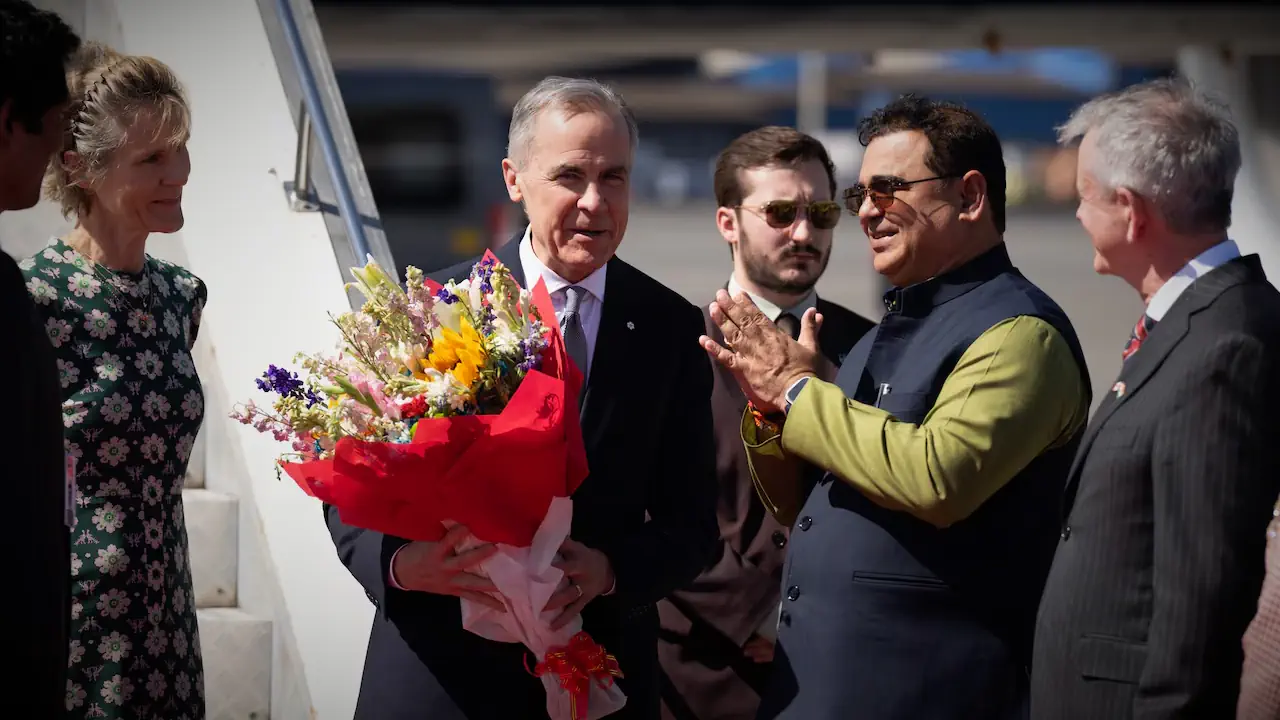
There is a particular kind of arrogance that comes with being the "smartest man in the room," and our current Prime Minister, Mark Carney, has it in spades. As I write this, the Right Honourable Member for the Laurentian Elite is currently thousands of miles away, touching down in Mumbai for a high-stakes reset with Prime Minister Narendra Modi. He’s there to talk about "strategic autonomy," "critical minerals," and his grand vision for a Canadian-Indian defense partnership. It’s a lovely image for the cameras: the suave former central banker playing world statesman on the global stage. But back home in the real world—the one where Canadians have to pay for the jet fuel powering his global tour—the ground is shifting.
While Carney is busy trying to diversify our trade and "shop for friends" in Sydney and New Delhi, the Canadian economy just suffered a devastating faceplant. Statistics Canada just pulled the rug out from under the PMO’s rosy narrative, reporting that the national economy didn't just slow down in the final quarter of 2025; it unexpectedly shrank by 0.6% on an annualized basis. The forecast was for growth. The reality was a contraction that has left the "managed economy" gurus in Ottawa muttering to themselves about technicalities. They promised us a "soft landing" and a "measured recovery," but instead, they’ve delivered a hole in the floor.
The working families of this country are struggling to put gas in their trucks and meat on the table, yet the geniuses in the Prime Minister’s Office are pointing at spreadsheets and muttering about "inventory drawdowns." It is the ultimate bureaucratic gaslight. They want you to believe that a shrinking economy is actually a sign of "resilience" because businesses are simply "clearing the shelves." Let’s call it what it is: a liquidation. A retreat. A failure of the very system Carney was supposed to be the master of. The landing wasn't soft; it was a crash, and the pilot is currently in India looking for a new runway because the one at home is crumbling.
The Fortress Facade and the Death of the Private Sector
The excuse du jour from the PMO is that this 0.6% drop is a "pull-back in inventories." It’s a classic Carney move: use a technicality to hide a tragedy. If businesses were confident in the "Carney Era," they’d be restocking those shelves. They’d be investing in new equipment. They’d be hiring. Instead, they are hunkering down, selling off what they have, and praying the next quarter isn't worse. To understand the magnitude of this failure, you have to look at the sheer volume of wealth that vanished from our warehouse floors. Businesses didn't just trim their stock; they liquidated it to the tune of over $23 billion in just three months. That massive fire sale acted like a lead weight on our national growth, dragging the entire economy down by more than four full percentage points.
Now, most of us on the right believe in a strong military. We believe in "peace through strength" and providing our men and women in uniform with the best tools available. But what Carney is doing isn't building a military; he’s building a state-run jobs program to mask a private-sector funeral. He is funneling $180 billion into a sovereign "Defence Industrial Strategy" and pumping up the military budget by nearly 46%. But don't let the big numbers fool you—this is "Guns-as-Social-Engineering." While he’s promising 125,000 "high-paying careers," our actual troops are left stranded with a massive capability gap. Half of our equipment is currently unusable, yet Carney is focused on "drone innovation hubs" and "Boreal research bureaus" that produce press releases instead of hardware.
The contrast is jarring. While the Prime Minister talks about a "sovereign supply chain," the actual data shows a 4.4% collapse in residential investment. We determined this by looking at the hard cash actually being put into new shingles, new foundations, and new apartments. When interest rates stay high and the economy shrinks, builders stop building. Carney is betting the house on long-term industrial policies that won't deliver a single bolt until 2040, while ignoring the fact that we should be buying what works right now from our allies to secure trade exemptions. He’s treating the Canadian Armed Forces as a regional development tool, leaving our soldiers ill-equipped while he funds "innovation" slush funds for the Laurentian elite.
The Provincial Dominoes and the Debt-Servicing Cliff
The rot isn't contained to the bubble in Ottawa. For years, the federal government has been able to hide its fiscal recklessness behind the relative stability of the provinces. No longer. As the national economy shrinks, the provincial budgets are starting to look like horror stories. This week, we saw the "Alberta Advantage" vanish in a cloud of red ink. The UCP government in Alberta just dropped a budget with a $9.4-billion deficit for 2026-27—a massive increase from the $4.1 billion projected just last year. When the heart of Canada’s energy sector sees its deficit more than double in a single year, the "Carney Stability" narrative is officially dead.
The burden of debt relative to the size of Alberta's economy is on track to nearly double by 2028. This isn't just a number; it represents the loss of the province's ability to fund its own future. And in Nova Scotia, the story is even grimmer. Their 2026-27 budget anticipates a $1.2-billion deficit, and they are fast approaching a hard "guardrail" where their debt will equal 40% of their entire economy. Make no mistake: that 40% mark is a fiscal cliff.
Once Nova Scotia hits that wall, their ability to maneuver disappears entirely. This is a mechanical certainty if our GDP stays flat. They become entirely dependent on federal transfers—which is likely exactly what Carney wants. By allowing the domestic economy to contract while bloating the federal "fortress" budget, he is effectively forcing provincial subservience. It’s a cold-blooded consolidation of power disguised as a fiscal crisis. He is hollowing out the provinces until they have no choice but to beg Ottawa for the scraps of his "industrial strategy."
The Liquidation of a Nation
The payoff for the average Canadian taxpayer in this "New Reality" is a bleak one. We are being told to tighten our belts while the government opens its wallet for "weapons systems" that won't be operational for a decade. The StatsCan report noted that government capital investment in military hardware was one of the few things that actually "aided" growth last quarter. That is the Carney plan in a nutshell: the only growth allowed is the growth he authorizes and finances with your money. As the economy shrinks, the burden of debt-servicing at the federal level has hit a terrifying floor of $49.1 billion.
We determined the impact of the current economic shrinking by calculating how much tax revenue disappears when the economy contracts. Because the economy is smaller than expected, the federal government is facing a revenue hole of roughly $2.4 billion. That is money that was supposed to pay for services but is now just gone. The "Smartest Man in the Room" has created a liquidity crisis in the making. He is hemorrhaging billions in tax revenue today while betting the house on a 46% increase in military capital that offers no relief to the taxpayer for years to come.
Mark Carney was brought in to be the "adult in the room," the steady hand to guide Canada through the post-tariff volatility. Instead, he has delivered an "unexpected" contraction and a pivot to a permanent war-economy footing to hide the fact that he has no idea how to generate real, private-sector wealth. He’s shopping for friends in Sydney and Mumbai while the shelves at home are being emptied by his own policies. The "Smartest Man in the Room" just outsmarted himself, and the rest of us are left to pay the price for his globalist delusions. We are watching our national prosperity being liquidated in real-time, replaced by a mountain of debt and a warehouse full of weapons we can't afford. This is the Carney economy: a fire sale followed by a funeral.