In our last look at the federal landscape, we examined the "Davos Gambit"—Prime Minister Mark Carney’s attempt to play the high-minded statesman on the world stage while our domestic house remains in a state of structural decay. It is one thing to lecture the global elite on the "end of the rules-based order," as the Prime Minister did last week at the World Economic Forum. It is quite another to manage a country that can no longer move its own products to the coast. By picking a fight with a transactional U.S. administration before securing a viable exit ramp for Canadian resources, Carney is effectively steering the national economy into a cul-de-sac.
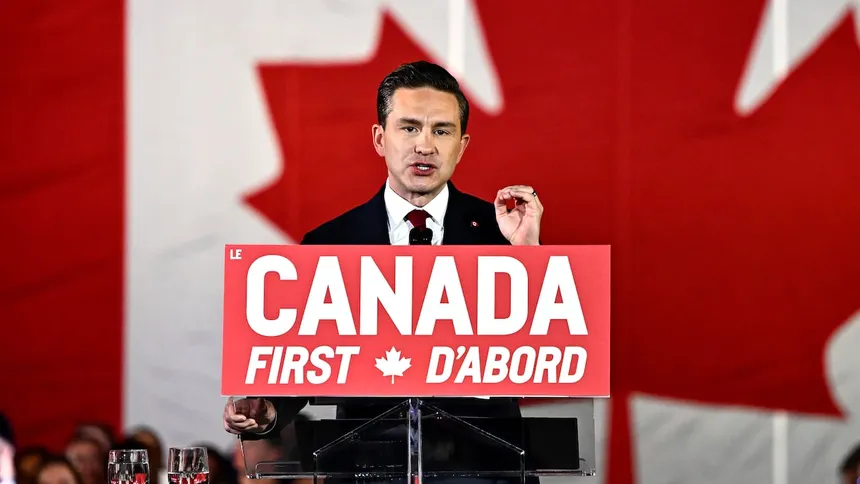
The opposition’s counter-offensive, embodied in Pierre Poilievre’s "Canadian Sovereignty Act," represents a necessary departure from this diplomatic posturing. While the Prime Minister occupies himself with "social license" and multilateral dialogues, the Sovereignty Act is framed as a long-overdue exercise in industrial clearing. It is less a legal manifesto and more an emergency construction order. For a nation currently strangled by its own regulatory architecture, the choice is becoming stark: we either build the infrastructure required for independence, or we remain a captive subsidiary of a volatile American market.
The "Pawn Shop" Operation
Carney’s diplomatic delays ignore the new reality of the "Managed Funnel" to the south. In late January 2026, the Trump administration moved toward "lifting" sanctions on Venezuelan crude, but the average observer should not mistake this for a return to the status quo. Following the capture of Nicolás Maduro on January 3, the U.S. has effectively replaced a total blockade with a pawn shop operation. Under Executive Order 14373, the U.S. Treasury now acts as the central banker for Venezuelan oil revenues, holding proceeds in "Foreign Government Deposit Funds" while Washington oversees the sales.
By selectively removing the legal barriers to trade, the U.S. is not being lenient; it is clearing the legal path to sell the oil it now effectively holds in custody. This creates an immediate and aggressive competitor for Canadian heavy crude in the Gulf of Mexico. If Trump can flood Gulf Coast refineries with "captured" Venezuelan oil—refineries specifically built for that heavy grade—he no longer requires Canadian imports as a strategic necessity. Without the Pacific Gateway promised by the Sovereignty Act, Canada remains in a hostage situation, serving a customer that is currently building its own alternative.
Logistics as Sovereignty
Sovereignty, in the Carney era, is a rhetorical flourish—a series of speeches about "strategic autonomy" delivered to audiences in Switzerland. In the Poilievre model, sovereignty is measured in cubic meters of concrete and kilometres of steel pipe. The proposed Act seeks to re-establish federal authority over projects deemed in the national interest, specifically targeting the legislative hurdles that have paralyzed the resource sector for a decade. By proposing the repeal of the Impact Assessment Act (formerly Bill C-69) and the Oil Tanker Moratorium Act (formerly Bill C-48), the Conservatives are attempting to take a sledgehammer to the "no-more-pipelines" era.
The strategic necessity of this shift is grounded in hard mathematics. Currently, the vast majority of Canadian energy exports are tied to the U.S. market. You cannot effectively tell Washington to respect Canadian interests when they are your only buyer. The Sovereignty Act’s focus on the Pacific Gateway is designed to break this stranglehold. By clearing the path for two major pipelines and a new greenfield LNG project, the objective is to pivot toward democratic allies in the Indo-Pacific—specifically Japan, South Korea, and India.
The "Bulldozer" vs. "Social License"
India represents the most significant missed opportunity of the last decade. As one of the world's fastest-growing energy consumers, New Delhi is looking for stable partners to help it diversify away from Russian and Qatari gas. While the current Liberal cabinet makes overtures to India to relaunch energy dialogues, the underlying problem remains. Diplomatic "dialogues" do not deliver energy; pipelines do. Without the "Federal Bulldozer" approach promised by the Sovereignty Act, these ministerial trips are little more than expensive photo opportunities.
The Prime Minister’s critique of the Act—claiming it would "destroy" Canada’s future—reveals the fundamental divide in Ottawa. Carney remains wedded to the concept of "social license," a vague and shifting standard that allows activist groups and provincial obstructionists to veto projects of national importance. This obsession with consensus has resulted in a decade of stagnation. The Sovereignty Act proposes to replace this "tyranny of the status quo" with the clear application of Section 92(10)(a) of the Constitution, which grants the federal government exclusive authority over interprovincial works.
Real sovereignty is not found in the approval of the Davos set. It is found in the ability to produce, transport, and sell your own resources on your own terms. Poilievre is offering a plan to build the door; Carney seems content to keep yelling at the wall. For a country that needs to fuel itself and defend itself, the choice between logistics and posturing has never been clearer.