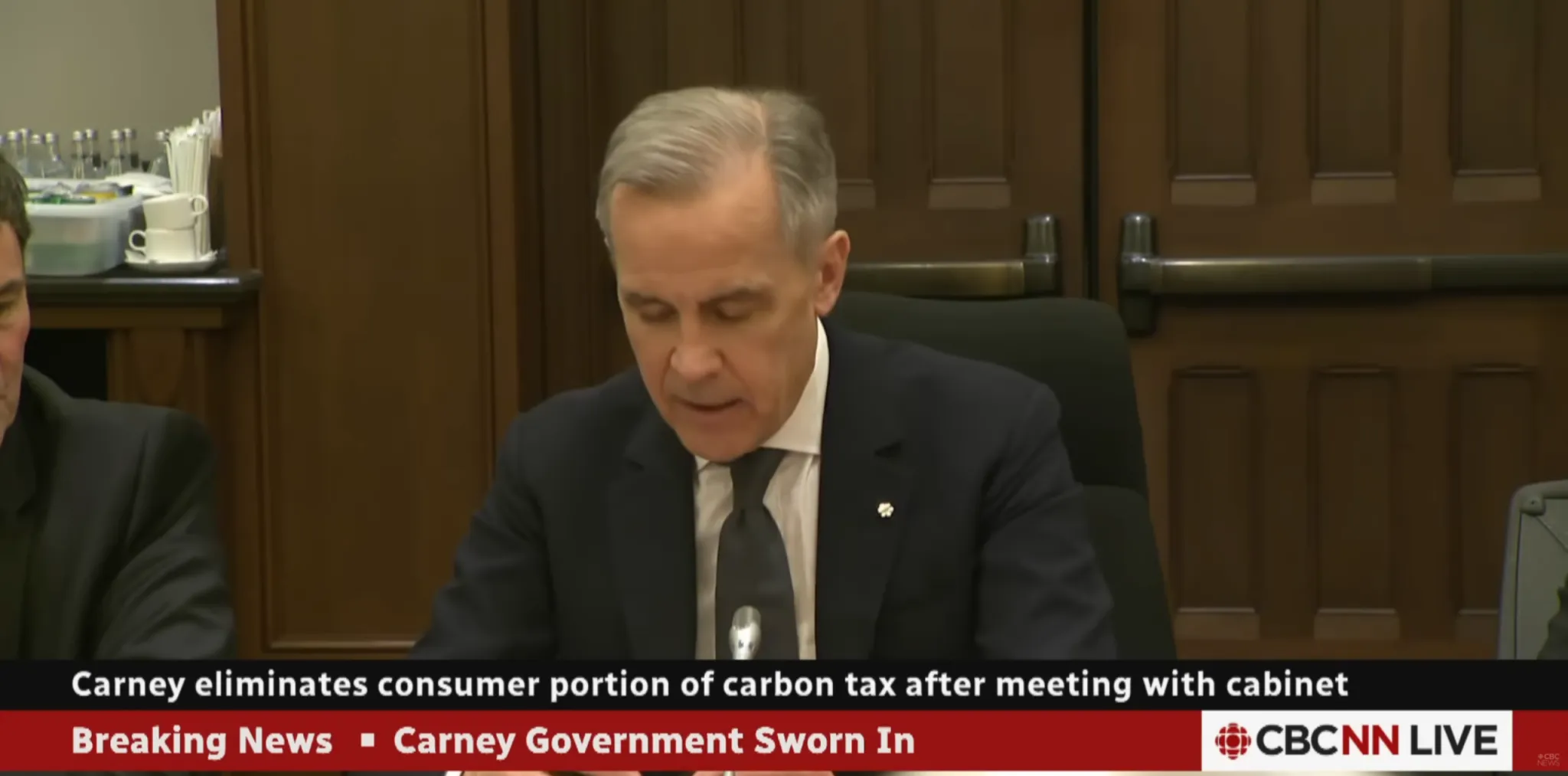
Mark Carney didn’t “axe the tax.” He moved it. The line on your gas bill is gone, sure. But the line in the Canada Gazette – specifically SOR/2025-107, the regulation that sets the federal fuel charge rates in Schedule 2 of the Greenhouse Gas Pollution Pricing Act to zero after March 31, 2025 – is very much alive, and it now points straight at the factories, mills and plants that make everything you buy. The bill still ends up in your hands; Ottawa just made it harder for you to see it.
The Great Shell Game: Killing the Visible Tax, Supercharging the Hidden One
On March 22, 2025, Finance Canada quietly published what the spin doctors call a “backgrounder” and what any honest person would call a confession. The federal fuel charge – the so-called consumer carbon tax – was set to $0 as of April 1, 2025. That’s the part suburban families could actually see: higher fuel, higher home heating, followed by a Canada Carbon Rebate cheque in the mail to remind them who hurt them and who was pretending to make it better.
The same document makes one other thing crystal clear: the price on pollution for large emitters “will continue to be a pillar” of the plan. In other words, they killed the piece that was politically toxic and doubled down on the piece they can bury inside every price tag in the economy. Families get one last rebate in April 2025, then the household side of the system is wound down and turned off.
Environment and Climate Change Canada adds the key fine print: from April 1, 2025 onward, the fuel charge is $0, but the Output-Based Pricing System (OBPS) for large industry “remains in effect.” OBPS is a regulatory carbon market wrapped in bureaucratic language. Big facilities get an emissions limit per unit of output; if they go over, they owe the federal government in cash or credits. That’s a tax by another name, with a trading desk attached.
Ottawa also quietly locked in the price path on the industrial side. Orders amending Schedule 4 push the excess emissions charge up every year until it hits $170 per tonne in 2030. The Carney government’s new Climate Competitiveness Strategy proudly promises to “strengthen industrial carbon pricing.” The visible tax is gone; the rising industrial tax is now the spine of their climate plan.
The “Corporate Absorption” Fairy Tale
The sales pitch from the climate-policy crowd is simple: don’t worry, this is an “industrial” tax, not a consumer tax. The Canadian Climate Institute’s own fact sheet brags that industrial carbon pricing has an impact of “around zero per cent” on household consumption. They insist these large-emitter systems “cost next to nothing for Canadian consumers.”
That number is not a bill; it’s a lab result. Real life doesn’t work that way. Families are getting hammered at the same time by interest rates, housing costs, and electricity rates. Every one of those is “only” a fraction of a percent. They all land in the same wallet. Corporations are not charities. When you increase the cost of steel, fertilizer, fuel, and industrial power, that doesn’t vanish inside the boardroom. It gets passed forward into prices, pushed backward into wages, or both.
Competitive Leakage in a Trump Tariff World
Industrial carbon pricing would be painful enough in a vacuum. Canada does not live in a vacuum. It lives next door to Donald Trump’s tariff wall. In 2025, the Trump administration rolled out wave after wave of tariffs: a sweeping 35% tariff on non-CUSMA goods, 50% on steel and aluminum, and 25% on autos.
Stack the two realities. On one side of the border, U.S. producers are shielded by tariffs and face no national industrial carbon price. On the other side, Carney is “strengthening” the tax on trade-exposed sectors. A Canadian steel mill or oil sands operator now competes against American rivals who are taxed at the border but not at home. Either they raise prices to survive, feeding inflation, or they cut jobs to stay in the game. The Carney government calls this “climate competitiveness.” To the people who actually make things, it looks like a slow-motion offshoring plan.
Carney’s “Climate Competitiveness” Smoke Screen
The genius of the new system is that it moves the tax upstream and the blame downstream. The Climate Competitiveness Strategy wraps this in high-gloss language about “mobilising capital,” but the concrete bullet is simple: Ottawa is using federal benchmarks to force every province onto a tougher path. Environment Canada makes clear where the proceeds go: OBPS revenues are sent back for industrial emissions-cutting projects, not to households. The household rebate is dead; the industrial-side proceeds fund is locked in.
The Receipt Is Still in Your Name
Strip away the jargon: there is no such thing as a cost-free climate plan. Under the old system, the PBO could at least claim most households got more in rebates than they paid. Under the new system, households get no rebate; they get higher embedded costs and a government that insists the impact is “negligible.”
Alberta and the rest of resource-heavy Canada are being sold a comforting lie. In the real economy, there is only one payer of last resort. It’s the person standing at the till, wondering why everything from rent to a new fridge costs more while the government insists they “removed the carbon price.” Ottawa didn’t stop taxing carbon; it just stopped admitting that you’re the one paying.